What to check on a Floating Cargo Hose.
A floating cargo hose is built with an outer layer of closed-cell buoyant material, or a jacketed floating section, so the assembled hose string stays on the sea surface between the ship's manifold and a single point mooring buoy, CALM buoy, or another vessel in a ship-to-ship transfer, rather than lying alongside a fixed jetty. This is the defining difference from chemical or alongside oil hoses, which are not required to float because they run a short, supported distance between the ship and a berth. Floating hose strings are typically…
What Sets a Floating Hose Apart
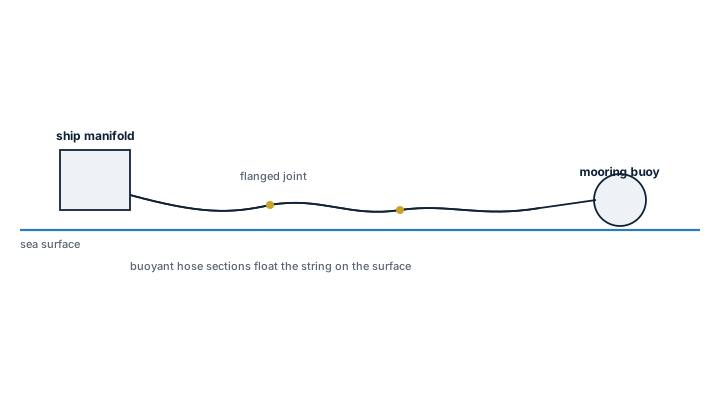
A floating cargo hose is built with an outer layer of closed-cell buoyant material, or a jacketed floating section, so the assembled hose string stays on the sea surface between the ship's manifold and a single point mooring buoy, CALM buoy, or another vessel in a ship-to-ship transfer, rather than lying alongside a fixed jetty. This is the defining difference from chemical or alongside oil hoses, which are not required to float because they run a short, supported distance between the ship and a berth. Floating hose strings are typically made up of several standard lengths connected by flanges, each fitted with its own floats, and must handle the bending and torsional loads of open-water motion between two floating or moored bodies, not just internal pressure. They are the standard fit for offshore crude oil terminals, FPSO offtake operations and ship-to-ship transfers.
Main Components
Hose body and reinforcement
A rubber or composite tube with reinforcement plies sized for the working pressure, similar in principle to other cargo hoses but built specifically to tolerate continuous flexing and torsion in open water.
Buoyancy layer
Closed-cell foam or an equivalent buoyant jacket bonded around the hose body, sized so the assembled string floats with adequate freeboard even when full of the heaviest cargo it is rated to carry.
Flanged end connections
Standard flange connections join individual hose lengths into a string and connect the string to the ship's manifold and the buoy or receiving vessel, with bolting and gaskets rated for the same working pressure as the hose body.
Bonding and marking
An internal or external bonding system dissipates static charge along the string, and each length carries individual identification marking and test history, since a string is only as reliable as its weakest length.
Selection and Sizing
Sizing is set by the transfer duty and by the specific mooring or ship-to-ship configuration the hose will serve:
- Bore diameter and working pressure matched to the required transfer rate and pumping arrangement
- String length matched to the distance between manifold and buoy or between the two vessels in an STS operation, including slack for vessel movement
- Cargo compatibility, since floating hoses in crude and product service still need a lining suited to the specific cargo
- Reel or flake-stowage handling requirements on deck, which affect the minimum bend radius specification
Regulations and Class
Floating hoses used in ship-to-ship operations fall under the OCIMF/ICS Ship-to-Ship Transfer Guide recommendations on hose testing, marking and maximum service life, alongside MARPOL Annex I requirements on oil transfer procedures where the cargo is oil. Individual hose lengths require periodic pressure and vacuum testing at intervals set by industry guidance, with each length withdrawn once it reaches its marked maximum age regardless of test outcome, since ageing of the buoyancy and reinforcement layers is not always visible from the outside. Class and terminal audits check that every length in a string carries current, matching test certification before an offshore transfer is permitted to proceed.
Typical Faults
| Fault | Cause | Consequence |
|---|---|---|
| Buoyancy layer degradation | Age, UV exposure, repeated compression during handling | String rides lower in the water, increased mechanical strain on the hose body |
| Flange leakage between lengths | Worn gasket, incorrect bolt torque, misalignment during connection | Cargo loss at the joint during transfer, environmental release risk |
| Kinking beyond minimum bend radius | Poor handling during connection or deployment from the reel | Localised reinforcement damage, reduced burst margin |
| Undetected internal ply damage | Cyclic flexing over the service life, not visible externally | Sudden failure under pressure despite an apparently sound exterior |
What to Look for in a Supplier
- Individual test certificates for every length making up a string, with matching manufacture dates where possible
- Confirmed compatibility with OCIMF/ICS ship-to-ship guide requirements if the hose is intended for that service
- Buoyancy performance data at full cargo fill, not just an empty-hose floating claim
- Clear marking of maximum service life on each length and a service history that travels with the hose
Track each length's individual age, not just the string as a whole — a string assembled from lengths of mixed vintage is only as good as its oldest piece, and that piece is rarely the one crew think to check first.