What to check on a Ship-to-Ship Cargo Hose.
The ship-to-ship (STS) cargo hose is a floating hose string rigged between two vessels moored alongside each other, most often during lightering, bunkering at anchor, or transfers where no jetty is available. Unlike the submarine hose, which is designed to sink and stay on the seabed, the STS hose must float on the surface throughout the operation so it can be handled by crane, tended by mooring boats, and recovered cleanly once cargo has passed. Buoyancy is built into the hose itself or added as separate float collars strapped along…
What makes this type
The ship-to-ship (STS) cargo hose is a floating hose string rigged between two vessels moored alongside each other, most often during lightering, bunkering at anchor, or transfers where no jetty is available. Unlike the submarine hose, which is designed to sink and stay on the seabed, the STS hose must float on the surface throughout the operation so it can be handled by crane, tended by mooring boats, and recovered cleanly once cargo has passed. Buoyancy is built into the hose itself or added as separate float collars strapped along its length.
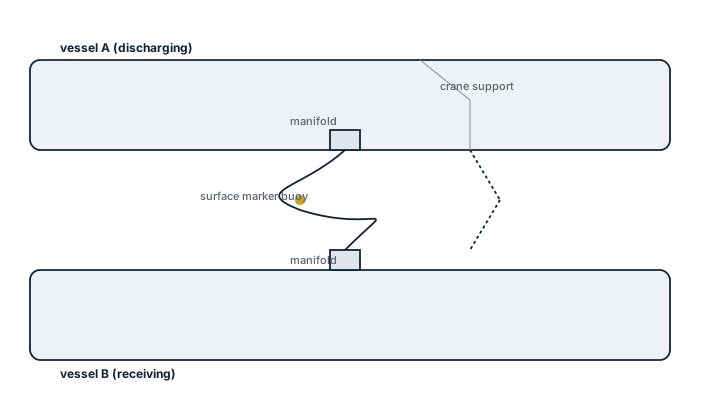
Main components
Hose body
A synthetic rubber or composite tube reinforced with helical wire and textile plies, covered by an abrasion- and weather-resistant outer layer. The construction has to flex repeatedly without kinking as the two ships move on their moorings.
Flanges and couplings
Steel or aluminium flanges bonded to each hose length, matched to the manifold table (commonly ANSI or DIN pattern) of both vessels, with bolted or quick-connect couplings depending on the trade.
Floats
Closed-cell foam collars fitted around the hose at intervals, or hoses with integral buoyancy layers, keeping the string on the surface even when full of cargo.
Tail hose and pick-up gear
A shorter, more flexible tail section connects to the manifold, fitted with lifting bridles, pick-up ropes and a messenger line so mooring boats or the receiving ship's crane can bring the hose end aboard.
Selection / Sizing
- Nominal bore, typically 6 to 16 inches, matched to the intended cargo throughput and both manifolds.
- Working pressure rating, with the hose tested well above the maximum transfer pressure expected.
- Minimum breaking load of the hose and its bridles, since the string carries its own weight plus dynamic loads from vessel motion.
- Cargo compatibility of the lining: crude and dark products, clean products, and chemicals each need a different tube compound.
- Overall string length, set by the anticipated distance between manifolds at the planned mooring configuration.
Regulations / Class
STS transfers are conducted under the OCIMF Ship to Ship Transfer Guide, which sets out hose testing, marking, and handling practice widely followed by charterers and terminals even where not mandatory. Hoses are pressure tested at survey intervals set by the operator's inspection regime, and each length carries a test date, working pressure, and identification marking. Electrical continuity across the string is checked as part of the same programme, since a break in bonding removes a path for static discharge.
Typical faults
| Fault | Consequence |
|---|---|
| Kinked or crushed hose from poor flaking on deck | Localised weak point, risk of burst under pressure |
| Waterlogged or damaged floats | Hose sinks or hangs at an angle, increasing strain on flanges |
| Loss of electrical continuity between flanges | No discharge path for static, ignition risk during transfer |
| Cover abrasion from repeated deck handling | Reinforcement exposed, hose condemned before its rated life |
What to look for in a supplier
- Current pressure test certificates and a legible hose history for every length in the string, not just the newest ones.
- Manifold table compatibility confirmed before the hose is ordered, not discovered at the first transfer.
- Float condition verified by weight check, since a waterlogged float looks intact but no longer supports the hose.
- Bridles and lifting gear rated and certified separately from the hose itself.
Flake the hose in long, even bights on deck before lowering it; a hose stowed in tight coils will kink the moment it takes a load, and that kink is where it fails.