Fixed Tank Cleaning Nozzle
A fixed tank cleaning nozzle is a wall- or deckhead-mounted, non-portable washing machine that rotates in a fixed pattern to cover its zone of a cargo tank, in contrast to portable machines lowered on a hose through a tank hatch for one-off cleans.
What to check on a Fixed Tank Cleaning Nozzle.
60 models from Scanjet Marine in Fixed Tank Cleaning Nozzle. Below: the full model list.
What makes a fixed nozzle different from portable cleaning gear
A fixed tank cleaning machine is permanently installed inside the cargo tank, plumbed to a cleaning medium supply line that runs through the deck, and driven either hydraulically, by a turbine in the water or chemical stream itself, or by a small electric motor. Because its position and throw pattern are fixed by the installation drawing, each unit only has to cover its own assigned zone of the tank's internal surface, and the tank's full set of machines is designed as a group to leave no shadowed area. This differs fundamentally from a portable machine lowered through a Butterworth hatch, which one crew member repositions between cleaning passes to reach areas a single fixed unit cannot.
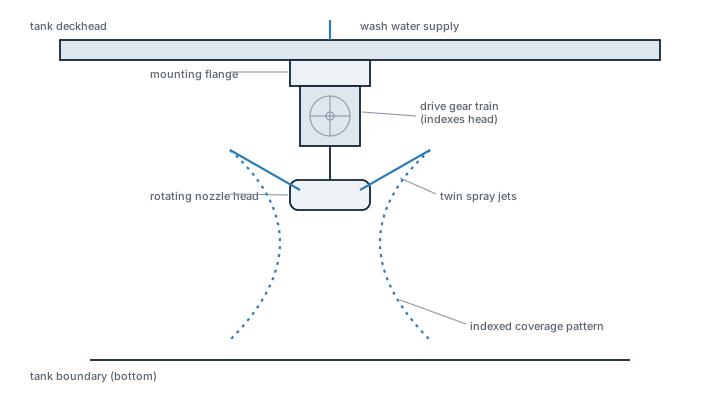
Legend
- tank deckhead
- wash water supply
- mounting flange
- drive gear train (indexes head)
- twin spray jets
- rotating nozzle head
- indexed coverage pattern
- tank boundary (bottom)
Main components
Nozzle head and drive gearing
Internal gearing steps down the rotation of the jet in two planes - a slow indexing rotation and a faster jet spin - so the wash pattern covers the tank surface in a repeating, overlapping sequence rather than tracing the same path continuously.
Supply line and isolation valve
Each machine connects to a dedicated branch of the cleaning medium main, isolated by a valve on deck so individual units can be taken out of service without shutting down the whole system.
Read the full guide
Mounting and tank penetration
The machine passes through a gas-tight deck or bulkhead fitting; the seal at this penetration is a frequent point of leakage if disturbed during tank entry work or repair.
Selection and sizing
Coverage is set by throw distance and jet pattern against tank height and internal structure (stringers, heating coils, swash bulkheads), and by the number of machines per tank needed to avoid shadow zones. Flow rate and pressure at the nozzle determine cleaning effectiveness for a given cargo residue and wash medium - hot seawater, fresh water, or a chemical cleaning agent - and must match the capacity of the ship's tank cleaning pump and heater.
Typical faults
- Worn drive gearing inside the head - the machine slows or stalls partway through its cycle, leaving an uncleaned band on the tank wall that is easy to miss during a visual check from the tank top.
- Blocked or damaged nozzle tip - cargo residue or scale reduces jet reach and pattern accuracy, shrinking effective coverage without any obvious external sign.
- Leaking deck penetration seal - cleaning medium or tank vapour passes the seal, risking contamination on deck or loss of tank gas-tightness.
- Isolation valve seized or leaking - the unit cannot be taken out of service cleanly for maintenance, or continues to pass fluid when the tank should be dry for entry.
- Incorrect indexing after reassembly - a machine rebuilt without matching the original gear timing sprays an already-covered zone twice and leaves another zone untouched.
What to look for in a supplier
- Original coverage diagrams and duty cycle data for the specific model, so a replacement machine reproduces the tank's approved shadow-free wash pattern.
- Spare gear sets and seal kits sized to the actual installed model rather than a generic equivalent.
- Materials compatible with the cargoes the tank actually carries, since chemical tankers in particular need nozzle and seal materials resistant to the specific cargo range.
- Documentation suitable for supporting the ship's tank cleaning procedure and any gas-freeing or inerting sequence tied to it.
After any repair to a fixed machine, check the indexing sequence against the original coverage diagram before relying on it - a machine that turns is not proof that it is covering the whole zone it was installed to clean.
Models in this type.
The best-documented model of each manufacturer first, then the next — 60 of 60 models in Fixed Tank Cleaning Nozzle. Every row links to full specifications, documents and service notes.
Manufacturers.
All 3 manufacturers with models of Fixed Tank Cleaning Nozzle. Names with a manufacturer page open it; the others open a search across the full library.
All manufacturers in the libraryAlso in Tank Cleaning Equipment.
The other equipment types in this category.
Write to us about this model — the answer comes by e-mail.
Name the make and the model and what the job is: a spare, a service call, a second opinion on a data sheet. We answer by e-mail.
No details at hand? A photo of the rating plate or the part is enough — simply attach it to the request.
Questions that come up with this equipment.
Is Fixed Tank Cleaning Nozzle data free?
Yes. Every model page, every guide and every datasheet for this type is readable without an account. An account adds saved searches and requests, nothing is taken away.
My model is missing — what now?
Send us the nameplate. We identify it by hand, add it to the library, and if you need a part or a service, the request is already on our desk.
Can you source a Fixed Tank Cleaning Nozzle part?
Yes. Tell us the manufacturer, the model and what you need — a person reads every request and replies by e-mail.