What to check on a Portable Tank Cleaning Machine.
Fixed tank cleaning machines are permanently installed in the tank, plumbed and wired in place, and used on vessels where the same wash pattern and location suit every voyage. A portable unit is the opposite: it is rigged through a butterworth plate or tank cleaning hatch on deck, lowered on its own hose and a separate hoisting wire to whatever depth is needed, and moved from tank to tank and from position to position within a tank as the wash progresses. That flexibility is the whole point on vessels carrying…
What sets this type apart
Fixed tank cleaning machines are permanently installed in the tank, plumbed and wired in place, and used on vessels where the same wash pattern and location suit every voyage. A portable unit is the opposite: it is rigged through a butterworth plate or tank cleaning hatch on deck, lowered on its own hose and a separate hoisting wire to whatever depth is needed, and moved from tank to tank and from position to position within a tank as the wash progresses. That flexibility is the whole point on vessels carrying varied cargoes tank to tank, or on older ships never fitted with fixed machines in every tank.
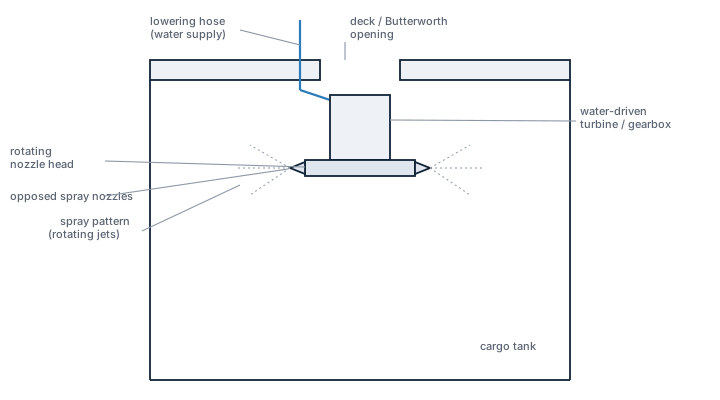
Main components
Rotating nozzle head
Water or a cleaning medium is forced through nozzles on a head that both spins and, on programmable units, indexes through a set vertical arc, so the jet sweeps the full internal surface of the tank in a repeating pattern rather than washing one spot continuously.
Drive mechanism
Simpler units are hydraulically driven purely by the water jet reaction turning an internal turbine; programmable units use a separate motor to control the indexing pattern and cycle time precisely.
Hose and hoisting wire
The supply hose carries the wash medium at pressure and is rated for the chemicals or hot water used; a separate wire lowers and raises the machine, and the two must be handled together without twisting or the hose can kink and burst.
Deck fitting and butterworth plate
The machine passes through a purpose-built deck opening that seals against tank atmosphere when the machine is not in use, an important point on tankers where tank atmosphere control matters as much as the cleaning itself.
Selection and sizing
Throw distance and jet pressure decide whether a single machine can clean the full height and width of a given tank from one or two positions, or whether more positions and longer cleaning time are needed; typical wash pressures run from a few bar up to well over one hundred bar for high-pressure programmable units. Compatibility with hot water or chemical cleaning media matters where cargo residue needs more than plain cold seawater to shift. Weight and portability matter in practice, since the unit is manhandled by the crew between tanks, not craned as a fixed installation would be.
Typical faults
| Fault | Cause | Consequence |
|---|---|---|
| Nozzle head seizure | Deposit buildup or lack of lubrication on the gear train | Machine stops indexing and washes one spot only, leaving the rest of the tank uncleaned |
| Hose kinking or burst | Hose and wire not lowered together, or hose exceeding its pressure rating | Loss of wash pressure or a hose failure inside the tank requiring recovery of the machine |
| Deck seal leakage at the butterworth plate | Worn gasket or plate not properly seated | Loss of inert gas or tank atmosphere control on tankers where this matters |
| Incomplete wash coverage | Wrong throw distance for the tank geometry, or machine positioned incorrectly | Residual contamination discovered only at the next loading, risking cargo rejection |
Regulations and class
Tank cleaning operations on oil tankers fall under MARPOL Annex I procedures for tank washing and, where crude oil washing is required, the vessel's approved crude oil washing manual. Entry into a tank after cleaning is governed by the ship's enclosed space entry procedures, and the tank atmosphere must be confirmed gas-free and adequately ventilated before anyone enters, regardless of how the cleaning was carried out. Class surveys check that portable machines and their deck fittings are in serviceable condition where they form part of the vessel's approved tank cleaning arrangement.
What to look for in a supplier
- Hose and seal materials rated for the actual cleaning media used, including hot water or chemical additives if applicable.
- Documented throw pattern and coverage data for the tank sizes on board, not a generic specification sheet.
- Spare nozzle heads and gear trains available, since these are the parts that wear fastest in service.
- A deck fitting compatible with the vessel's existing butterworth plates without modification.
Never assume a tank is clean because the machine ran its full cycle - walk the coverage pattern against the tank's actual internal structure, because stringers, ladders and heating coils create shadow zones no rotating nozzle reaches on its own.