Fixed Tank Cleaning Machine
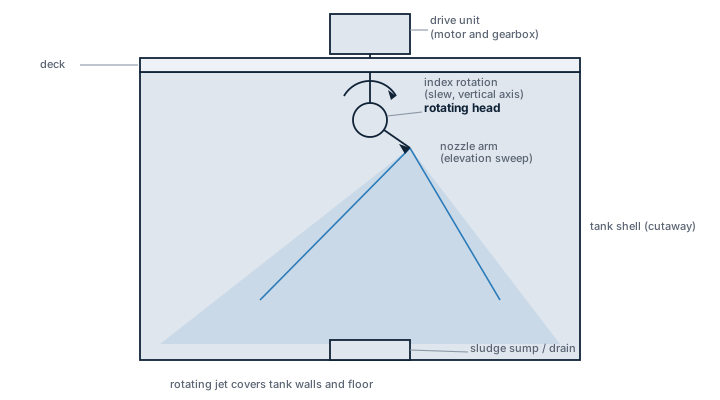
A fixed tank cleaning machine is permanently piped and mounted inside the cargo tank, rotating on two axes to sweep high-pressure water or chemical jets across the internal surface without anyone entering the tank to move it.
Read more — Fixed Tank Cleaning Machine explained ▾
What sets fixed machines apart from portable ones
A portable tank cleaning machine has to be lowered through a tank hatch on a hose and repositioned by the crew to cover the whole tank, which means someone is working at height over an open hatch and the tank has to be gas-freed or entered under permit to reposition the unit. A fixed machine is bolted permanently inside the tank, piped from deck level, and covers its full sweep pattern without anyone entering — the machine moves, not the person. That single difference is why fixed machines dominate on chemical and larger product tankers, where tank entry is minimised as a matter of policy, not just convenience.
Main components
Machine head and nozzle
A rotating head with one or two nozzles sweeps in a programmed pattern, driven by the reaction force of the jet itself on most designs, turbine or impact-driven rotation, rather than a separate motor, which keeps the in-tank part of the machine simple and free of electrics in a potentially explosive atmosphere.
Drive and gearbox
The rotation gearing sets the sweep pattern — full 360-degree coverage in both the horizontal and vertical planes needs a two-axis drive, while some fixed installations use a fixed elevation with only horizontal rotation for simpler tank geometries.
Supply piping and deck connection
Permanent piping runs from the machine through the tank boundary to a deck-mounted supply connection, where the crew hooks up the washing medium, water, heated water, or a chemical wash solution, from a portable pump or the ship's own tank cleaning system.
Mounting and access
The machine mounts on a flanged spool piece let into the tank top or shell, sized so the machine itself can be pulled for maintenance without a full tank entry in most designs — an important distinction when comparing models.
Selection and sizing
- Tank geometry and internal obstructions, heating coils, swash bulkheads, that create shadow zones no single machine position reaches
- Throw distance and jet pressure required to reach every internal surface from the mounting position chosen
- Cargo compatibility of wetted-part materials — stainless grade needs to match the corrosivity of the cargoes the tank carries
- Number of machines per tank — larger or more complex tanks need more than one unit to avoid shadow zones
Regulations and class
Tank cleaning machines used in cargo tanks that may hold a flammable atmosphere fall under the electrical and mechanical equipment requirements of IMO's IBC Code for chemical tankers and equivalent MARPOL Annex I/II provisions for oil and NLS cargoes — non-electrical, jet-driven machines avoid the ignition source concerns that would apply to a motor-driven alternative, which is one reason the design has stayed dominant. Class surveys check the machine mounting and piping integrity as part of the cargo system survey; there is no separate class certificate for the cleaning machine itself, but its installation is reviewed against the approved cargo system drawings.
Typical faults
| Fault | Consequence |
|---|---|
| Nozzle wear from continued use past service life | Reduced jet pressure and throw, incomplete tank coverage that shows up as a failed cleanliness check |
| Gearbox seizure from lack of lubrication | Machine stops rotating, wash medium hits one spot repeatedly instead of sweeping the tank |
| Piping or flange leak into the tank | Wash medium loss and possible cross-contamination between cargo grades |
| Wrong wetted-part material for the cargo | Accelerated corrosion of the machine, particle contamination of the next cargo |
What to look for in a supplier
- Coverage pattern data or shadow-zone analysis for the specific tank geometry, not a generic sweep diagram
- Wetted-part material options matched to the full range of cargoes the tank is expected to carry
- Spare nozzle and gearbox parts availability, since machine downtime during a cleaning window has schedule consequences
- Confirmation the machine can be withdrawn for service without a full tank entry, where that matters to the operator's tank entry policy
A cleanliness failure after a wash is as often a shadow-zone problem as a machine fault — check the coverage pattern against the actual tank layout before assuming the machine itself needs work.
4 manufacturers · 5 models
Scanjet Marine
2- Nozzle blockage or deposits reduce jet quality and leave areas incompletely cleaned
- Seal, swivel or valve wear causes leakage and loss of effective cleaning pressure
- Bearing, gearing or indexing wear on moving units causes irregular rotation, rough movement or incomplete coverage
- Corrosion or erosion changes nozzle geometry and reduces cleaning performance
- Restricted upstream flow, dirty strainers or incorrect valve line-up produces weak cleaning action
- Fixed installation eliminates the need for portable equipment and saves deck space
- Programmable wash patterns optimise cleaning time and chemical usage
- Coverage up to 25 m per pass suitable for large product tanks
- Robust construction designed for oil, chemical and LPG residues
- Integrated controller allows remote operation and pattern storage
- Nozzle erosion or blockage can occur with abrasive cargoes, requiring annual inspection
- Drive motor failures have been reported in the field
- Gearbox oil leaks are a known maintenance issue
- Limited to fixed‑tank installations; not suitable for portable cleaning needs
- Higher initial capital cost compared with simple handheld systems
- Nozzle blockage or deposits reduce jet quality and leave areas incompletely cleaned
- Seal, swivel or valve wear causes leakage and loss of effective cleaning pressure
- Bearing, gearing or indexing wear on moving units causes irregular rotation, rough movement or incomplete coverage
- Corrosion or erosion changes nozzle geometry and reduces cleaning performance
- Restricted upstream flow, dirty strainers or incorrect valve line-up produces weak cleaning action
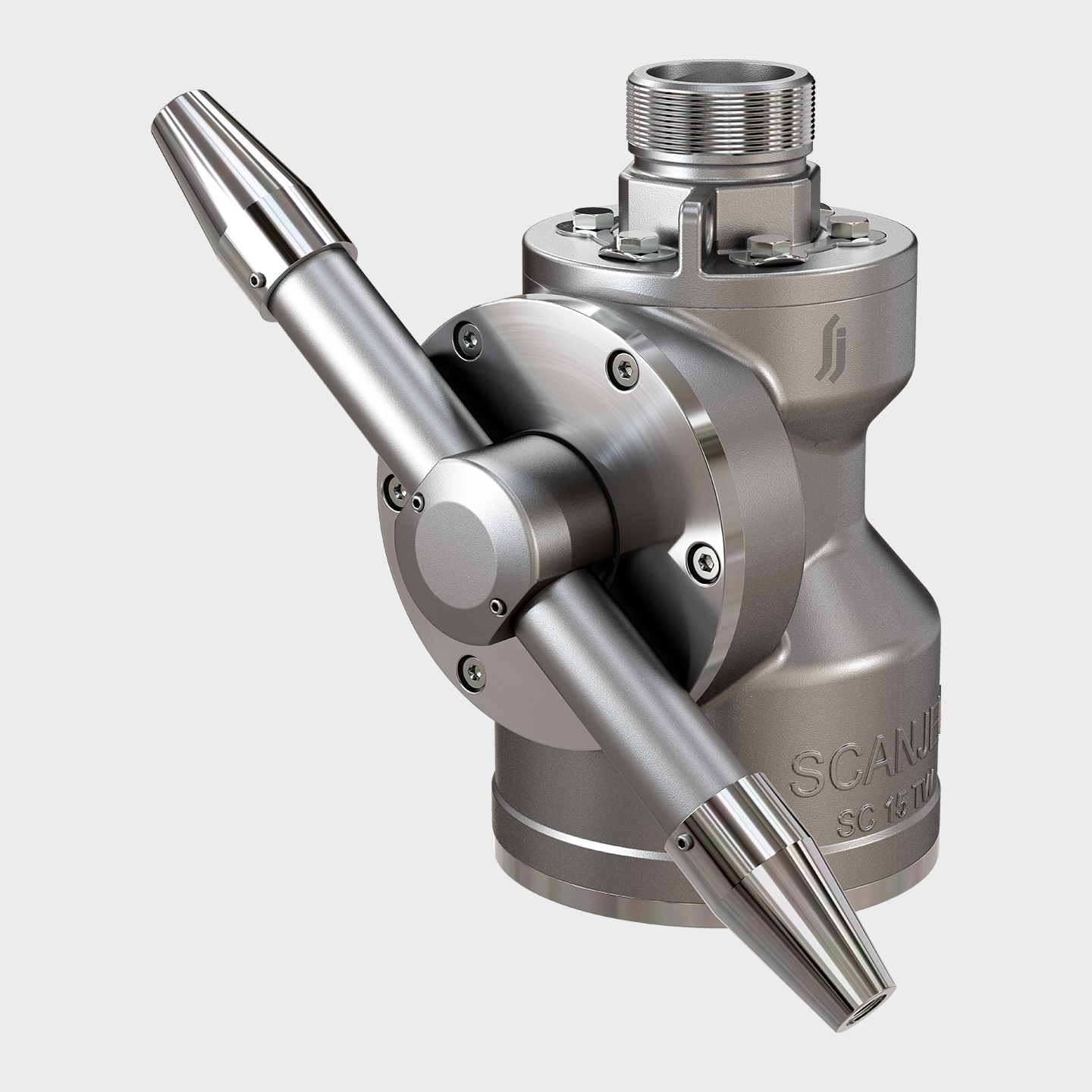
- Compact footprint fits vessels with limited deck space
- Programmable control allows repeatable cleaning sequences
- Fixed installation eliminates the need for portable equipment handling
- Suitable for tanks up to 15 m, covering a common size range for product carriers and barges
- Nozzle erosion can reduce jet effectiveness over time
- Drive mechanism wear may require regular maintenance intervals
- Gearbox failures have been reported, indicating potential reliability concerns
- Limited to tanks ≤15 m; not suitable for larger tankers or bulk carriers
Alfa Laval
1- Durchsatzbereich
- i40 S: 3-56 m³/h | i40 D: 7-80 m³/h | TZ-82: 15 m³/h (8mm-Düsen @ 7 bar)
- Betriebsdruck
- Typischerweise 4-12 bar; empfohlener Betriebsdruck 5-6,5 bar
- Wurfweite/reichweite
- TZ-82: 26 Meter horizontale Wurfweite (Benetzungsradius)
- Düsendurchmesser-Bereich
- 7-10 mm (verschiedene Konfigurationen für Durchsatz-Optimierung)
- Deck-Öffnung erforderlich
- i40 S/i40 D: nur 145 mm (kompakteste 2. Generation)
- Material-standard
- AISI 316 Edelstahl für Hauptkomponenten; PEEK für Seals/Verschleißteile
- Betriebstemperatur
- 0–95°C (32–203°F)
- Antriebsart
- Turbine-driven by cleaning medium flow (COW: crude oil washthrough possible)
- IMO-Konformität
- Erfüllt IMO-Anforderungen für COW (Crude Oil Washing) Systeme
- i40 S (Single-Nozzle, 2. Generation)
- i40 D (Dual-Nozzle, 2. Generation)
- i65 S (Single-Nozzle, High-Impact)
- T-73 (Automatic, 5.000-30.000 m³)
- TZ-67 (Rotary Jet Head, 50-500 m³)
- TZ-75 (Portable, 1.000-5.000 m³)
- TZ-82 (Portable/Fixed, bis 3.000 m³)
- TZ-89 (Media-Lubricated)
- 270FT Mark I (Single-Nozzle Crude Oil Tanker)
- Area: Nozzle wear and erosionCheck: Inspectors regularly check nozzles for wear marks, scratches, surface erosion and deformed openings. Nozzle blockages from sludge accumulation are the most frequent periodic maintenance task. Damaged nozzles must be replaced as a group.
- Area: Gearbox/turbine wear and vibrationCheck: Inspectors monitor for abnormal vibrations, temperature rise and irregular noise. Detached gear teeth and uneven disk distribution cause vibration problems. Inspection recommended every 200-300 operating hours; bearing replacement after 300-500 hours or at least every 3 years.
- Area: Ball bearings and sleeve bushings wearCheck: Inspectors check ball bearings for free rotation without contamination and damage. Sleeve bushings in gearbox frame must be checked: maximum diameter not exceeding 10.4 mm (bore not ovally deformed). Inspect all bearings and sealing rings every 6 months; replacement after 6,000 operating hours or every 3 years.
- Area: Seals and shaft passages (hysteresis coupling design)Check: Inspectors check for oil leakage and contamination at seal points. The hysteresis coupling eliminates conventional speed-setting shafts and reduces leak points. All rubber seals should be replaced at each service inspection to ensure hygiene and performance. Moisture and contamination ingress leads to seal failure.
- Area: Programming pattern and control sequence functionalityCheck: Inspectors test programming logic and valve control for correct 3D-indexed impact pattern. Check creep movement (vertical screw movement while horizontal rotation occurs) and progressive compression from coarse to fine over 8 cycles.
- Area: COW (Crude Oil Washing) system approval and crude oil compatibilityCheck: Inspectors verify IMO certification and crude oil wash-through approval. Toftejorg T-73 and 270FT Mark I are specifically designed for crude oil tankers. Check for corrosion/wear from crude oil exposure and verify valve seals under crude oil operating conditions.
Universal inspection/service points for tank cleaning machines (Gunclean Toftejorg, 2026-06). Per-model specs not auto-filled.
- Compact deck penetration (only 145 mm) allows installation on vessels with limited hatch space.
- Turbine‑driven by the cleaning medium eliminates need for external electric motor and reduces power consumption.
- Wide flow range (3–80 m³/h depending on nozzle configuration) covers most product, crude‑oil and ballast tank sizes up to ~3 000 m³.
- AISI 316 stainless steel and PEEK seals provide good corrosion resistance to seawater, fresh water and many oil products.
- IMO‑approved for Crude Oil Washing (COW), enabling compliance with tanker cleaning regulations.
- Nozzle erosion is a frequent maintenance item; replacement groups are required after limited service hours.
- Vibration and bearing wear can develop if turbine alignment or flow conditions deviate, demanding regular inspections every 200–300 h.
- Operating pressure is limited to ~12 bar (optimal 5‑6.5 bar); high‑pressure cleaning (>15 bar) is not possible.
- Maximum effective capacity (~3 000 m³) may be insufficient for the largest VLCC cargo tanks, requiring multiple units.
- Dependence on sufficient medium flow (COW or water) means performance drops in low‑flow scenarios.
Dasic
1- Nozzle blockage or deposits reduce jet quality and leave areas incompletely cleaned
- Seal, swivel or valve wear causes leakage and loss of effective cleaning pressure
- Bearing, gearing or indexing wear on moving units causes irregular rotation, rough movement or incomplete coverage
- Corrosion or erosion changes nozzle geometry and reduces cleaning performance
- Restricted upstream flow, dirty strainers or incorrect valve line-up produces weak cleaning action
- Large 30 m cleaning coverage reduces cleaning time
- Fully programmable 360° rotation for uniform wash
- Designed for chemical‑tank environments with corrosion‑resistant components
- Integrated controller allows automated cleaning cycles
- Nozzle wear is a common maintenance issue
- Controller malfunctions have been reported in the field
- Drive motor failures can lead to downtime
- Fixed installation limits use to vessels equipped with the system
GEA Tuchenhagen
1- Nozzle blockage or deposits reduce jet quality and leave areas incompletely cleaned
- Seal, swivel or valve wear causes leakage and loss of effective cleaning pressure
- Bearing, gearing or indexing wear on moving units causes irregular rotation, rough movement or incomplete coverage
- Corrosion or erosion changes nozzle geometry and reduces cleaning performance
- Restricted upstream flow, dirty strainers or incorrect valve line-up produces weak cleaning action
- Hygienic stainless‑steel design suitable for food‑grade cargoes
- Fixed installation saves deck space compared with mobile cleaning rigs
- Orbital motion delivers uniform coverage and high cleaning efficiency
- German engineering reputation for reliability and low vibration
- Can be integrated directly with existing cargo pump systems
- Bearing wear can lead to seizure if maintenance intervals are missed
- Nozzle blockage is possible with viscous or particulate‑laden cargos
- Drive mechanism wear may require more frequent overhauls than simple scrapers
- Fixed layout limits flexibility for irregular tank shapes or very small tanks
- Higher upfront capital cost compared with basic manual cleaning setups