Cargo Tank (Moss, Membrane, Type C)
Moss spherical tanks, GTT membrane containment and Type C pressure vessels are three different answers to holding liquefied gas independent of the hull, and the choice between them shapes everything from boil-off rate to how the ship itself can be built.
What to check on a Cargo Tank (Moss, Membrane, Type C).
1 models from IHI in Cargo Tank (Moss, Membrane, Type C). Below: the full model list.
What sets each containment type apart
A Moss tank is a free-standing sphere resting on a cylindrical skirt, structurally independent of the hull and built to IGC Code Type B rules, which allow it to survive a partial loss of insulation without immediate risk. GTT membrane containment uses a thin corrugated stainless steel or Invar membrane bonded to insulation panels that are in turn supported by the hull structure itself, so the tank shape follows the hull rather than the hull being shaped around a sphere. This is why membrane LNG carriers have a more conventional, boxy hull form and generally more usable cargo volume for the same overall dimensions. Type C tanks are pressure vessels, cylindrical or bi-lobe, built to conventional pressure vessel codes and used mainly on LPG and smaller LNG or ethylene carriers where cargo can be carried at higher pressure with less deep refrigeration, trading insulation complexity for a simpler, more robust tank.
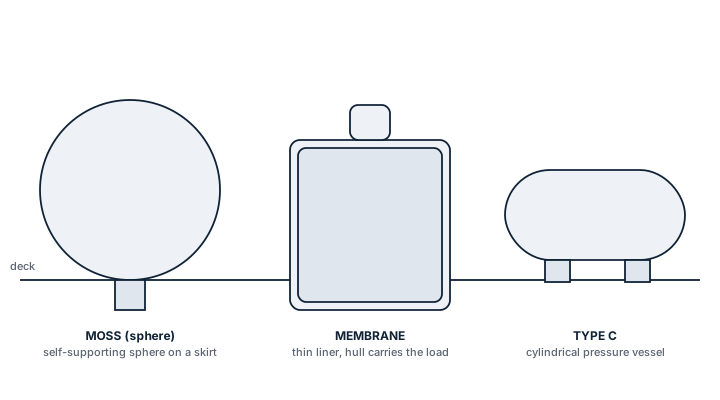
Legend
- TYPE C cylindrical pressure vessel
- deck
- MOSS (sphere) self-supporting sphere on a skirt
- MEMBRANE thin liner, hull carries the load
Main components
Moss tank
Aluminium or 9% nickel steel sphere, supported on an equatorial skirt, with polyurethane foam insulation applied externally and a domed deck house structure, the characteristic visible spheres, protecting the tank top.
Membrane tank
Primary barrier, the thin corrugated membrane in direct contact with cargo, an insulation space, a secondary barrier designed to contain cargo for a defined period if the primary fails, and a second insulation space bonded to the inner hull.
Read the full guide
Type C tank
Thick-walled pressure vessel, typically 9% nickel steel or stainless steel, with saddle or skirt supports, insulated where deeper refrigeration than fully pressurised carriage requires.
Boil-off and reliquefaction system
Common to all three types: cargo that absorbs heat boils off and must be reliquefied, used as fuel, or burned off, sized differently depending on the containment type's insulation performance.
Selection
The decision sits mostly with the shipyard and owner at newbuild stage rather than something chosen later, since it defines the hull. Type C is chosen for LPG, ethylene and smaller-scale LNG where pressurised or semi-refrigerated carriage suits the trade. Membrane is now dominant for large LNG carriers because of its cargo volume efficiency. Moss spheres remain in service on older LNG tonnage and some specialist trades, valued for tank independence and inspection access, but few new Moss ships have been ordered in recent years as membrane technology has closed the boil-off gap.
Regulations and class
All three fall under the IGC Code, which classifies containment systems as Type A, B or C based on the level of secondary barrier protection required and the consequences assumed from a leak. Type B systems, Moss spheres and some membrane designs, require a partial secondary barrier or drip tray; Type C tanks, being fully independent pressure vessels of proven design, generally need no secondary barrier because a leak is not expected to threaten the hull. Class societies survey tank structure, insulation condition and boil-off performance on a periodic basis, with membrane systems subject to specific in-service inspection regimes agreed with the system licensor.
Typical faults
| Type | Typical fault | Consequence |
|---|---|---|
| Moss sphere | Insulation degradation or damage to the foam jacket | Rising boil-off rate, increased reliquefaction plant load |
| Membrane | Primary barrier fatigue cracking at corrugations after repeated thermal cycling | Cargo migrating into insulation space, detected by gas sensors before reaching the secondary barrier |
| Membrane | Insulation panel bonding failure | Localised cold spot on hull, hull steel temperature monitoring alarm |
| Type C | External corrosion under insulation cladding | Wall thinning found at survey, requiring cladding removal to assess |
| All types | Boil-off rate creeping above design | Higher fuel gas consumption or more reliquefaction plant running hours than the voyage plan assumed |
What to look for in a supplier
- For Moss and membrane repair work, licensor-approved contractors only, since GTT and Moss Maritime both maintain approved repair yard lists and unapproved work can void class approval of the containment system.
- For Type C tank work, pressure vessel code compliance matching the code the tank was originally built to, and welder qualification for the specific tank material.
- Boil-off gas analysis and hull steel temperature monitoring system compatibility with the vessel's existing cargo control system.
- Documented track record on the specific containment type, since Moss, membrane and Type C repair skills are not interchangeable.
Track boil-off rate trend over voyages, not just the single-voyage figure - a slow upward creep is usually insulation degradation long before it shows up as a visible defect at survey.
Models in this type.
The best-documented model of each manufacturer first, then the next — 1 of 1 models in Cargo Tank (Moss, Membrane, Type C). Every row links to full specifications, documents and service notes.
Manufacturers.
All 9 manufacturers with models of Cargo Tank (Moss, Membrane, Type C). Names with a manufacturer page open it; the others open a search across the full library.
All manufacturers in the libraryAlso in Gas Carrier Systems.
The other equipment types in this category.
Write to us about this model — the answer comes by e-mail.
Name the make and the model and what the job is: a spare, a service call, a second opinion on a data sheet. We answer by e-mail.
No details at hand? A photo of the rating plate or the part is enough — simply attach it to the request.
Questions that come up with this equipment.
Is Cargo Tank (Moss, Membrane, Type C) data free?
Yes. Every model page, every guide and every datasheet for this type is readable without an account. An account adds saved searches and requests, nothing is taken away.
My model is missing — what now?
Send us the nameplate. We identify it by hand, add it to the library, and if you need a part or a service, the request is already on our desk.
Can you source a Cargo Tank (Moss, Membrane, Type C) part?
Yes. Tell us the manufacturer, the model and what you need — a person reads every request and replies by e-mail.