"> Gas Detection System - Equipment Database

Gas Detection System

critical IMO Required 4 models total

A fixed gas detection system samples cargo, interbarrier and motor room atmospheres on a continuous cycle and can trip ventilation shutdown automatically, so its calibration record tells you more about real protection than its alarm log ever will.

Read more — Gas Detection System explained

What Sets a Fixed Gas Detection System Apart

A fixed gas detection system continuously samples the atmosphere in spaces where a gas carrier's cargo could accumulate if a seal, valve gland or pipe joint failed: cargo compartments, interbarrier and insulation spaces, motor rooms for cargo pumps and compressors, and cofferdams adjacent to cargo tanks. Unlike a portable multi-gas meter carried by the duty engineer, it runs unattended, around the clock, and reports directly to the cargo control room and bridge. The distinction that matters against a portable instrument is coverage and response time: a fixed system is already sampling the space before anyone suspects a leak, and it can trigger ventilation shutdown or alarms automatically rather than waiting for a crew round.
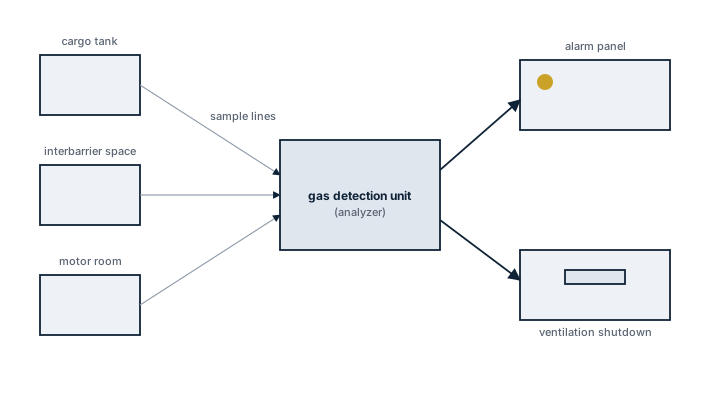
Fixed gas detection system
Flow diagram of a fixed gas detection system sampling cargo tank, interbarrier space and motor room atmospheres in a continuous cycle to a central analyzer, which drives the alarm panel and can trip ventilation shutdown.

Main Components

Sample points and sniffing lines

Small-bore stainless steel or synthetic tubing runs from each monitored space back to a central sampling unit, drawing air continuously through a pump. Sample points sit low in spaces where the cargo is heavier than air (most LPG cargoes) and high where it is lighter (LNG, ammonia under some conditions), with point placement fixed by the ship's approved gas detection plan rather than by convenience.

Sensor and analyser unit

The analyser cycles through sample points sequentially, drawing each stream past a sensor calibrated for the specific cargo range carried. Catalytic sensors oxidise flammable gas on a heated bead and measure the resulting resistance change; infrared sensors measure absorption at a wavelength specific to hydrocarbon or ammonia molecules and tolerate oxygen-depleted atmospheres that would starve a catalytic bead.

Control and alarm panel

The panel logs readings against each sample point, drives audible and visual alarms at two thresholds, typically a pre-alarm near 20% of the lower flammable limit and a high alarm near 60%, and interfaces with the ventilation and cargo control systems so a confirmed high reading can trip fans or close dampers automatically.

Selection and Sizing

The controlling figures are the number of sample points needed to cover the approved spaces, the cycle time for a full round of sampling (commonly under 30 minutes, faster on newer installations), the sensor technology matched to the cargo range, and whether oxygen deficiency monitoring is bundled in for interbarrier and void spaces where nitrogen purging is used.

Regulations and Class

Fixed gas detection on gas carriers is required under the IGC Code, which specifies which spaces must be monitored, alarm set points, and response actions. Class societies survey the system at each annual and renewal survey, and calibration gas checks are typically required at intervals set by the manufacturer and accepted by class, commonly every six to twelve months.

Typical Faults

  • Blocked or crushed sample tubing gives a falsely stable low reading and can mask a real leak.
  • Sensor drift or poisoning, for example silicone vapours disabling catalytic beads, causes under-reading that only shows up at the next calibration check.
  • Sample pump wear slows the sampling cycle, so an alarm arrives later than the design cycle time promises.
  • Condensation in sample lines on temperature-swing routes blocks flow intermittently, producing erratic readings.

What to Look for in a Supplier

  • Sensor technology proven for the specific cargo range the vessel trades in, not a generic hydrocarbon sensor repurposed for ammonia or ethylene service.
  • Spare sensor and calibration gas availability in the ports the vessel actually calls at.
  • Documented calibration and response-time test procedures that match what class will ask for at survey.
  • Integration compatibility with the existing cargo control and alarm system rather than a standalone add-on.

Treat a gas detection system's calibration record as seriously as its alarm log: a system that has never triggered a real alarm but also has not been calibration-checked on schedule tells you nothing about whether it would actually catch a leak.

4000h
Service Interval

Typical Manufacturers

Dräger MSA Simtronics

3 manufacturers · 4 models

Consilium Marine & Safety

2
Consilium Marine & Safety AB Fixed Gas Detection CGD50/500 and Gas Sampling System CGS50/500
Fixed Gas Detection CGD50/500 and Gas Sampling System CGS50/500
Per IGC Code requirements · LNG / LPG / Gas Cargo · Fixed infrared gas detection system
Common Failures & Inspection Points
  • LNG tank pressure rise due to BOG management error
  • Evaporator tube leakage due to thermal cycling stress
  • Gas valve unit (GVU) solenoid valve failure
  • Gasdetektionssystem Fehlalarm
Service: Gas detection calibration quarterly. GVU function test before each gas operation. IGF Code compliance at annual survey.
Spare Parts: Consilium Marine & Safety AB: Spezialteile per Hersteller. Lead time: 4-8 Wochen. Gasdetektions-Sensoren an Bord.
Strengths
  • Integrated sampling allows precise concentration measurement at multiple points
  • Designed to meet IGF Code requirements and DNV approval for LNG carriers
  • Modular architecture simplifies installation and future upgrades
  • Remote monitoring capability via vessel automation systems
  • Quarterly calibration schedule aligns with industry best practice
Weaknesses
  • Requires strict quarterly calibration and pre‑operation GVU function tests, increasing maintenance workload
  • Documented false‑alarm incidents can lead to unnecessary BOG venting
  • Magnet valve failures reported in the gas‑valve unit (GVU) may affect reliability
  • Primarily suited for LNG/LPG applications; less flexible for other gas types
Typical Vessels: LNG CarrierLPG CarrierFSRU (Floating Storage Regasification Unit)Gas‑fueled Ro‑Ro/Container vessels
Certifications: DNV
Decision Guide: Choose if: you need a certified, integrated gas detection and sampling solution for LNG/LPG cargo tanks with remote monitoring and IGF Code compliance. Avoid if: your vessel operates with non‑LNG gases, you have limited maintenance resources, or you prefer a system with a longer field‑proven record of valve reliability.
Use Cases: Deployed on LNG carriers to continuously monitor tank headspace for methane leaks, trigger BOG management actions, and provide sampled gas for laboratory analysis during cargo operations. Also used on FSRUs for safety monitoring during regasification cycles.
Consilium Marine & Safety AB Fixed Gas Detection System CGS 50/500 and CGD 50/500
Fixed Gas Detection System CGS 50/500 and CGD 50/500
Per IGC Code requirements · LNG / LPG / Gas Cargo · Infrared fixed gas detector
Common Failures & Inspection Points
  • LNG tank pressure rise due to BOG management error
  • Evaporator tube leakage due to thermal cycling stress
  • Gas valve unit (GVU) solenoid valve failure
  • Gasdetektionssystem Fehlalarm
Service: Gas detection calibration quarterly. GVU function test before each gas operation. IGF Code compliance at annual survey.
Spare Parts: Consilium Marine & Safety AB: Spezialteile per Hersteller. Lead time: 4-8 Wochen. Gasdetektions-Sensoren an Bord.
Strengths
  • Integrated with the vessel’s Gas Vent Unit (GVU) for automatic shutdown on alarm
  • Meets IMO IGF Code requirements for LNG carrier safety systems
  • Modular design allows coverage of up to 500 m³ per unit, scalable for large tankers
  • Quarterly calibration routine keeps sensor accuracy within tight tolerances
Weaknesses
  • Requires regular (quarter‑hourly) calibration and functional testing, increasing maintenance workload
  • Potential for false alarms if not properly compensated for temperature/pressure variations
  • Limited to detection of methane‑family gases; additional sensors needed for other hazardous vapours
  • Higher upfront cost compared with basic point‑type detectors
Typical Vessels: LNG CarrierLPG CarrierFSRU (Floating Storage Regasification Unit)Chemical Tanker (methane‑bearing cargoes)
Certifications: IMO IGF Code compliance
Decision Guide: Choose if the vessel requires an integrated, class‑approved gas detection system that interfaces with a GVU and satisfies IMO IGF Code for LNG/LPG operations. Avoid if the ship only needs occasional spot checks, operates with non‑methane cargoes, or budget constraints preclude the higher capital cost.
Use Cases: Installed in cargo tank headspaces, pump rooms, and vent lines of LNG/LPG carriers to provide early warning of boil‑off gas releases, trigger automatic venting/shutdown sequences, and support compliance audits during annual class inspections.

Dräger

1
Dräger PIR 7200 Gas Detection System
0-100% LEL, multi-point · LNG / LPG / Gas Cargo · infrared multi‑gas detector
Common Failures & Inspection Points
  • IR sensor window contamination
  • Sample line condensation blockage
  • 4-20 mA signal loop fault
Service: Calibration with certified gas every 6 months. Sample line blow-through weekly.
Spare Parts: Dräger: Spezialteile per Hersteller. Lead time: 4-8 Wochen. Gasdetektions-Sensoren an Bord.
Strengths
  • Continuous, real‑time monitoring with dual‑beam IR sensor for high accuracy
  • Robust marine‑grade housing and approved for IMO D‑2 type approval
  • Integrated 4‑20 mA output compatible with existing ship alarm panels
  • Automatic sample line purge (blow‑through) reduces condensation blockage
  • Low maintenance interval; only periodic calibration required
Weaknesses
  • IR sensor window can become contaminated, requiring regular cleaning
  • Sample line may condense in cold climates, leading to blockage if not purged
  • 4‑20 mA signal loop faults can be difficult to diagnose on complex networks
  • Higher upfront cost compared with basic electrochemical detectors
  • Limited to hydrocarbon gases; does not detect toxic gases like H₂S or CO
Typical Vessels: Oil tankerLPG/chemical tankerBulk carrier (cargo holds with gas risk)Offshore supply vesselRo‑Ro ferry with enclosed cargo decks
Certifications: IMO D-2
Decision Guide: Choose if you need reliable, continuous detection of flammable hydrocarbon gases in cargo or engine spaces and have the budget for a certified infrared system. Avoid if your primary concern is toxic gas monitoring, you require a low‑cost solution, or operating in environments where frequent window cleaning is impractical.
Use Cases: Installed in cargo tank ventilation ducts, engine room exhaust lines, bilge compartments, and any enclosed spaces where hydrocarbon vapor accumulation poses an explosion risk. Frequently used on tankers for compliance with MARPOL Annex I and SOLAS gas monitoring requirements.

MSA

1
MSA MSA Ultima X5000 Gas Monitor
MSA Ultima X5000 Gas Monitor
0-100% LEL, toxic gas capable · LNG / LPG / Gas Cargo · handheld multi-gas detector
Common Failures & Inspection Points
  • Sensor poisoning by silicone
  • Transmitter display fogging
  • Junction box corrosion
Service: Sensor replacement every 2-3 years. Bump test monthly.
Spare Parts: MSA: Spezialteile per Hersteller. Lead time: 4-8 Wochen. Gasdetektions-Sensoren an Bord.
Strengths
  • Robust IP66/IECEx rated housing suitable for harsh marine environments
  • Integrated wireless (Bluetooth) for real‑time data upload to ship safety systems
  • Long battery life (up to 30 hours) with hot‑swap capability
  • Wide detection range covering O₂, CO, H₂S and combustible gases up to 10% LEL
  • User‑friendly interface with large backlit display and audible/visual alarms
Weaknesses
  • Higher purchase price than basic single‑gas units
  • Sensors require replacement every 2–3 years, adding lifecycle cost
  • Potential for sensor poisoning if silicone‑based lubricants are used near the probe
  • Display can fog in high humidity if housing seals degrade
  • Not suitable as a fixed installation; limited to portable use
Typical Vessels: TankerLNG CarrierChemical/Product TankerOffshore Support VesselContainer Ship (confined‑space entry)
Certifications: ATEXIECExUSCG Type Approval
Decision Guide: Choose if you need a versatile, portable detector with wireless logging for confined‑space work and compliance with ATEX/IECEx standards. Avoid if budget constraints favor fixed‑type systems or if the vessel only requires single‑gas monitoring.
Use Cases: Deployed on board during tank entry, cargo hold inspections, engine room hot work, and any confined‑space operation where continuous multi‑gas monitoring is required to protect crew from oxygen deficiency, toxic gases, or explosive atmospheres.