"> Cargo Tank (Moss, Membrane, Type C) - Equipment Database

Cargo Tank (Moss, Membrane, Type C)

critical IMO Required 8 models total

Moss spherical tanks, GTT membrane containment and Type C pressure vessels are three different answers to holding liquefied gas independent of the hull, and the choice between them shapes everything from boil-off rate to how the ship itself can be built.

Read more — Cargo Tank (Moss, Membrane, Type C) explained

What sets each containment type apart

A Moss tank is a free-standing sphere resting on a cylindrical skirt, structurally independent of the hull and built to IGC Code Type B rules, which allow it to survive a partial loss of insulation without immediate risk. GTT membrane containment uses a thin corrugated stainless steel or Invar membrane bonded to insulation panels that are in turn supported by the hull structure itself, so the tank shape follows the hull rather than the hull being shaped around a sphere. This is why membrane LNG carriers have a more conventional, boxy hull form and generally more usable cargo volume for the same overall dimensions. Type C tanks are pressure vessels, cylindrical or bi-lobe, built to conventional pressure vessel codes and used mainly on LPG and smaller LNG or ethylene carriers where cargo can be carried at higher pressure with less deep refrigeration, trading insulation complexity for a simpler, more robust tank.
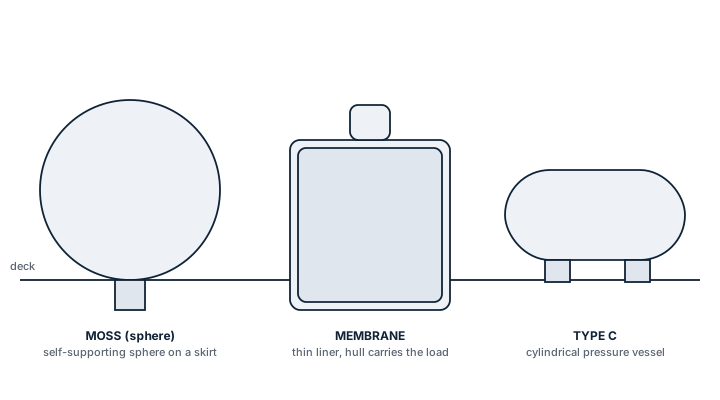
Gas carrier cargo tank types compared
Three cargo containment types shown against the same ship deck line: a Moss sphere resting on a skirt, a prismatic membrane tank built into the hull, and an independent Type C pressure vessel on saddle supports.

Main components

Moss tank

Aluminium or 9% nickel steel sphere, supported on an equatorial skirt, with polyurethane foam insulation applied externally and a domed deck house structure, the characteristic visible spheres, protecting the tank top.

Membrane tank

Primary barrier, the thin corrugated membrane in direct contact with cargo, an insulation space, a secondary barrier designed to contain cargo for a defined period if the primary fails, and a second insulation space bonded to the inner hull.

Type C tank

Thick-walled pressure vessel, typically 9% nickel steel or stainless steel, with saddle or skirt supports, insulated where deeper refrigeration than fully pressurised carriage requires.

Boil-off and reliquefaction system

Common to all three types: cargo that absorbs heat boils off and must be reliquefied, used as fuel, or burned off, sized differently depending on the containment type's insulation performance.

Selection

The decision sits mostly with the shipyard and owner at newbuild stage rather than something chosen later, since it defines the hull. Type C is chosen for LPG, ethylene and smaller-scale LNG where pressurised or semi-refrigerated carriage suits the trade. Membrane is now dominant for large LNG carriers because of its cargo volume efficiency. Moss spheres remain in service on older LNG tonnage and some specialist trades, valued for tank independence and inspection access, but few new Moss ships have been ordered in recent years as membrane technology has closed the boil-off gap.

Regulations and class

All three fall under the IGC Code, which classifies containment systems as Type A, B or C based on the level of secondary barrier protection required and the consequences assumed from a leak. Type B systems, Moss spheres and some membrane designs, require a partial secondary barrier or drip tray; Type C tanks, being fully independent pressure vessels of proven design, generally need no secondary barrier because a leak is not expected to threaten the hull. Class societies survey tank structure, insulation condition and boil-off performance on a periodic basis, with membrane systems subject to specific in-service inspection regimes agreed with the system licensor.

Typical faults

TypeTypical faultConsequence
Moss sphereInsulation degradation or damage to the foam jacketRising boil-off rate, increased reliquefaction plant load
MembranePrimary barrier fatigue cracking at corrugations after repeated thermal cyclingCargo migrating into insulation space, detected by gas sensors before reaching the secondary barrier
MembraneInsulation panel bonding failureLocalised cold spot on hull, hull steel temperature monitoring alarm
Type CExternal corrosion under insulation claddingWall thinning found at survey, requiring cladding removal to assess
All typesBoil-off rate creeping above designHigher fuel gas consumption or more reliquefaction plant running hours than the voyage plan assumed

What to look for in a supplier

  • For Moss and membrane repair work, licensor-approved contractors only, since GTT and Moss Maritime both maintain approved repair yard lists and unapproved work can void class approval of the containment system.
  • For Type C tank work, pressure vessel code compliance matching the code the tank was originally built to, and welder qualification for the specific tank material.
  • Boil-off gas analysis and hull steel temperature monitoring system compatibility with the vessel's existing cargo control system.
  • Documented track record on the specific containment type, since Moss, membrane and Type C repair skills are not interchangeable.

Track boil-off rate trend over voyages, not just the single-voyage figure - a slow upward creep is usually insulation degradation long before it shows up as a visible defect at survey.

8760h
Service Interval

Typical Manufacturers

Moss Maritime GTT TGE Marine

4 manufacturers · 8 models

MacGregor

4
MacGregor Finland Oy Lashing eye, for lashing bridge, Type: U-PLT-2/C
Lashing eye, for lashing bridge, Type: U-PLT-2/C
Per IGC Code requirements · LNG / LPG / Gas Cargo · high-strength steel lashing eye
Common Failures & Inspection Points
  • LNG tank pressure rise due to BOG management error
  • Evaporator tube leakage due to thermal cycling stress
  • Gas valve unit (GVU) solenoid valve failure
  • Gasdetektionssystem Fehlalarm
Service: Gas detection calibration quarterly. GVU function test before each gas operation. IGF Code compliance at annual survey.
Spare Parts: MacGregor Finland Oy: Spezialteile per Hersteller. Lead time: 4-8 Wochen. Gasdetektions-Sensoren an Bord.
Strengths
  • Engineered for the high loads of LNG/LPG membrane tanks
  • Corrosion‑resistant coating suitable for cryogenic environments
  • Integrated with MacGregor deck and lashing bridge systems for easy installation
  • Meets IGF Code requirements and DNV approval for gas carrier applications
  • Facilitates rapid inspection and replacement during scheduled dry‑dock
Weaknesses
  • Optimised only for MacGregor‑designed deck layouts – limited retrofit flexibility
  • Higher procurement cost compared with generic lashing eyes
  • Requires specialised welding/bolting procedures during installation
  • Spare parts and support are tied to MacGregor supply chain
Typical Vessels: LNG CarrierLPG CarrierCryogenic Gas Tanker
Certifications: DNVIGF Code compliant
Decision Guide: Choose if the vessel uses a MacGregor deck or lashing bridge on Moss‑type membrane tanks and requires certified, high‑load‑capacity securing points. Avoid if the ship employs a different deck system, has strict budget constraints, or needs a generic low‑cost solution.
Use Cases: Installed on LNG/LPG carriers to lock the lashing bridge that holds the cargo tank's membrane structure during loading, transit, and unloading, ensuring structural integrity under dynamic sea loads.
Lashing eye, single, corner, Type: U-PLT/C
Per IGC Code requirements · LNG / LPG / Gas Cargo · Moss membrane cargo‑tank lashing eye
Common Failures & Inspection Points
  • LNG tank pressure rise due to BOG management error
  • Evaporator tube leakage due to thermal cycling stress
  • Gas valve unit (GVU) solenoid valve failure
  • Gasdetektionssystem Fehlalarm
Service: Gas detection calibration quarterly. GVU function test before each gas operation. IGF Code compliance at annual survey.
Spare Parts: MacGregor Finland Oy: Spezialteile per Hersteller. Lead time: 4-8 Wochen. Gasdetektions-Sensoren an Bord.
Strengths
  • High tensile strength stainless steel construction meeting IGF Code requirements
  • DNV‑approved design specifically engineered for Moss Type C tanks
  • Corrosion‑resistant finish suitable for cryogenic LNG/LPG environments
  • Standardised dimensions simplify installation and replacement
  • Proven track record on existing LNG carrier fleets
Weaknesses
  • Applicable only to Moss membrane Type C tank designs – not interchangeable with other containment systems
  • Requires specialised welding procedures during installation
  • Higher unit cost compared with generic lashing eyes due to certification and material grade
  • Potential fatigue issues if not inspected according to quarterly calibration schedule
Typical Vessels: LNG CarrierLPG CarrierGas Carrier (cryogenic)Dual‑fuel tanker equipped with Moss membrane tanks
Certifications: DNVIMO IGF Code compliance
Decision Guide: Choose if the vessel uses a Moss membrane Type C cargo tank and requires a certified, high‑strength lashing eye that meets DNV and IGF Code standards. Avoid if the tank type differs (e.g., GTT Mark III) or budget constraints preclude a specialised component.
Use Cases: Installed at each corner of the cargo containment system on LNG/LPG carriers to anchor structural members, distribute sloshing loads, and maintain hull‑tank integrity during heavy seas and maneuvering.
Welding cone Type 12
Per IGC Code requirements · LNG / LPG / Gas Cargo · Welding cone for Moss membrane tank
Common Failures & Inspection Points
  • LNG tank pressure rise due to BOG management error
  • Evaporator tube leakage due to thermal cycling stress
  • Gas valve unit (GVU) solenoid valve failure
  • Gasdetektionssystem Fehlalarm
Service: Gas detection calibration quarterly. GVU function test before each gas operation. IGF Code compliance at annual survey.
Spare Parts: MacGregor Finland Oy: Spezialteile per Hersteller. Lead time: 4-8 Wochen. Gasdetektions-Sensoren an Bord.
Strengths
  • DNV‑approved component specifically engineered for Type C Moss membrane tanks
  • Integrated mounting points simplify connection to gas vent/valve units (GVU) and detection sensors
  • Quarterly calibration access built into the design reduces downtime for gas‑detection maintenance
  • Meets IMO IGF Code requirements, facilitating annual class inspections
  • Modular construction allows installation during newbuild or retrofit with minimal hull alteration
Weaknesses
  • Documented failures linked to BOG management errors causing pressure build‑up in the tank
  • Thermal cycling can induce evaporator‑tube leaks if not properly managed
  • Magnet valve of the GVU has a known propensity for failure, requiring frequent functional tests
  • Gas detection system may generate false alarms, increasing operational vigilance
  • Applicable only to Moss Type C membrane tanks; not compatible with other tank concepts
Typical Vessels: LNG CarrierLPG CarrierGas Carrier
Certifications: DNV
Decision Guide: Choose if the vessel uses a Moss‑type C membrane cargo tank and requires a DNV‑approved, IGF‑code compliant welding cone with easy access for gas‑detection calibration. Avoid if the ship employs a different tank technology or if minimizing maintenance on vent/valve assemblies is a higher priority than standard compliance.
Use Cases: Installed on newbuild LNG/LPG carriers during hull construction to provide a reliable sealed interface for BOG handling, and retrofitted on existing Moss membrane tanks during major overhauls where upgraded gas‑venting and detection integration is needed.
MacGregor Finland Oy Welding Cone Type 40
Welding Cone Type 40
Per IGC Code requirements · LNG / LPG / Gas Cargo · Moss membrane welding cone
Common Failures & Inspection Points
  • LNG tank pressure rise due to BOG management error
  • Evaporator tube leakage due to thermal cycling stress
  • Gas valve unit (GVU) solenoid valve failure
  • Gasdetektionssystem Fehlalarm
Service: Gas detection calibration quarterly. GVU function test before each gas operation. IGF Code compliance at annual survey.
Spare Parts: MacGregor Finland Oy: Spezialteile per Hersteller. Lead time: 4-8 Wochen. Gasdetektions-Sensoren an Bord.
Strengths
  • Proven design for Type C Moss membrane tanks, widely installed on LNG carriers
  • Integrated with MacGregor’s BOG management system, facilitating compliance with IGF Code requirements
  • DNV‑approved and IMO IGF‑Code compliant, simplifying classification approval
  • Modular construction allows relatively quick installation during new builds or conversions
Weaknesses
  • Sensitive to BOG‑management errors; pressure buildup incidents have been reported
  • Thermal cycling can cause pipe‑to‑pipe leakage if not adequately monitored
  • Magnet valve (GVU) failures have been documented, requiring rigorous pre‑operation testing
  • Requires quarterly gas‑detector calibration and regular functional tests, increasing maintenance workload
Typical Vessels: LNG CarrierLPG CarrierSmall to medium gas carriers using Moss membrane tanks
Certifications: DNVIMO IGF Code compliance
Decision Guide: Choose if you need a DNV‑approved, IMO‑compliant welding cone for Type C Moss membrane tanks on new builds or conversions and have the operational discipline to perform quarterly gas‑detector calibrations and pre‑run GVU tests. Avoid if your crew lacks experience with BOG management or if you require a low‑maintenance solution without frequent calibration cycles.
Use Cases: Installed in newly built LNG carriers, retrofits of existing vessels converting to Moss membrane tanks, and onshore gas storage units that employ the same membrane technology. Frequently used where high‑integrity gas containment and compliance with IGF Code are mandatory.

Kongsberg Maritime

2
Common Control Platform CCP project 141004 (Marine Controller H6045), CCP project 141007 (Marine Controller H6059, Type H1151), CCP project 141009 (Marine Controller H1170)
Per IGC Code requirements · LNG / LPG / Gas Cargo · Integrated marine cargo tank control system
Common Failures & Inspection Points
  • LNG tank pressure rise due to BOG management error
  • Evaporator tube leakage due to thermal cycling stress
  • Gas valve unit (GVU) solenoid valve failure
  • Gasdetektionssystem Fehlalarm
Service: Gas detection calibration quarterly. GVU function test before each gas operation. IGF Code compliance at annual survey.
Spare Parts: Kongsberg Maritime AS Avd. Longva: Spezialteile per Hersteller. Lead time: 4-8 Wochen. Gasdetektions-Sensoren an Bord.
Strengths
  • Fully DNV‑approved for Moss membrane (Type C) cargo tanks, ensuring class compliance
  • Modular architecture with redundant processors for high reliability
  • Real‑time BOG management and automated venting reduces manual intervention
  • Seamless integration with Kongsberg gas detection sensors and valve actuators
  • Standardized user interface across all CCP projects simplifies crew training
Weaknesses
  • Complex installation and commissioning; requires experienced integrator
  • Mandatory quarterly gas‑detector calibration adds maintenance workload
  • Higher capital cost compared with basic single‑function controllers
  • Software updates must be managed carefully to avoid configuration drift
  • Known failure modes include BOG mis‑management and magnet valve failures if not maintained
Typical Vessels: LNG CarrierMethanol CarrierLPG CarrierOther gas carriers using Moss membrane tanks
Certifications: DNVIMO IGF Code
Decision Guide: Choose if: the vessel uses Moss membrane (Type C) cargo tanks, requires DNV‑approved integrated control of BOG and venting, and benefits from a unified interface for gas detection and valve actuation. Avoid if: the ship employs a different tank concept (e.g., spherical or independent tanks), has very tight budget constraints, or lacks access to qualified Kongsberg support for commissioning.
Use Cases: Deployed on modern LNG and methanol carriers built with Moss membrane cargo systems, where continuous monitoring of tank pressure/temperature and automated BOG handling are critical for safety and efficiency. Typical installations include vessels operating under the IGF Code on long‑haul routes requiring high reliability and class approval.
Kongsberg Maritime Finland OY VJ (pulling type) 40 kN, 60 kN, 85 kN and 125 kN; TJ (pushing type) 55 kN, 80 kN, 95 kN, 125 kN and 135 kN
VJ (pulling type) 40 kN, 60 kN, 85 kN and 125 kN; TJ (pushing type) 55 kN, 80 kN, 95 kN, 125 kN and 135 kN
Per IGC Code requirements · LNG / LPG / Gas Cargo · High-force gas handling valve
Common Failures & Inspection Points
  • LNG tank pressure rise due to BOG management error
  • Evaporator tube leakage due to thermal cycling stress
  • Gas valve unit (GVU) solenoid valve failure
  • Gasdetektionssystem Fehlalarm
Service: Gas detection calibration quarterly. GVU function test before each gas operation. IGF Code compliance at annual survey.
Spare Parts: Kongsberg Maritime Finland OY: Spezialteile per Hersteller. Lead time: 4-8 Wochen. Gasdetektions-Sensoren an Bord.
Strengths
  • Wide range of rated forces (40–135 kN) covering most membrane‑tank applications
  • DNV‑approved design with proven compliance to the IMO IGF Code
  • Modular construction allows easy replacement and field servicing
  • Integrated diagnostics compatible with Kongsberg’s gas detection and control system
Weaknesses
  • Requires quarterly gas‑detector calibration and pre‑operation GVU function tests, increasing maintenance workload
  • Higher initial capital cost compared with basic pneumatic valves
  • Limited to Moss membrane Type C tanks; not directly compatible with self‑supporting or spherical tank designs
  • Complex control logic can demand specialized training for crew
Typical Vessels: LNG CarrierLPG CarrierGas Carrier (Moss membrane tanks)
Certifications: DNVIMO IGF Code
Decision Guide: Choose if you need a robust, high‑force valve for Moss membrane Type C cargo tanks with integrated monitoring and DNV approval. Avoid if the vessel uses non‑membrane tank types, has limited maintenance resources, or budget constraints preclude higher‑spec equipment.
Use Cases: Deployed on LNG/LPG carriers equipped with Moss membrane containment systems to control boil‑off gas (BOG) pressure, manage loading/unloading cycles, and interface with the ship’s gas detection and venting system during normal operation and emergency shutdowns.

Framo Fusa

1
Cargo Heaters, type no. HE225/750, HE400/1000, HE430, HE500/1000 - steam conn. left and right
Per IGC Code requirements · LNG / LPG / Gas Cargo · steam‑heated cargo heater
Common Failures & Inspection Points
  • LNG tank pressure rise due to BOG management error
  • Evaporator tube leakage due to thermal cycling stress
  • Gas valve unit (GVU) solenoid valve failure
  • Gasdetektionssystem Fehlalarm
Service: Gas detection calibration quarterly. GVU function test before each gas operation. IGF Code compliance at annual survey.
Spare Parts: Framo Fusa AS: Spezialteile per Hersteller. Lead time: 4-8 Wochen. Gasdetektions-Sensoren an Bord.
Strengths
  • High heating power range (225 kW to 1 000 kW) covering most LNG/LPG carrier needs
  • Dual steam inlet (left/right) offers operational redundancy
  • Designed specifically for Moss membrane tanks (Type C), ensuring optimal heat transfer
  • Integrated gas‑detection calibration schedule and GVU function test support safe BOG management
  • DNV approved, proven in long‑term service on gas carriers
Weaknesses
  • Requires reliable steam supply; not suitable for vessels without dedicated boiler capacity
  • Thermal cycling can lead to evaporator pipe fatigue if not monitored
  • Dependence on GVU solenoid valve – documented failures when valve maintenance is lax
  • Gas‑detection system prone to false alarms if calibration is missed
  • Installation space may be limited on smaller tankers due to heater size
Typical Vessels: LNG CarrierLPG CarrierMixed Gas CarrierMoss‑type membrane tanker
Certifications: DNV
Decision Guide: Choose if the vessel uses Moss‑type membrane cargo tanks, needs high steam‑based heating capacity, and has an existing boiler system to supply steam. Avoid if the ship relies on electric or diesel‑driven heaters, lacks sufficient steam generation, or operates in environments where thermal fatigue of evaporator pipes is a major concern.
Use Cases: Used during cargo loading/unloading to raise tank temperature, maintain cargo fluidity in cold climates, prevent wax formation in LPG, and assist boil‑off gas management on LNG carriers by providing supplemental heat when BOG compressors are offline.

Jiangyin Marine Equipment Manufacturing

1
A-15 Fireproof Door, Type 262JC-F2023-14
Per IGC Code requirements · LNG / LPG / Gas Cargo · Fire‑resistant cargo‑tank door
Common Failures & Inspection Points
  • LNG tank pressure rise due to BOG management error
  • Evaporator tube leakage due to thermal cycling stress
  • Gas valve unit (GVU) solenoid valve failure
  • Gasdetektionssystem Fehlalarm
Service: Gas detection calibration quarterly. GVU function test before each gas operation. IGF Code compliance at annual survey.
Spare Parts: Jiangyin Marine Equipment Manufacturing Co., Ltd.: Spezialteile per Hersteller. Lead time: 4-8 Wochen. Gasdetektions-Sensoren an Bord.
Strengths
  • DNV‑approved fire rating meeting IMO IGC Code requirements
  • Corrosion‑resistant steel construction suited to cryogenic environments
  • Integrated sealing system compatible with BOG management and gas detection equipment
  • Standardized dimensions for easy installation on Moss membrane tanks (Type C)
  • Designed for quarterly gas‑detector calibration access
Weaknesses
  • Relatively high weight compared with non‑fire‑rated hatch covers
  • Limited opening size may restrict large equipment entry
  • Requires regular functional testing of adjacent GVU and detection systems to avoid false alarms
  • Installation tolerances are tight; retrofit on older vessels can be labor‑intensive
Typical Vessels: LNG CarrierLPG CarrierChemical Tanker with membrane cargo tanks
Certifications: DNVIMO IGC Code
Decision Guide: Choose if you need a certified fire‑resistant access point for a Moss membrane cargo tank on LNG/LPG carriers and want DNV/IGC compliance. Avoid if vessel weight budget is extremely tight, or if larger hatch openings are required for heavy equipment.
Use Cases: Installed on newbuild and retrofitted gas carriers to provide safe crew access for inspection, maintenance, and emergency egress of membrane cargo tanks while complying with fire safety regulations.