Integrated Automation System (IAS)
An Integrated Automation System replaces separate alarm, control and power-management panels with one network and shared database, so a single sensor reading feeds alarm, trending and remote-control logic at once — the reason a network fault, not a sensor fault, is now the most disruptive failure mode in the engine room.
What to check on an Integrated Automation System (IAS).
21 models from Schneider Electric in Integrated Automation System (IAS). Below: the full model list.
What sets an IAS apart
Older engine rooms ran alarm monitoring, engine remote control and power management as three separate systems, each with its own wiring, sensors and operator panel. An IAS puts them on one redundant network with a shared database: a single temperature sensor feeds the alarm system, the trending historian and the control logic simultaneously, and one HMI screen shows all three functions. The gain is fewer duplicated sensors, consistent data across functions, and centralised diagnostics. The cost is that a network or database fault can take down alarm, control and power management together, which is why redundancy architecture — not any single component — is what defines the quality of an IAS installation.
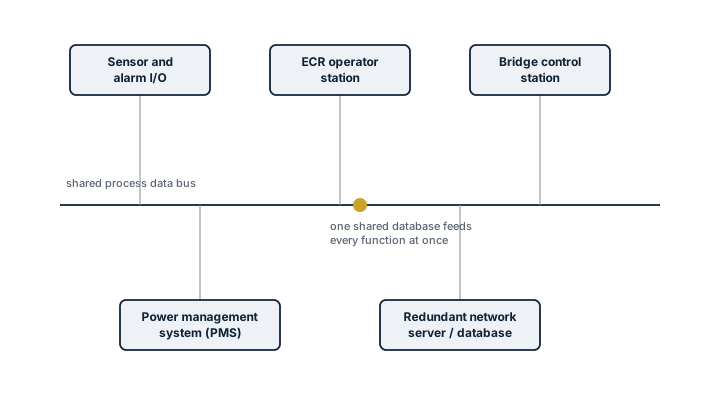
Legend
- Sensor and alarm I/O
- Bridge control station
- shared process data bus
- one shared database feeds every function at once
- Power management system (PMS)
- ECR operator station
- Redundant network server / database
Main components
Process / controller stations
Distributed PLC or DCS-style controllers, usually installed in pairs with hot-standby or redundant CPUs, execute the control and alarm logic locally so a single controller failure does not blind the whole engine room.
Remote I/O cabinets
Field-mounted cabinets convert sensor and actuator signals to the network protocol close to the equipment, reducing long analogue cable runs and making it possible to isolate one section for maintenance without pulling wiring throughout the ship.
Read the full guide
Network backbone
A dual, physically separated fibre or Ethernet ring connects controllers, I/O cabinets and workstations, so a single cable damage point does not isolate any station — this ring redundancy is the single most important design feature to verify at delivery.
HMI workstations and historian
Operator stations in the engine control room, bridge and cargo control room display live and trended data from the common database; a historian logs alarms and process values for troubleshooting and for evidence during incident investigation.
Selection and sizing
- I/O count and spare capacity for future retrofits, since adding points later usually means adding a whole remote I/O cabinet
- Redundancy level: single network with standalone backup panels, dual network, or fully redundant controllers matching the intended UMS/AUT notation
- Response time and alarm processing capacity under flood conditions (many simultaneous alarms, e.g. after blackout)
- Network segregation between the OT (operational technology) automation network and any IT network used for crew internet or office systems
Regulations and class
SOLAS Ch. II-1 sets requirements for periodically unattended machinery spaces, underpinning class notations such as AUT-UMS, which require specific alarm, safety and fire detection coverage before a vessel can run with an unattended engine room. IACS Unified Requirements cover the alarm and safety system functions expected for these notations. IMO's cyber risk management resolution (MSC.428(98)) pushes owners to document how the automation network is segregated and protected, which in practice shapes how IAS suppliers architect the OT/IT boundary on new installations.
Typical faults
| Cause | Consequence |
|---|---|
| Single network ring damaged at two points simultaneously | Segment isolated from the database, alarms and control lost for that section without a clear local indication |
| Software/firmware update applied without a documented rollback plan | Loss of control or nuisance alarms across multiple systems at once, since one database feeds everything |
| Remote I/O cabinet condensation or vibration-loosened terminals | Intermittent, hard-to-trace faults reported as random alarms rather than one cabinet issue |
| Undocumented IT network bridged onto the automation network | Cyber exposure and potential for a single malware event to affect propulsion or power management |
What to look for in a supplier
- Documented redundancy architecture matching the class notation being sought, not a generic industrial control platform relabelled for marine use
- Confirmed long-term software and spare-parts support, since IAS hardware generations become obsolete faster than the ship's service life
- Clear OT/IT network segregation in the delivered design, with evidence for the cyber risk management documentation
- Local training and documentation depth sufficient for the ship's own engineers to diagnose faults, not only the maker's service technicians
When an IAS starts producing a flood of unrelated alarms at once, suspect the network or database layer before chasing each sensor individually — the shared architecture that makes IAS efficient in normal operation is exactly what turns one fault into many symptoms.
Models in this type.
The best-documented model of each manufacturer first, then the next — 21 of 21 models in Integrated Automation System (IAS). Every row links to full specifications, documents and service notes.
Manufacturers.
All 22 manufacturers with models of Integrated Automation System (IAS). Names with a manufacturer page open it; the others open a search across the full library.
All manufacturers in the libraryAlso in Automation & Control.
The other equipment types in this category.
Write to us about this model — the answer comes by e-mail.
Name the make and the model and what the job is: a spare, a service call, a second opinion on a data sheet. We answer by e-mail.
No details at hand? A photo of the rating plate or the part is enough — simply attach it to the request.
Questions that come up with this equipment.
Is Integrated Automation System (IAS) data free?
Yes. Every model page, every guide and every datasheet for this type is readable without an account. An account adds saved searches and requests, nothing is taken away.
My model is missing — what now?
Send us the nameplate. We identify it by hand, add it to the library, and if you need a part or a service, the request is already on our desk.
Can you source a Integrated Automation System (IAS) part?
Yes. Tell us the manufacturer, the model and what you need — a person reads every request and replies by e-mail.