Offshore Containers
Offshore containers and baskets are built and certified to DNV 2.7-1, or the equivalent EN 12079, for repeated crane lifts to and from a moving platform or vessel deck, a load case standard cargo containers are never tested against.
What to check on an Offshore Containers.
1 models from DESMI in Offshore Containers. Below: the full model list.
What Makes This Type
An offshore container is designed and certified for repeated lifting by crane between an installation and a supply vessel, often in a seaway with the deck moving under the load, which is a fundamentally different design case from a standard ISO cargo container built to be stacked and moved by twistlock spreader on level ground. The certifying standard, DNV 2.7-1, or the closely related EN 12079, requires a proof load test and defines a fatigue life in number of lifts, not just a static strength figure. Offshore baskets are the open-frame variant of the same certification, built for irregular loads such as pipe, drums or loose equipment that a closed container cannot carry efficiently.
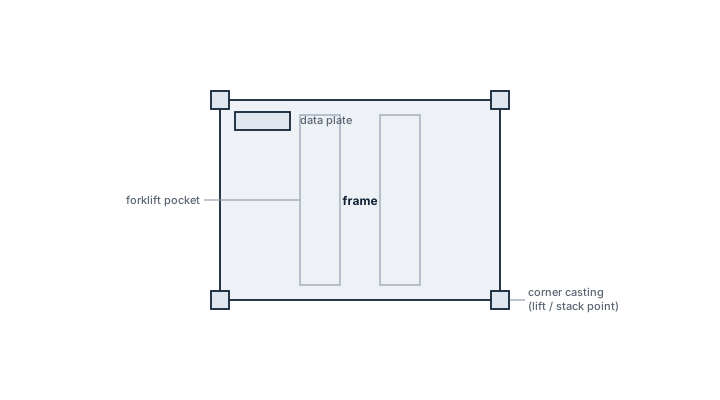
Legend
- data plate
- forklift pocket
- frame
- corner casting (lift / stack point)
Main Components
- Frame and corner posts: the structural steel frame carrying the rated gross weight, stamped with the container's individual serial number and certification data.
- Lifting set: four-leg wire rope or chain sling permanently attached at the top corners, rated and certified as part of the container's lifting arrangement, not a generic sling substituted at will.
- Corner fittings and lashing points: ISO-standard corner castings for stacking and lashing on deck, separate from the lifting set itself.
- Floor and side panels or open frame (basket): solid panels on a closed container, or an open mesh/frame structure on a basket, chosen for the cargo the unit is meant to carry.
Selection and Sizing
Gross weight rating, tare weight and net payload are the primary sizing figures, alongside the specific cargo the unit will carry, since a chemical or waste container needs sealed floor drains and containment that a general cargo unit does not. Certification category under DNV 2.7-1 (offshore container, half-height container, or basket) has to match the intended use, and the lifting set configuration is chosen for the number of lifting points the crane operation actually requires. Deck footprint and stacking compatibility with the vessel's existing container handling equipment are also part of selection on a vessel running a fixed rotation.
Regulations and Class
DNV 2.7-1 and EN 12079 both require a proof load test at a defined multiple of the safe working load before a unit enters service, a periodic recertification interval typically every five years, and individual marking with serial number, tare weight, maximum gross weight and last test date visible on the unit. Class and flag inspections check that the certification plate is current and legible and that the lifting set has not been substituted with an uncertified replacement, which is a common finding on older units in service.
Read the full guide
Typical Faults
| Fault | Consequence |
|---|---|
| Corrosion at the corner post welds | Reduced structural strength exactly at the highest-stress point in a lift, the most common cause of failed recertification |
| Wire rope lifting set wear, broken strands or corrosion | Reduced safe working load of the lifting set below the container's rated capacity |
| Missing or illegible certification plate | Unit rejected at the quayside or platform, since operators will not lift an unverifiable container |
| Basket mesh or floor damage | Loss of cargo through the frame during a lift, a dropped-object risk on an offshore installation |
What to Look for in a Supplier
- Current DNV 2.7-1 or EN 12079 certificate for each individual unit, not a fleet-level or model-type certificate.
- Traceable inspection and recertification history, since a gap in the record is itself a rejection reason on many offshore operators' checklists.
- Matching lifting set replacement certified to the container's original rated configuration if the set needs renewal.
Check the recertification date on the plate before every offshore lift, not just before the annual survey - a container that is five years and one week old is refused by most platform operators regardless of visible condition.
Models in this type.
The best-documented model of each manufacturer first, then the next — 1 of 1 models in Offshore Containers. Every row links to full specifications, documents and service notes.
Manufacturers.
All 310 manufacturers with models of Offshore Containers. Names with a manufacturer page open it; the others open a search across the full library.
All manufacturers in the library- Akel Gemicilik ve Deniz Endustrisi San ve Tic Ltd7
- Al Shaan Engineering Works LLC6
- Al Shirawi Equipment Company L.L.C9
- B9 Mechanical Services6
- Bootle Containers Ltd.6
- Centurion UK Rentals & Services Limited - Centurion Fluid Filtration8
- D&P Innovations Sdn. Bhd.8
- D.F. Barnes Fabrication Limited12
- David Ritchie (Implements) Ltd.9
- De Beers Marine (Pty) Ltd15
- Degem Gemi Bakım Onarım İnş. Tarım ve Hayvancılık San. Tic. Ltd. Şti.6
- ETUDES ET PRODUCTIONS SCHLUMBERGER SAS8
- Ferrite Steel Engineering Sdn Bhd6
- HARGEN OFFSHORE CONTAINERS LTDA16
- Hydra Rig NOV - A Division of National Oilwell Varco UK Ltd9
- J.D. Theile GmbH & Co. KG6
- Kejuruteraan Mega Niaga Sdn Bhd10
- Magnum Technology Center FZE15
- MKAP Container Sdn Bhd8
- National Oilwell Varco UK45
- NOV ELMAR, a division of National Oilwell Varco UK Limited32
- Petrocast Metal Industries L.L.C16
- RMZ Oilfield Engineering Pte Ltd12
- Safelift Offshore10
- Specialist Services L.L.C14
- SRI Energy Inc.7
- Suretank Ltd24
- Swire Energy Service18
- The Crosby Group9
- TNR Offshore Celik Yapi San. ve Tic. A.S.19
- Uniteam Poland Sp. z o.o.10
- Venture Gulf Engineering WLL10
- VG Offshore Containers International (M) Sdn Bhd13
- Worldwide Oilfield Machine, Inc.12
- Yangzhou Tonglee Reefer Container Co., Ltd.16
- Yoke Industrial36
Show all 310 manufacturers
- 2020 FMCG Inc1
- 3C Metal Belmet (Pty) Ltd3
- 4Subsea Astori AS1
- A. D. Engineering1
- A.Nobles & Sons P\L1
- A.S.A.P. Industries Manufacturing, LLC1
- A1 ENGINEERING & SERVICES W.L.L1
- Aberdeen Lifting Services Ltd.1
- ACRO CABOS DE ACO INDUSTRIA E COMERCIO LTDA1
- AFAB Holdings Ltd1
- African Wire Ropes (Pty) Ltd1
- AIMCO Integrated Solutions1
- Aker Solutions do Brasil Ltda1
- Al Fuzail Engineering Services WLL2
- Al Masaood L.L.C.2
- Al Muftah International L.L.C4
- Al Muftah International Tr.1
- AL Nasr Metal Industries L.L.C2
- AL Raha Metal Products Factory LLC3
- AL SHUROOQ OILFIELD EQUIPMENT FZC2
- Al Wazan Trading1
- All Gases Sdn. Bhd.4
- ALLBRIGHT GLOBAL OIL FIELDS SERVICES1
- Allman Global Services Ltd.1
- AMS Lifting & Towing Systems (Pty) Ltd.1
- Anchor Industries (Pty) Ltd1
- APPLIED ENGINEERING PTE LTD1
- ARC Engineering LLC1
- Armoda2
- AS Einar Kunsts ETF.2
- Ashtead Technology Ltd2
- Asian Offshore Services Sdn. Bhd.1
- ATDS ANGOLA TRADING DEVELOPMENT AND SERVICES, LDA1
- Baker Hughes, a GE Company2
- BOREASPRO GUC SISTEMLERI MAKINE VE ARAC KIRALAMA SANAYI TICARET A.S.1
- Box Modul AB1
- Bullivants Pty Ltd1
- CAB ENERGISERVICIOS, S.A. DE C.V.1
- Calbah Industries Pty Ltd1
- Cansco Middle East Pressure Equipment L.L.C1
- Cape East Limited2
- CARGO LIFT S.A. DE C.V.1
- Carl Stahl Lifting Equipment Trading L.L.C.1
- CERTEX (UK) LIMITED1
- CERTEX Danmark A/S1
- Certex USA, Inc.1
- CETCO Energy Services Company, LLC1
- Claxton Engineering Services Ltd1
- CODIMAR CONSTRUCOES E MONTAGENS LTDA1
- Constellation Engineering (RSA) Pty Ltd2
- Container d.o.o. Proizvodno Podjetje1
- Core Lifting of Lafayette, LLC1
- CORPORATIVO CABLES DEL GOLFO E INSUMOS INDUSTRIALES1
- CTS Container & Trailer Services Ltd.5
- Dalian CIMC Logistics Equipment Co., Ltd.1
- Dalian CIMC Special Logistics Equipment5
- Damen Shipyards Gorinchem B.V.1
- DATA CENTER VAULT INDUSTRIES SOLE PROPERIETORSHIP L.L.C1
- DCM Containers & Engineering Private Limited1
- De Ruiter Staalkabel B.V.1
- Deepsea Technologies (India) Pvt. Ltd.1
- DESMI RO-CLEAN A/S1
- Don Mashburn Inc1
- Dong Fang International Container (Qingdao) Co., Ltd.1
- Dutest Qatar W.L.L.1
- Dwellop AS3
- Dynamic Crane Service and Fabrication2
- Dynamic Lifting Solutions1
- Eastern Alloy, Inc.2
- Ecvio AS1
- ENERTEC W.L.L1
- EPCF Prima Sdn Bhd2
- EPIC OG Sdn Bhd1
- European Management & Marine Corporation Ltd1
- FISCHER INDUSTRIA MECANICA LTDA1
- Flow Test Equipment FZCO4
- Foley Engineering, LLC1
- Forum Energy Technologies2
- Forum U.S. Inc, dba DYNACON1
- Four Lines Industries LLC1
- Franklin Offshore Australia Pty. Ltd.1
- Franklin Offshore International Pte. Ltd.1
- Franklin Offshore Qatar W.L.L.1
- FRIEDLANDER ANGOLA-TUBOS E MONTAGENS,LDA1
- Generon IGS4
- GEOLOG S.r.l.1
- Geowell Sdn. Bhd.1
- Global Energy Ventures SARL1
- Global Engineering Supplies Corporation LLC1
- Goforth Corporation Sdn. Bhd.1
- Gorica Industries L.L.C.1
- GREEN BOX CONTAINERS L.L.C2
- Green Mountains Environment & Transports Services - Sole Proprietorship L.L.C1
- Gulf America1
- Gulf Shore Group1
- Gulf Technical Equipment & Hydraulic Factory LLC3
- Gulf Technical Factory4
- Gunnebo Industrier Aktiebolag2
- Gunnebo-Anja Industrier AS1
- Hades Oilfield Product Limited5
- Haggie Distribution Pty Ltd [Cape Town]1
- Halliburton Manufacturing & Leasing Company, LLC2
- Hans Shipping & Engineering Co. Ltd.1
- Harlum Services Limited1
- Harper UK Ltd2
- Hayatt Steel Pvt. Ltd3
- Heft Testing Private Limited1
- Hendrik Veder Group B.V1
- Hendrik Veder Group Norway AS1
- Hendrik Veder Group UK Ltd1
- Hercules SLR Inc.1
- Hexagon Purus Weeze GmbH1
- HI Energy FZC2
- Himile Mechanical Manufacturing (Shandong) Co., Ltd.2
- HIPAQ A/S1
- Holloway Houston Inc.1
- HUNTING ENERGY SERVICES FZE3
- Hydrus Energy Engineering Ltd1
- IK-Norway AS1
- IMC PREFABRIK CELIK YAPI SANAYI VE TICARET LTD.STI.2
- Independent Lifting Services Limited1
- IntegriCert, LLC1
- INTERNATIONAL TUBULAR SERVICES M.E - WLL2
- Intervention Solutions W.L.L.2
- IPH DO BRASIL COMERCIO E REPRESENTAÇÕES LTDA1
- Italmet S.r.l.1
- ITC Hydraulic Services Ltd1
- IWES3
- JDR Cable Systems2
- Jian Feng Sling Co., Ltd.1
- Jiangmen Hongyi Offshore Equipment Co., Ltd2
- Jiangsu Huajian Container Co., Ltd.2
- Jingbian Litong Industry and Trade Co., Ltd2
- Jingjiang Asian-Pacific Special Material Co., Ltd.1
- KG-bau, s.r.o.1
- KITO CHAIN ITALIA1
- KKB Engineering Berhad1
- Kolos Lifting & Inspection AS1
- LAAM OFFSHORE INDUSTRIA, COMERCIO E SERVICOS DE CABOS DE ACO LTDA1
- Linde Gas AS1
- Logan Industries International Corporation1
- MacArtney A/S1
- Machinefabriek Emce3
- Magnum Technology Center HFZA1
- Magnum Technology Center Ltd.1
- Maju Universal Engineering Sdn Bhd1
- Mak Kee International H.K. Ltd.1
- MANTOVANI & VICENTINI S.r.l.6
- Master Field Mechanical Equipment LLC1
- Master Line Mechanical Equipment Works LLC4
- Matorly (Shenzhen) Fluid Engineering Co., Ltd.1
- Mazzella Companies1
- McKinnon Chain South Africa (Pty) Ltd5
- METALLTEKNIKK AS1
- Micoda Process Systems International LLC6
- Midgrab S.A. de C.V.1
- Modex6
- Modex Energy Rentals Singapore Pte. Ltd.1
- Module Build Ltd.2
- NAZ Industries LLC1
- NEADE INDUSTRIA E COMERCIO DE PRODUTOS PARA ELEVACAO E MOVIMENTACAO DE CARGAS LTDA1
- New Industries, LLC1
- Neway Flow Control DMCC1
- NEWAY FLOW CONTROL FZE1
- NEWMECH SERVICES LTD1
- Nexos Solutions Limited3
- Nippon Gases Offshore3
- Nordic Steel AS4
- Noren Bergen AS1
- NOV Completion & Production Solutions1
- NOV PRODUCTS MIDDLE EAST - FZE1
- Nøsted & AS1
- Nucore Group Ltd1
- Ocean Edge Services Inc2
- OEG Asia Pacific Pte Ltd2
- OEG Offshore5
- Offshore Tech (Zhangjiagang) Co.,Ltd.1
- Oil Field Instrumentation (India) Pvt Limited1
- Oilfield Solutions Ltd1
- Oilfields Supply Center Sdn. Bhd.1
- Oktopus Gesellschaft für angewandte Wissenschaft, innovative Technologien und Service mbH1
- OneSubsea GmbH5
- Osprey3 Limited2
- PAC Eastcoast Engineering & Services Sdn. Bhd.3
- PAILERIA Y MECANICA DEL SURESTE2
- Parker Hannifin Manufacturing Netherlands (Process Filtration) B.V1
- Petrogear FZE1
- Petrotubular Petroleum Services (FZC)1
- PEWAG Austria GmbH3
- Pier Solutions (International) Ltd1
- Pioneer Marine Refrigeration And HVAC1
- Pioneer Refrigeration And Airconditioning Works2
- Planet Blue Energy FZE1
- Prasanvi General Contracting L.L.C3
- Prior Power Solutions Limited2
- Process Components Limited1
- PRODUCTOS DE CARGA1
- Proofload Pty Ltd1
- Proserv Al Badie LLC1
- Protankgrup1
- PROTECH L.L.C.1
- PROVEEDOR INDUSTRIAL QUALITY SA DE2
- PT Franklin Offshore Indonesia Perkasa1
- PT Profab Indonesia3
- PT. Meindo Elang Indah1
- Purple Containers (OPC) Private Limited1
- QHS Scotland Ltd1
- Quick Fit Engineering & Fabricators1
- Rapid Solutions Engineering Industries LLC2
- Rapid Solutions Engineering LLC3
- RB Ross Steel Fabrications Limited2
- REDA Production Systems2
- Remprodex Sp. z o.o.4
- Romson Oil Field Services Ltd1
- Royal Van Beest Group B.V.1
- Rudiment Engineering LLC1
- ScanCab A/S1
- SCHLUMBERGER VECTOR SAS1
- Sea Ropes, LLC1
- SEABED SCOUR CONTROL SYSTEMS LIMITED1
- Seatrax Equipment Services1
- SERVICIOS SIANI2
- SES Energy AS2
- Shandong Shenli Rigging Co., Ltd.2
- Shanghai Baoshan Pacific Container Co., Ltd.3
- SHARJAH OXYGEN COMPANY LLC2
- Shenzhen Jutal Machinery Equipment Co., Ltd.1
- Sicom S.p.A.1
- SIVA INDUSTRIA E COMERCIO DE ARTEFATOS DE ARAME E ACO LTDA1
- SJS Limited2
- Southwest Wire Rope LLC1
- Spooltech, LLC.1
- SPT Mühendislik ve Ticaret Ltd. Şti.1
- Sri Sai Oilfield Equipments & Marine Services4
- SSN Makina A.S.3
- Sterke A/S1
- Supreme Integrated Technology, Inc.1
- Suzhou Dragon Modular Technology Co. Ltd1
- Swire Energy Services Ltd1
- Tankquip Resources1
- Technical Oilfield Supplies Centre1
- Technical Supplies & Services Co. W.L.L.1
- Techshore Middle East FZE1
- TECNOLOGIA EM CABOS DE ACO BRASCABO LTDA1
- Thai Mui Corporation Public Company Limited1
- THIELE GmbH & Co. KG4
- Top Slings East Malaysia Sdn. Bhd.1
- Total Waste Management Alliance Ltd2
- Trans Construction AS1
- Trinidad Inspection Services Limited1
- True Sea Services (FZE)1
- True Sea Services FZC6
- TWMA UK Ltd6
- UIS-AZ LLC1
- Umoe Advanced Composites AS1
- Unique System FZE1
- United Metal Works Factory Abu Dhabi - Sole Proprietorship L.L.C1
- Van Beest B.V.1
- Van Oord Dredging and Marine Contractors B.V.3
- Vesseltech Engineering Sdn. Bhd.1
- Vetco Gray Scandinavia AS1
- Viereck & Co. (GmbH & Co.) KG1
- Vlierodam B.V. - Handelsmaatschappij1
- Voe Marine Engineering Ltd1
- VSY Service Container Ltd2
- W-Industries of Texas, LLC.1
- WattSmart B.V. h/o Hazo Techniek1
- Weatherford Oil Tool GmbH1
- Welfab Engineering Works Sdn. Bhd.1
- WILLIAM HACKETT LIFTING PRODUCTS LIMITED3
- Yantai Jereh Petroleum Equipment & Technologies Co., Ltd.5
- Yousef Ali Al-Yami Technical Services Est1
- Zaklad Budowy Maszyn ZREMB CHOJNICE S.A.6
- Zhangjiagang Uniteam Mobile Shelter System Co., Ltd.2
Also in Cargo Lashing & Container Equipment.
The other equipment types in this category.
Write to us about your machine — the answer comes by e-mail.
Name the make and the model and what the job is: a spare, a service call, a second opinion on a data sheet. We answer by e-mail.
No details at hand? A photo of the rating plate or the part is enough — simply attach it to the request.
Questions that come up with this equipment.
Is Offshore Containers data free?
Yes. Every model page, every guide and every datasheet for this type is readable without an account. An account adds saved searches and requests, nothing is taken away.
My model is missing — what now?
Send us the nameplate. We identify it by hand, add it to the library, and if you need a part or a service, the request is already on our desk.
Can you source a Offshore Containers part?
Yes. Tell us the manufacturer, the model and what you need — a person reads every request and replies by e-mail.