What to check on a Cargo Hooks & Shackles.
Twistlocks and lashing rods are permanent fittings that stay on the container stack for the whole voyage. Cargo hooks and shackles are portable connectors: they join a sling to a crane hook, close a lashing chain around a padeye, or link two sections of rigging together for a single lift or a single voyage's lashing arrangement. Because they move from job to job and from ship to ship, they carry no history the crew can see at a glance beyond the markings stamped into the metal. A shackle picked up…
What sets hooks and shackles apart
Twistlocks and lashing rods are permanent fittings that stay on the container stack for the whole voyage. Cargo hooks and shackles are portable connectors: they join a sling to a crane hook, close a lashing chain around a padeye, or link two sections of rigging together for a single lift or a single voyage's lashing arrangement. Because they move from job to job and from ship to ship, they carry no history the crew can see at a glance beyond the markings stamped into the metal. A shackle picked up from the wrong bin can be the weak link in an otherwise correct rigging plan, which is why identification and marking matter as much as the steel itself.
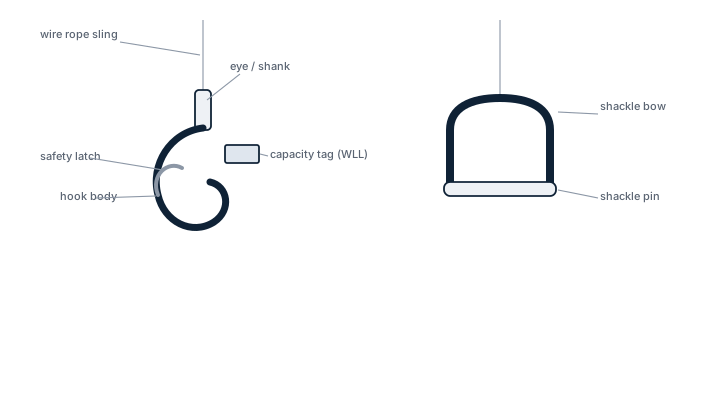
Main components
Cargo hooks
A cargo hook is a forged, curved load-bearing element with a swivel eye at the top and, on most modern types, a spring-loaded safety latch across the throat to stop the sling from riding off under slack conditions. Bodies are typically drop-forged alloy steel, heat treated and proof loaded before certification.
Shackles
Bow (anchor) shackles have a wider, rounded body and take multi-leg slings or angled loads well; dee (chain) shackles have straight sides and are meant for loads pulling in line with the shackle body. Pins come as screw pin, round pin with cotter, or safety bolt with nut and split pin, the latter two preferred where the shackle cannot be inspected or tightened during the lift.
Swivels
Swivel hooks and swivel shackles let a suspended load rotate freely, which stops the wire rope from twisting and birdcaging under load, a common cause of premature wire failure on long lifts.
Selection and sizing
Selection starts from the working load limit, not the breaking load. Class and manufacturer both apply a safety factor, commonly in the region of 5:1 or 6:1 between minimum breaking load and WLL, and that margin is not a buffer to be used deliberately. Material grade matters: forged alloy grades (often marked grade 6, 8 or higher) are the norm for cargo work; mild steel shackles sold for general hardware use are not rated for lifting and should never appear in a ship's cargo gear. Corrosion protection is chosen for the trade: hot-dip galvanized for general cargo work, and stainless or specially coated fittings where the gear lives permanently exposed to spray. Bow diameter and pin diameter must match the sling or shackle it will be paired with; an undersized pin inside an oversized shackle bow allows side loading that the rating never accounted for.
Regulations and class requirements
Lifting hooks and shackles used for cargo operations are entered in the ship's cargo gear register and are subject to periodic thorough examination and proof load testing under class rules, typically on a four to five year cycle depending on flag and class society. Items used within a container or breakbulk lashing system fall under the vessel's approved Cargo Securing Manual, which specifies the type, WLL and quantity of securing hardware permitted for each cargo configuration. Every item must carry a legible WLL stamp and, where applicable, a certificate reference; gear without traceable marking is not considered fit for use regardless of its apparent physical condition.
Typical faults
- Overload deformation (bent bow, opened hook throat) that quietly reduces the true WLL below the stamped figure, often invisible without careful measurement.
- Surface corrosion and pitting, which concentrates stress at the pit and can lead to sudden failure with no prior warning of overload.
- Worn or damaged pin threads on screw-pin shackles, letting the pin back out and disengage under vibration or a slack cycle.
- Missing or illegible WLL marking, which by itself is enough to condemn a piece of gear since safe load can no longer be verified.
- Mismatched combinations, such as a shackle too narrow for its sling, forcing side loading and bending the pin under a load the shackle was never rated to take at that angle.
What to look for in a supplier
- Certification to a recognized lifting standard with proof-load test certificates supplied for each batch, not just a type approval on paper.
- Correct, durable WLL marking and full material traceability back to the cast or forged batch.
- Compatibility confirmed against the ship's existing wire, chain and sling sizes rather than a generic size match.
- Availability of individual replacement pins and components so a damaged shackle does not force replacement of an entire rigging set.
A shackle with no legible WLL stamp gets condemned on sight during survey, however solid it looks; never trust a piece of lifting gear you cannot trace back to its certificate.