What to check on a ROV & Subsea Equipment.
Remotely operated vehicles range from small observation units carrying a camera and little else, through inspection-class units with limited manipulation, up to work-class ROVs able to carry heavy tooling packages for construction, salvage or intervention work at depth. What defines the type is not the vehicle alone but the whole system: the launch and recovery system, the tether management system, the umbilical carrying power and signal, and the surface control van. A vehicle rated for 1000 m is worthless without an umbilical and winch rated for the same depth, and…
What sets ROV and subsea equipment apart
Remotely operated vehicles range from small observation units carrying a camera and little else, through inspection-class units with limited manipulation, up to work-class ROVs able to carry heavy tooling packages for construction, salvage or intervention work at depth. What defines the type is not the vehicle alone but the whole system: the launch and recovery system, the tether management system, the umbilical carrying power and signal, and the surface control van. A vehicle rated for 1000 m is worthless without an umbilical and winch rated for the same depth, and a work-class vehicle needs a launch system able to handle its weight and the sea state it will be launched in.
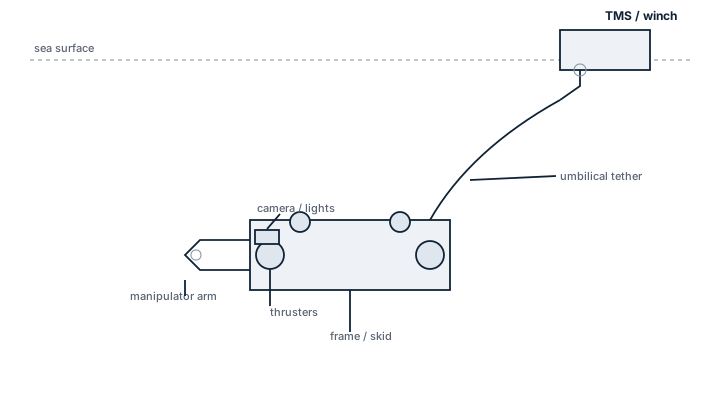
Main components
Vehicle
Thrusters, buoyancy foam, camera and lighting package, and on work-class units one or two manipulator arms plus mounting points for tooling skids.
Tether management system (TMS)
A cage or garage that carries the vehicle through the splash zone and manages the neutrally buoyant tether between the TMS and the vehicle, isolating the vehicle from umbilical drag and ship motion.
Umbilical and winch
Armoured umbilical carrying power, fibre-optic or copper signal conductors, and often hydraulic hose, spooled on a powered winch sized for the full working depth plus margin.
Launch and recovery system (LARS)
A-frame or crane-based system that deploys and recovers the TMS and vehicle through the splash zone, typically the limiting factor on what sea state a launch can be attempted in.
Control van and power unit
Surface control cabin with pilot and co-pilot stations, video recording, and the hydraulic power unit for work-class manipulators and tooling.
Selection and sizing
- Depth rating of the vehicle, umbilical and winch together, since the shallowest-rated component sets the working depth of the whole system
- Bollard pull and thruster configuration against expected current at the work site
- Manipulator payload and reach for the specific intervention task, not a generic figure
- LARS sea state limit against the vessel's expected operating window
- Tooling interface compatibility, hot-stab and hydraulic circuit count, for any client-supplied subsea tooling
Regulations and class
ROV systems used from a class-certified vessel fall under the class society's rules for lifting appliances and, where the LARS is a permanent installation, its crane or A-frame certification and periodic load testing. IMCA guidance documents are the de facto industry reference for ROV system specification, personnel competence and operations, and clients working offshore commonly require IMCA-aligned documentation even though IMCA is not a regulator. Diving and ROV support work on oil and gas installations may additionally fall under flag or coastal state offshore safety regulation depending on the operating area.
Typical faults
| Fault | Cause | Consequence |
|---|---|---|
| Loss of thruster control | Water ingress into a thruster motor housing or connector | Reduced manoeuvrability, possible abort of the dive |
| Umbilical damage | Chafe against the TMS frame or overboarding sheave misalignment | Loss of power or signal to the vehicle, potential loss of the vehicle if severed |
| Manipulator drift | Hydraulic seal wear or contaminated hydraulic fluid | Loss of positional accuracy during a delicate intervention task |
| LARS failure to launch | Sheave or latch wear not caught in routine inspection | Operation delayed or cancelled, weather window missed |
What to look for in a supplier
- Depth and load ratings documented for the vehicle, umbilical, winch and LARS as a matched system, not each component in isolation
- Recent third-party load test and certification for lifting components of the LARS
- Documented spare parts holding for thrusters, connectors and manipulator seals appropriate to the planned campaign length
- Pilot and technician competence records aligned with IMCA guidance where the client requires it
Depth rating on a spec sheet means nothing until the umbilical, winch and TMS are checked against the same number — a vehicle rated deeper than its tether is rated shallow.