What to check on a Offshore Containers.
An offshore container is designed and certified for repeated lifting by crane between an installation and a supply vessel, often in a seaway with the deck moving under the load, which is a fundamentally different design case from a standard ISO cargo container built to be stacked and moved by twistlock spreader on level ground. The certifying standard, DNV 2.7-1, or the closely related EN 12079, requires a proof load test and defines a fatigue life in number of lifts, not just a static strength figure. Offshore baskets are the…
What Makes This Type
An offshore container is designed and certified for repeated lifting by crane between an installation and a supply vessel, often in a seaway with the deck moving under the load, which is a fundamentally different design case from a standard ISO cargo container built to be stacked and moved by twistlock spreader on level ground. The certifying standard, DNV 2.7-1, or the closely related EN 12079, requires a proof load test and defines a fatigue life in number of lifts, not just a static strength figure. Offshore baskets are the open-frame variant of the same certification, built for irregular loads such as pipe, drums or loose equipment that a closed container cannot carry efficiently.
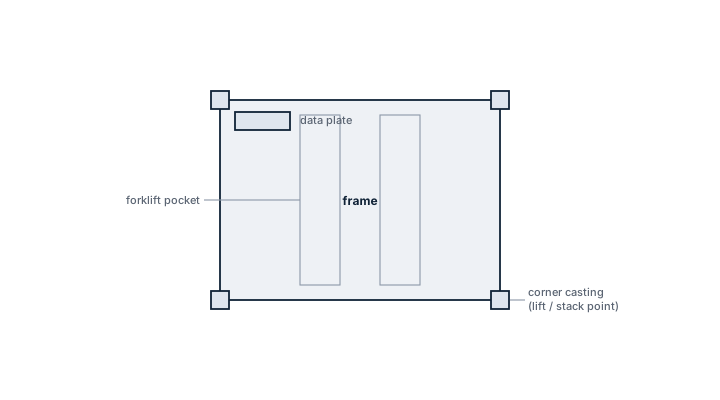
Main Components
- Frame and corner posts: the structural steel frame carrying the rated gross weight, stamped with the container's individual serial number and certification data.
- Lifting set: four-leg wire rope or chain sling permanently attached at the top corners, rated and certified as part of the container's lifting arrangement, not a generic sling substituted at will.
- Corner fittings and lashing points: ISO-standard corner castings for stacking and lashing on deck, separate from the lifting set itself.
- Floor and side panels or open frame (basket): solid panels on a closed container, or an open mesh/frame structure on a basket, chosen for the cargo the unit is meant to carry.
Selection and Sizing
Gross weight rating, tare weight and net payload are the primary sizing figures, alongside the specific cargo the unit will carry, since a chemical or waste container needs sealed floor drains and containment that a general cargo unit does not. Certification category under DNV 2.7-1 (offshore container, half-height container, or basket) has to match the intended use, and the lifting set configuration is chosen for the number of lifting points the crane operation actually requires. Deck footprint and stacking compatibility with the vessel's existing container handling equipment are also part of selection on a vessel running a fixed rotation.
Regulations and Class
DNV 2.7-1 and EN 12079 both require a proof load test at a defined multiple of the safe working load before a unit enters service, a periodic recertification interval typically every five years, and individual marking with serial number, tare weight, maximum gross weight and last test date visible on the unit. Class and flag inspections check that the certification plate is current and legible and that the lifting set has not been substituted with an uncertified replacement, which is a common finding on older units in service.
Typical Faults
| Fault | Consequence |
|---|---|
| Corrosion at the corner post welds | Reduced structural strength exactly at the highest-stress point in a lift, the most common cause of failed recertification |
| Wire rope lifting set wear, broken strands or corrosion | Reduced safe working load of the lifting set below the container's rated capacity |
| Missing or illegible certification plate | Unit rejected at the quayside or platform, since operators will not lift an unverifiable container |
| Basket mesh or floor damage | Loss of cargo through the frame during a lift, a dropped-object risk on an offshore installation |
What to Look for in a Supplier
- Current DNV 2.7-1 or EN 12079 certificate for each individual unit, not a fleet-level or model-type certificate.
- Traceable inspection and recertification history, since a gap in the record is itself a rejection reason on many offshore operators' checklists.
- Matching lifting set replacement certified to the container's original rated configuration if the set needs renewal.
Check the recertification date on the plate before every offshore lift, not just before the annual survey - a container that is five years and one week old is refused by most platform operators regardless of visible condition.