What to check on a Generator Set.
A generator set, or genset, is a diesel engine and a synchronous alternator built on one common bed, driven at a fixed speed and delivering three-phase AC power at the ship's supply voltage and frequency. It is self-contained and can be started, loaded and stopped independently of the propulsion plant. That sets it apart from a shaft generator, coupled to the main engine's reduction gear and only able to hold frequency while the vessel is under way at sufficient speed, and from the emergency generator, a dedicated, separately located unit…
What Makes a Generator Set Different
A generator set, or genset, is a diesel engine and a synchronous alternator built on one common bed, driven at a fixed speed and delivering three-phase AC power at the ship's supply voltage and frequency. It is self-contained and can be started, loaded and stopped independently of the propulsion plant. That sets it apart from a shaft generator, coupled to the main engine's reduction gear and only able to hold frequency while the vessel is under way at sufficient speed, and from the emergency generator, a dedicated, separately located unit sized only to cover safety loads after a blackout.
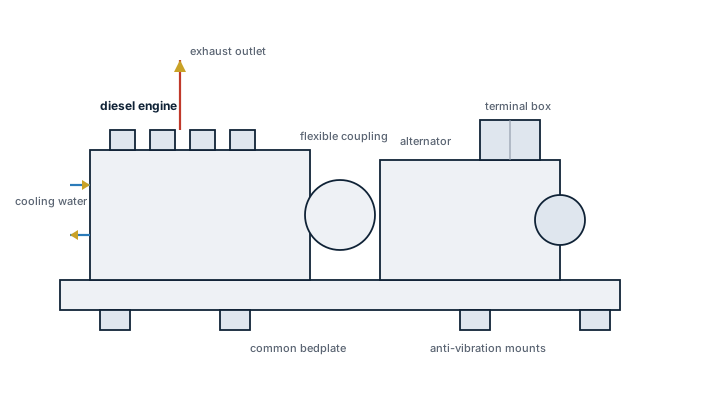
Most ships carry two to four gensets so load can be shared, one unit can be taken out for overhaul without losing redundancy, and sets can be run in parallel when peak load from cargo pumps, bow thruster or mooring winches exceeds what one machine can carry alone.
Main Components
Prime mover
A medium-speed, four-stroke diesel engine, typically running 720-1000 rpm on a 50 Hz ship or 900-1200 rpm on 60 Hz, with rated speed chosen to divide evenly into the required frequency by the alternator's pole count.
Alternator
A brushless synchronous alternator with an automatic voltage regulator (AVR) that holds output voltage constant as load changes and supplies the excitation needed for parallel operation.
Governor
Controls fuel rack position to hold speed, and therefore frequency, within class limits under sudden load changes. Most newer installations use electronic governors integrated with the power management system rather than the older mechanical-hydraulic type.
Control and protection panel
Houses synchronizing equipment, protection relays for reverse power, overcurrent, earth fault and over/under frequency, and the interface to the ship's power management system (PMS).
Cooling, starting and exhaust
Jacket water and charge air cooling circuits, a compressed-air or electric starting system, and an exhaust line with silencer and, on newer tonnage, selective catalytic reduction (SCR) or exhaust gas recirculation (EGR) for NOx control.
Selection and Sizing
- Rated output in kW at a stated power factor, usually 0.8, since alternators are rated in kVA
- Voltage and frequency: 440 V / 60 Hz is common on many trading vessels, 690 V on ships with large electric propulsion or thruster loads
- Number of sets versus redundancy required, balancing capital cost against the ability to lose one set and still cover essential load
- Fuel flexibility: MDO/MGO only, dual-fuel capability, or heavy fuel oil capable with the necessary treatment plant
Regulations and Class
NOx emissions fall under MARPOL Annex VI and are certified per engine through an EIAPP certificate confirming compliance with the applicable Tier limit for the ship's construction date and operating area. Classification societies require that gensets can be paralleled safely, that load-sharing and load-shedding logic is proven, and that the vessel can recover from a full blackout within a defined time. Periodic survey covers governor response, protection relay testing and insulation resistance of the windings.
Typical Faults
| Fault | Cause | Consequence |
|---|---|---|
| Wet stacking | Prolonged running at low load, common when oversized sets cover light harbour load | Unburnt fuel and carbon foul the turbocharger, exhaust and injectors |
| Failed synchronizing or reverse power trip | Governor droop mismatch or AVR fault between paralleled sets | Set trips offline, remaining sets can overload, risk of blackout |
| High jacket water temperature alarm | Cooler fouling or seawater pump failure | Automatic load reduction or shutdown to prevent engine damage |
| Falling insulation resistance | Moisture or oil vapour ingress into alternator windings | Earth fault trip, risk of winding failure if not dried out and corrected |
What to Look for in a Supplier
- Engine and alternator already offered as a matched, type-tested package rather than assembled from unrelated components
- Valid EIAPP certification for the NOx tier the ship needs, with documentation the flag state will accept
- A service and spares network reaching the vessel's actual trading area, not just the country of manufacture
- Published noise and vibration data compatible with the engine room's resilient mounting arrangement
- A control system that integrates cleanly with the vessel's existing power management system
A genset that spends most of its life lightly loaded in port will foul faster than one working near its rated output; rotating duty between sets and avoiding permanent light-load running on one machine saves far more maintenance than any oil additive.