"> Shore Connection Box - Equipment Database

Shore Connection Box

medium 3 models total

A shore connection box isolates the ship's electrical network from its own generators and ties it instead to a shore supply, so engines can be shut down completely while alongside instead of idling to hold hotel load.

Read more — Shore Connection Box explained

What makes this type

The shore connection box is the interface point where a vessel's electrical distribution system can be switched from its own generators to a shore-side power supply, commonly called cold ironing. Unlike a simple socket, it contains the switching, protection and interlocking needed to guarantee that ship and shore sources are never connected together at the same time. Where the category as a whole covers generation, this specific unit is about the handover: making sure the changeover happens without a blackout and without back-feeding shore cables that were never designed to carry ship-generated current.
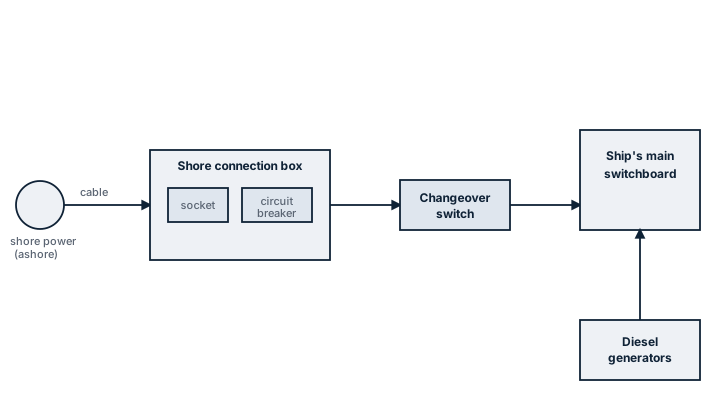
Shore connection box, power flow
Flow diagram of a shore connection box showing shore power arriving by cable at the socket and circuit breaker, passing through a changeover switch to the ship's main switchboard, which is otherwise fed by the diesel generators.

Main components

Connector assembly

The physical plug and socket, built to a recognised marine shore connection standard so that different ports and different ships can mate with the same hardware. On larger vessels this is a high-voltage connector rated for several thousand volts; on coastal and harbour craft it is often a low-voltage industrial connector.

Changeover switchgear

A mechanically or electrically interlocked switch that only permits shore power to close once the ship's generator breakers are open, and vice versa. This is the safety core of the box.

Protection relays

Over/under voltage, over/under frequency and earth fault protection, because shore supply quality varies far more than a ship's own generators.

Frequency and voltage matching

Where shore frequency does not match the ship's own (50 Hz shore supply feeding a 60 Hz vessel, or the reverse), a frequency converter sits between the box and the ship's switchboard. Voltage transformers cover the gap where shore voltage does not match ship voltage directly.

Earthing and bonding link

A dedicated earth conductor that bonds ship and shore hull potential before power is connected, preventing stray current corrosion and step-touch hazards on deck.

Selection / sizing

  • Load to be carried while alongside (hotel load, reefer plugs, cargo pumps if applicable) sets the current rating.
  • Shore supply voltage and frequency available at the intended ports of call.
  • Connector standard expected by the terminal or berth.
  • Cable length and whether a motorised cable reel is needed for cable management.
  • Space and weight for the frequency converter, which is often the largest single item in the installation.

Regulations / Class

The high-voltage shore connection interface is standardised jointly by IEC, ISO and IEEE under IEC/ISO/IEEE 80005-1, covering connector geometry, interlocking sequence and safety earthing. MARPOL Annex VI does not mandate cold ironing directly but is the regulatory driver behind port and flag state incentives to fit it, since running generators alongside is a source of the emissions the annex targets. Where a class society issues a cold ironing notation, it will require type testing of the interlock logic and periodic survey of the connector and protection settings.

Typical faults

FaultCauseConsequence
Interlock bypassed or defeatedCrew disables interlock to speed up connectionRisk of paralleling ship and shore sources out of phase, tripping both networks
Connector pittingRepeated hot mating, salt spray, poor cleaningRising contact resistance, local heating, eventual burn-through
Earth link connected after powerWrong sequence during connectionHull potential difference during make-up, corrosion and shock risk
Frequency converter faultOverload or cooling fan failureLoss of shore power, forced return to generators

What to look for in a supplier

  • Certified compliance with IEC/ISO/IEEE 80005-1 rather than a proprietary connector design.
  • Documented interlock logic that can be tested and verified during commissioning, not a black box.
  • Track record supplying the specific port infrastructure the vessel actually trades to.
  • Service support for the frequency converter, which is the component most likely to need specialist repair.

Never treat the interlock as optional even under time pressure at the berth. A wrong-sequence connection can trip switchboards on both the ship and the shore grid, and the yard or terminal will remember which vessel did it.

30 yr
Typical Lifetime

Typical Manufacturers

ABB Siemens Cavotec

3 manufacturers · 3 models

ABB

1
ABB Shore Connection System unverified
· Shore power connection box
Strengths
  • Proven ABB reliability with long service life in harsh marine environments
  • Integrated fault detection, earth‑leakage monitoring and remote diagnostics
  • Modular design allows scalable current/voltage ratings to match vessel size
  • Complies with IEC 60309 and IEC 60945 marine electrical standards out of the box
  • Compact footprint simplifies installation in limited dockside space
Weaknesses
  • Higher capital cost compared with generic, non‑marine‑rated connectors
  • Installation requires qualified ABB‑approved electricians and specific cable infrastructure
  • Limited to the current/voltage ratings offered in the product line – may need multiple units for very large ships
  • Spare parts inventory is vendor‑specific, potentially increasing lead times
Typical Vessels: Cruise shipContainer vesselTankerRo‑Ro ferryLNG carrier
Decision Guide: Choose if: you need a certified, marine‑grade shore power interface for vessels >5 MW, require built‑in monitoring and remote support, and operate in ports with strict emission controls. Avoid if: the vessel’s power demand is low (<1 MW), budget constraints dominate, or existing dock infrastructure cannot accommodate ABB’s cable/connectors without major upgrades.
Use Cases: Typically deployed on large passenger liners and cargo ships that plug into shore electricity while berthed to eliminate auxiliary diesel generation, thereby reducing emissions and fuel consumption. Also used in ports offering high‑capacity cold‑ironing services for fast turnaround of high‑power vessels.

ABB Marine (Finland/Switzerland)

1
Onshore Power Supply (OPS)
1-20 MVA · Shore-to-Ship Power · Shore connection box with integrated transformer and frequency converter
Voltage: 6.6kV / 11kV
Type
Shore Connection System
Size Range
  • OPS LV
  • OPS MV
Construction
Shore connection box, transformer, frequency converter
Common Failures & Inspection Points
  • Connection interface issues
  • Transformer overload
  • Frequency converter failure
Service: Standard shore connection maintenance.
Spare Parts: ABB Marine. Lead time: 3-6 weeks.
Strengths
  • Integrated transformer + frequency converter in one compact unit simplifies installation
  • Modular LV and MV versions allow matching the power rating of a wide range of ships
  • High conversion efficiency (typically >95%) reduces losses and emissions
  • Built‑in monitoring, diagnostics and remote service via ABB Marine Suite
  • Designed to meet IEC/ISO shore‑power standards for safety and interoperability
Weaknesses
  • Significant upfront capital cost compared with basic static connectors
  • Requires compatible ship‑side power electronics (e.g., ABB SPM or equivalent)
  • Installation demands dedicated shore infrastructure and possible grid upgrades
  • Maximum rating (≈10 MW) may be insufficient for the largest cruise ships or LNG carriers
  • Transformer overload risk if vessel demand exceeds system rating without proper load management
Typical Vessels: Cruise shipFerryContainer vesselProduct tankerOffshore supply vessel
Decision Guide: Choose if the vessel regularly calls at ports equipped with shore power, aims to cut fuel use and emissions, has compatible ship‑side equipment, and can justify the capital outlay for a proven ABB solution. Avoid if the vessel lacks access to shore‑power infrastructure, operates on routes without grid support, or requires power beyond the OPS maximum rating.
Use Cases: Cold‑ironing of cruise ships in European ports (e.g., Rotterdam, Oslo), ferry terminals in Scandinavia, container berths on the US East Coast where shore‑power is mandated, and offshore supply vessels docking at oil platforms that provide grid power for auxiliary loads.

Cavotec (Switzerland/Sweden)

1
Shore Power Connection (Cold Ironing)
1-20 MVA · Shore-to-Ship Power Connection · Shore Power Connection Box
Voltage: 6.6kV / 11kV / 440V
Type
Shore Connection / Cold Ironing System
Size Range
  • SC 440V
  • SC 6.6kV
  • SC 11kV
Drive Type
N/A (passive connection)
Construction
Shore connection box, cable management, frequency converter (50/60 Hz), transformer
Common Failures & Inspection Points
  • Connection plug/socket wear from repeated mating
  • Cable insulation damage from handling
  • Interlocking mechanism failure
  • Shore-side frequency converter issues (50↔60 Hz)
  • Earth fault from wet connection
Service: Connection plug inspection before each use. Cable insulation test annually. Interlocking mechanism test quarterly. IEC/IEEE 80005-1 compliance check.
Spare Parts: Cavotec (Lugano, Switzerland). Lead time: 3-6 weeks. Connection plugs: 4-8 weeks.
Strengths
  • Three voltage families (440 V, 6.6 kV, 11 kV) cover most ship power requirements
  • Built‑in frequency converter enables seamless 50 Hz ↔ 60 Hz compatibility
  • Compact passive design with no moving parts reduces routine maintenance
  • Integrated cable handling and interlock system simplifies safe mating/demating
  • IEC/IEEE 80005‑1 compliance ensures interoperability across ports and vessels
Weaknesses
  • Only AC supply; ships requiring DC cold ironing need additional equipment
  • Requires a compatible ship‑side inlet and matching voltage rating
  • Interlocking mechanism can wear with frequent use, leading to occasional failures
  • Higher‑voltage (6.6 kV/11 kV) units have larger footprint and heavier civil works
  • Initial capital cost is higher than basic plug‑type connectors
Typical Vessels: Container shipsCruise linersRo‑Ro ferriesLNG carriers (with compatible AC systems)Offshore supply vessels
Certifications: IEC/IEEE 80005-1DNV GL Type Approval
Decision Guide: Choose if you need a flexible, standards‑compliant shore power solution that can handle multiple voltage levels and frequency conversion with integrated cable management. Avoid if the vessel only accepts DC shore power, budget constraints are tight, or space for high‑voltage equipment is limited.
Use Cases: Deployed in emission‑control ports to provide zero‑emission berthing for large commercial vessels; common in European hub ports (e.g., Rotterdam, Hamburg) and North American cruise terminals where regulatory pressure drives cold ironing adoption.