Towing Winch
A towing winch pays out and hauls in wire under controlled tension rather than simply holding or releasing it, which is what separates it from a fixed towing hook and from an ordinary mooring winch that is never rated for the shock loads a towline sees underway.
What to check on a Towing Winch.
58 models from Karmøy Winch in Towing Winch. Below: the full model list.
What Sets a Towing Winch Apart
The defining feature of a towing winch is its ability to render, paying out wire under load in a controlled way when the towline sees a sudden surge, then hauling back in once the load eases. A fixed towing hook has no such capability, it either holds the line or releases it in one movement, and a standard mooring winch is not built for the dynamic shock loading a towline generates as a tug works a ship in a seaway. Most towing winches also offer a constant-tension mode, holding a set line tension automatically as the towed vessel moves relative to the tug, which a simple brake-only winch cannot do.
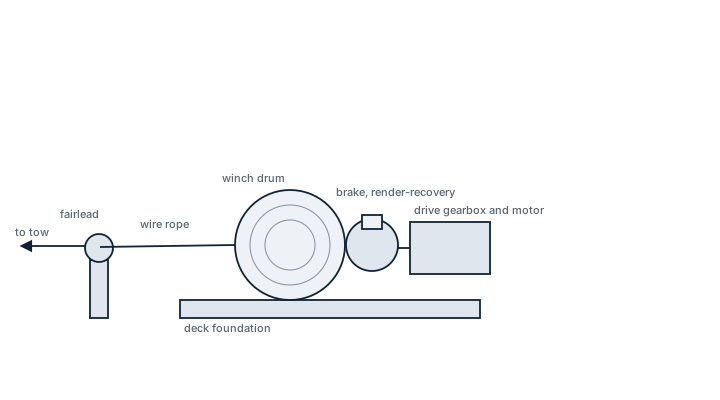
Legend
- winch drum
- brake, render-recovery
- drive gearbox and motor
- to tow
- fairlead
- wire rope
- deck foundation
Main Components
- Drum – single or split, sized for the towline and, on many designs, a separate pennant or guide wire.
- Brake – band or disc, rated to hold the towline at a defined percentage above maximum expected pull.
- Drive – hydraulic or electric motor, sized for both hauling speed and render/recover response.
- Level wind and spooling gear – keeps the wire laying evenly across the drum under load.
- Load cell or tension monitoring – feeds the constant-tension control loop and gives the operator a live reading.
- Emergency quick release – drops the load fast if the towline must be let go in an emergency.
- Towline and fairlead – wire rope construction chosen for flexibility and resistance to crushing, run out over a stern roller or fairlead.
Selection and Sizing
Brake holding capacity has to exceed the towline's breaking strength by the margin required for the vessel's towing or escort notation, not just match the tug's bollard pull. Drum capacity is set by wire diameter and the length needed for the trade the tug works in, and the rendering speed range and constant-tension band both need to suit the sea states expected, since an escort tug working at speed alongside a large ship sees very different dynamics from a harbour tug on a short line. These duty differences are exactly what separates an escort-rated winch from a basic harbour towing winch of similar drum size.
Regulations and Class
Class towing and escort notations require the winch brake to be tested and certified to hold at a defined margin above the rated towline pull, and the towline itself carries its own certification with periodic proof load testing. Where a winch is fitted as part of a ship's emergency towing arrangement rather than a tug's working gear, SOLAS Chapter II-1 requirements for tankers of 20,000 dwt and above apply, including the ability to bring the arrangement into use quickly and, on many designs, without needing external power.
Read the full guide
Typical Faults
- Brake lining wear or glazing – reduces holding capacity and risks uncontrolled paying-out under load exactly when the brake is needed most.
- Fatigue or broken wires at drum crossover points – the towline can part suddenly under a shock load that a visually intact rope should have survived.
- Level wind misalignment – wire piles up and crushes itself on the drum, reducing both capacity and rope life.
- Faulty hydraulic valve in constant-tension mode – tension hunts up and down, generating snatch loads on the towline instead of absorbing them.
- Load cell drift – the operator sees an inaccurate tension reading and either over- or under-tensions the tow without realising it.
What to Look for in a Supplier
- A brake test certificate showing holding capacity at the winch's rated load, not just the drive motor's output.
- A towline specification matched to the drum grooving and the constant-tension control system, since not every wire construction suits every winch.
- Service support for the hydraulic power unit specific to the winch, rather than a generic hydraulics contractor.
- Spare brake linings and load cell calibration held or readily available.
Test render and recover under an actual load before relying on constant-tension mode in service; a winch that behaves correctly on a static bench test can still hunt or snatch once real wave-induced loads are on the line.
Models in this type.
The best-documented model of each manufacturer first, then the next — 58 of 58 models in Towing Winch. Every row links to full specifications, documents and service notes.
Manufacturers.
All 21 manufacturers with models of Towing Winch. Names with a manufacturer page open it; the others open a search across the full library.
All manufacturers in the libraryAlso in Towing Equipment.
The other equipment types in this category.
Write to us about this model — the answer comes by e-mail.
Name the make and the model and what the job is: a spare, a service call, a second opinion on a data sheet. We answer by e-mail.
No details at hand? A photo of the rating plate or the part is enough — simply attach it to the request.
Questions that come up with this equipment.
Is Towing Winch data free?
Yes. Every model page, every guide and every datasheet for this type is readable without an account. An account adds saved searches and requests, nothing is taken away.
My model is missing — what now?
Send us the nameplate. We identify it by hand, add it to the library, and if you need a part or a service, the request is already on our desk.
Can you source a Towing Winch part?
Yes. Tell us the manufacturer, the model and what you need — a person reads every request and replies by e-mail.