What to check on a Towing Hook.
A towing hook is the load-bearing connection point on a tug or towing vessel where the towline attaches, distinguished from a towing winch by one property: it can release the towline instantly, even under full load. A winch pays out or holds line under tension but cannot slip it in an emergency without unspooling; a hook opens in a fraction of a second when the trigger is pulled. That single function exists for one reason - girting. If a tow swings the tug's stern around faster than the tug can…
What defines a towing hook
A towing hook is the load-bearing connection point on a tug or towing vessel where the towline attaches, distinguished from a towing winch by one property: it can release the towline instantly, even under full load. A winch pays out or holds line under tension but cannot slip it in an emergency without unspooling; a hook opens in a fraction of a second when the trigger is pulled. That single function exists for one reason - girting. If a tow swings the tug's stern around faster than the tug can counter, the towline pulls the tug sideways and can capsize it within seconds. A quick-release hook is the only thing standing between that situation and a lost vessel.
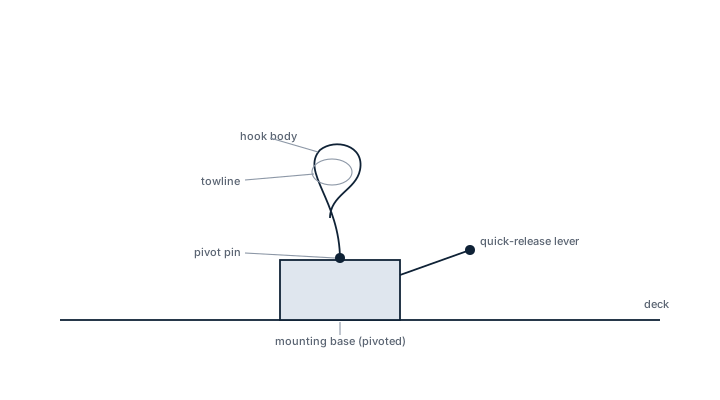
Hooks are fitted low and close to midships on harbour and escort tugs so the towline geometry stays predictable as the tug manoeuvres. On larger ocean tugs the hook is often replaced or supplemented by a towing winch with a load-limiting brake, because long-distance tows need controlled paying-out rather than a single release point.
Main components
Hook body
Forged or cast steel body shaped to retain the towline bridle or pennant under the working load while allowing it to swing through a wide arc as the tug changes heading relative to the tow.
Release mechanism
A spring-loaded or cam-operated latch, tripped either manually by a lever at the hook or remotely from the wheelhouse by a pneumatic, hydraulic, or electric actuator. Remote release is standard on escort tugs, since the skipper needs to release before reaching the hook physically.
Shock absorber
A spring or rubber-compression unit absorbing the snatch load when the towline suddenly comes taut, protecting both the hook and the tug's structure from impact loading.
Pedestal and foundation
The hook sits on a reinforced foundation that spreads the towing load into the tug's structure; this foundation is engineered as part of the hull, not bolted on as an afterthought.
Load indicator
Many modern hooks carry a load pin or load cell feeding a readout to the wheelhouse, letting the crew see towline tension rather than judge it by feel.
Selection and sizing
Sizing starts from the tug's bollard pull, not from the towline diameter. A hook rated below the tug's own bollard pull can be overloaded by the tug's engines alone, before the tow even resists. Typical points to check:
- Safe working load (SWL) versus the tug's maximum bollard pull, with margin for dynamic snatch loads that can spike well above steady-state tension.
- Release under full load - the mechanism must open reliably at maximum SWL, not just at rest.
- Arc of movement - the hook must swing freely through the angles the tug will actually work at, including towing on the beam during escort work.
- Remote release response time, particularly for escort and harbour tugs operating close to large vessels.
- Corrosion protection for a component that lives in permanent salt spray.
Regulations and class
There is no SOLAS chapter dedicated to towing hooks; the governing requirements sit in class society tug notations. DNV, ABS, and Lloyd's Register each publish rules for towing and escort tug notations that specify proof load testing, typically to 1.5 times SWL, at survey intervals the class society sets - commonly around every four to five years, alongside annual visual inspection and function testing of the quick-release mechanism. Flag state and port state control also check that the quick-release actually works during tug certification, since a seized hook is a known cause of fatal capsizes.
Typical faults
| Fault | Cause | Consequence |
|---|---|---|
| Release mechanism will not trip under load | Corrosion, lack of lubrication, or paint buildup on the trigger linkage | Tug cannot slip the tow during girting - leading cause of tug capsize |
| Premature or accidental release | Worn latch surfaces or a damaged spring | Loss of tow control, possible loss of towline overboard |
| Shock absorber seized or fatigued | Corrosion of the spring housing or metal fatigue after repeated snatch loads | Full snatch load transmitted directly into the hull structure |
| Pin or bushing wear | Normal service wear without scheduled replacement | Misalignment of the towline lead, uneven load distribution |
What to look for in a supplier
- Current proof load test certificate matching the class notation the tug carries.
- Documented quick-release performance under full rated load, not just a bench test at rest.
- Spare parts availability for the release mechanism, since this is the part that fails first.
- Class approval for the specific tug notation the vessel is certified under.
- A maintenance and function-test schedule the supplier can support after delivery, not just installation.
Test the quick-release both dry and under simulated load on the same day the towline is rigged - a hook that releases cleanly on the bench can still seize once salt and paint have worked into the trigger linkage over a season.