Cargo Heater/Vaporizer
A cargo vaporizer turns liquefied gas back into vapour by adding heat under controlled pressure — undersize it and the ship cannot maintain vapour return balance during discharge; oversize the heat input and the same unit can flash more liquid than the line is rated to carry.
What to check on a Cargo Heater/Vaporizer.
2 models from Wärtsilä in Cargo Heater/Vaporizer. Below: the full model list.
What this type is
A cargo heater/vaporizer supplies heat to liquefied gas cargo, either to raise a semi-refrigerated cargo's temperature before discharge or to deliberately convert liquid cargo to vapour, most commonly for vapour-return balancing during loading and discharging, or for gas-burning propulsion where cargo boil-off is not sufficient. It is distinct from the cargo pumps and compressors that move the gas — the vaporizer's job is purely thermal, changing the cargo's phase or temperature, and it sits in the cargo piping as a heat exchanger rather than a mover.
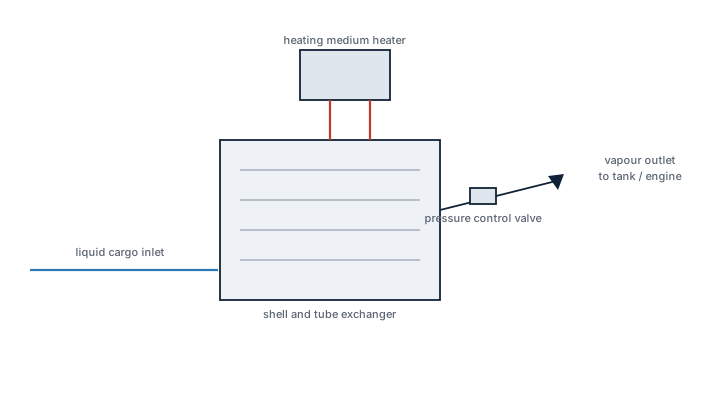
Main components
- Heat exchanger core — typically a shell-and-tube or plate design, with the cargo on one side and a heating medium (seawater, glycol, or steam depending on cargo and ambient conditions) on the other.
- Heating medium circuit — pumps, an intermediate glycol loop where direct seawater contact with the cargo side is unacceptable, and its own heater or waste-heat source.
- Pressure and temperature control — regulates heat input to keep the vaporized cargo within the pressure the downstream piping and compressors are rated for.
- Safety devices — relief valves, high-pressure and low-temperature trips, and isolation valves that shut the unit in on an abnormal condition.
Selection and sizing
Sizing is set by the required vapour flow rate for the cargo operation — vapour return during loading, boil-off gas supply to a dual-fuel engine, or discharge heating rate — against the cargo's latent heat of vaporization and the temperature difference available from the heating medium. The heating medium choice depends on cargo type: seawater is adequate for many LPG grades in most climates, but very low-temperature cargoes such as LNG at atmospheric pressure typically need an intermediate glycol or similar medium to avoid freezing the heating side.
| Cargo type | Typical heating medium | Key constraint |
|---|---|---|
| LPG (propane/butane) | Seawater, sometimes glycol | Ambient seawater temperature margin |
| Ammonia | Glycol or steam | Material compatibility |
| LNG | Glycol/intermediate loop | Avoiding freeze-up on the heating side |
Regulations and class
Gas carrier cargo systems, vaporizers included, fall under the IGC Code (or IGF Code where the vaporizer feeds gas fuel to the engine), which sets requirements for material selection, relief protection, and separation of cargo and heating-medium circuits so a leak in the heat exchanger cannot let cargo escape into the sea or the heating system contaminate the cargo. Class rules require periodic survey of the pressure-containing parts and function testing of the associated safety trips; exact intervals follow the society's gas carrier survey scheme.
Read the full guide
Typical faults
- Heat exchanger tube leak allowing cargo into the heating medium (or the reverse) — a serious event caught by the pressure/composition monitoring the IGC Code requires on the heating circuit.
- Icing on the heating side with very cold cargoes, reducing heat transfer and vaporizer output over the course of an operation.
- Fouling or scaling on the seawater side over time, quietly derating the unit's capacity without an obvious alarm.
- Control valve hunting on cargo pressure, causing swings in vapour output that upset the terminal's vapour balance during loading.
What to look for in a supplier
- Material certification for the specific cargo grades the vessel carries, including compatibility with ammonia or other aggressive cargoes if applicable.
- IGC/IGF Code compliance documentation for the exact service — cargo heating versus fuel gas vaporizing are not always interchangeable duty.
- Heating medium circuit design suited to the vessel's trading temperature range, not just the cargo's design case.
- Leak-detection and isolation philosophy for the heat exchanger consistent with the vessel's cargo control system.
Check the heating-medium side for cargo contamination at every survey opportunity, not only after an alarm — a slow tube leak in a vaporizer can run undetected for a long time if the only check is the alarm that is supposed to catch it.
Models in this type.
The best-documented model of each manufacturer first, then the next — 2 of 2 models in Cargo Heater/Vaporizer. Every row links to full specifications, documents and service notes.
Manufacturers.
All 6 manufacturers with models of Cargo Heater/Vaporizer. Names with a manufacturer page open it; the others open a search across the full library.
All manufacturersAlso in Gas Carrier Cargo Systems.
The other equipment types in this category.
One request. A person reads it and replies by e-mail.
Tell us the manufacturer, the model and what you need — a part, a service call, a second opinion. A person reads every request and replies by e-mail.
No details at hand? A photo of the rating plate or the part is enough — simply attach it to the request.
Three things people ask first.
Is Cargo Heater/Vaporizer data free?
Yes. Every model page, every guide and every datasheet for this type is readable without an account. An account adds saved searches and requests, nothing is taken away.
My model is missing — what now?
Send us the nameplate. We identify it by hand, add it to the library, and if you need a part or a service, the request is already on our desk.
Can you source a Cargo Heater/Vaporizer part?
Yes. Tell us the manufacturer, the model and what you need — a person reads every request and replies by e-mail.