"> Cargo Heater/Vaporizer - Equipment Database

Cargo Heater/Vaporizer

medium 7 models total

A cargo vaporizer turns liquefied gas back into vapour by adding heat under controlled pressure — undersize it and the ship cannot maintain vapour return balance during discharge; oversize the heat input and the same unit can flash more liquid than the line is rated to carry.

Read more — Cargo Heater/Vaporizer explained

What this type is

A cargo heater/vaporizer supplies heat to liquefied gas cargo, either to raise a semi-refrigerated cargo's temperature before discharge or to deliberately convert liquid cargo to vapour, most commonly for vapour-return balancing during loading and discharging, or for gas-burning propulsion where cargo boil-off is not sufficient. It is distinct from the cargo pumps and compressors that move the gas — the vaporizer's job is purely thermal, changing the cargo's phase or temperature, and it sits in the cargo piping as a heat exchanger rather than a mover.
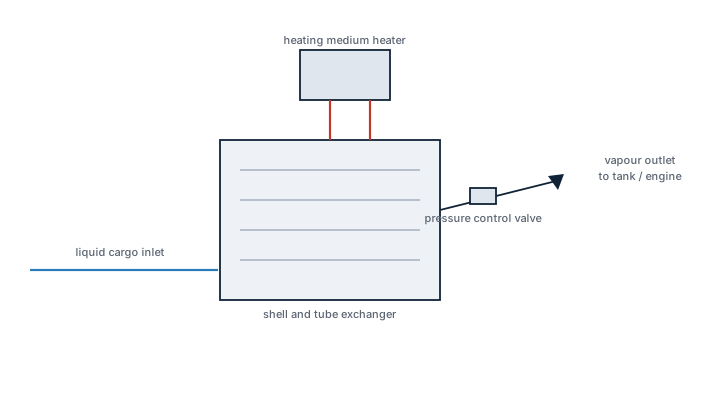
Cargo heater / vaporizer flow
Flow through a cargo vaporizer: liquid cargo entering a shell-and-tube exchanger, a heating medium loop from a heater warming the tubes, the pressure control valve, and vapour leaving to the cargo tank or engine.

Main components

  • Heat exchanger core — typically a shell-and-tube or plate design, with the cargo on one side and a heating medium (seawater, glycol, or steam depending on cargo and ambient conditions) on the other.
  • Heating medium circuit — pumps, an intermediate glycol loop where direct seawater contact with the cargo side is unacceptable, and its own heater or waste-heat source.
  • Pressure and temperature control — regulates heat input to keep the vaporized cargo within the pressure the downstream piping and compressors are rated for.
  • Safety devices — relief valves, high-pressure and low-temperature trips, and isolation valves that shut the unit in on an abnormal condition.

Selection and sizing

Sizing is set by the required vapour flow rate for the cargo operation — vapour return during loading, boil-off gas supply to a dual-fuel engine, or discharge heating rate — against the cargo's latent heat of vaporization and the temperature difference available from the heating medium. The heating medium choice depends on cargo type: seawater is adequate for many LPG grades in most climates, but very low-temperature cargoes such as LNG at atmospheric pressure typically need an intermediate glycol or similar medium to avoid freezing the heating side.

Cargo typeTypical heating mediumKey constraint
LPG (propane/butane)Seawater, sometimes glycolAmbient seawater temperature margin
AmmoniaGlycol or steamMaterial compatibility
LNGGlycol/intermediate loopAvoiding freeze-up on the heating side

Regulations and class

Gas carrier cargo systems, vaporizers included, fall under the IGC Code (or IGF Code where the vaporizer feeds gas fuel to the engine), which sets requirements for material selection, relief protection, and separation of cargo and heating-medium circuits so a leak in the heat exchanger cannot let cargo escape into the sea or the heating system contaminate the cargo. Class rules require periodic survey of the pressure-containing parts and function testing of the associated safety trips; exact intervals follow the society's gas carrier survey scheme.

Typical faults

  • Heat exchanger tube leak allowing cargo into the heating medium (or the reverse) — a serious event caught by the pressure/composition monitoring the IGC Code requires on the heating circuit.
  • Icing on the heating side with very cold cargoes, reducing heat transfer and vaporizer output over the course of an operation.
  • Fouling or scaling on the seawater side over time, quietly derating the unit's capacity without an obvious alarm.
  • Control valve hunting on cargo pressure, causing swings in vapour output that upset the terminal's vapour balance during loading.

What to look for in a supplier

  • Material certification for the specific cargo grades the vessel carries, including compatibility with ammonia or other aggressive cargoes if applicable.
  • IGC/IGF Code compliance documentation for the exact service — cargo heating versus fuel gas vaporizing are not always interchangeable duty.
  • Heating medium circuit design suited to the vessel's trading temperature range, not just the cargo's design case.
  • Leak-detection and isolation philosophy for the heat exchanger consistent with the vessel's cargo control system.

Check the heating-medium side for cargo contamination at every survey opportunity, not only after an alarm — a slow tube leak in a vaporizer can run undetected for a long time if the only check is the alarm that is supposed to catch it.

4 manufacturers · 7 models

TGE Marine

3
TGE Marine LNG Vaporizer Type A unverified
· LNG / LPG
System type
heater_vaporizer
Shell and tube LNG vaporizer
TGE Marine LPG Heater Type B unverified
· LNG / LPG
System type
heater_vaporizer
Cargo heater for LPG carriers
TGE Marine Ethylene Vaporizer unverified
· LNG / LPG
System type
heater_vaporizer
Low-temp vaporizer for ethylene

Wärtsilä

2
Hamworthy (Wartsila) Hamworthy Cargo Heater
Hamworthy Cargo Heater
variable · LNG / LPG / Gas Cargo · steam‑heated shell‑tube vaporizer
Type
shell_tube_heater
Common Failures & Inspection Points
  • Tube bundle corrosion
  • Steam trap failure
  • Temperature control malfunction
Service: Shell-and-tube type. Tube inspection every 2.5 years.
Spare Parts: Hamworthy (Wartsila): Spare parts from manufacturer. Lead time: 3-8 weeks. Gaskets and valve inserts to be held on board.
Strengths
  • High heat‑transfer efficiency due to shell‑and‑tube design
  • Robust steel construction with a long service record on gas carriers
  • Tube bundle can be inspected and serviced every 2.5 years, simplifying maintenance
  • Integrates directly with existing ship steam systems – no extra power plant needed
  • Proven reliability in harsh marine environments
Weaknesses
  • Susceptible to tube‑bundle corrosion if cargo water content is high
  • Steam trap failures can cause efficiency loss and require regular checks
  • Temperature control less precise than modern electric or oil‑fired heaters
  • Relatively large footprint compared with compact electric units
  • Longer start‑up time due to steam‑up requirements
Typical Vessels: LPG CarrierChemical TankerGas Carrier
Decision Guide: Choose if: you have an existing ship‑board steam plant, need a proven and robust heater for LPG or chemical cargoes, and value ease of inspection. Avoid if: you lack steam supply, require rapid temperature changes, or prefer low‑maintenance electric heating solutions.
Use Cases: Used to heat liquid LPG during discharge to prevent wax formation, maintain cargo temperature on long voyages, and vaporise chemicals for transfer operations on gas carriers and chemical tankers.
Wärtsilä LNG Fuel Gas Vaporizer unverified
· LNG
System type
heater_vaporizer
Medium
LNG
Forced vaporizer for LNG fuel gas supply

Alfa Laval

1
Alfa Laval Cargo Vaporizer
variable · LNG / LPG / Gas Cargo · plate heat exchanger vaporizer
Type
plate_vaporizer
Common Failures & Inspection Points
  • Plate gasket failure
  • Fouling from cargo impurities
  • Temperature control valve stiction
Service: Plate heat exchanger design. Gasket inspection annually.
Spare Parts: Alfa Laval: Spare parts from manufacturer. Lead time: 3-8 weeks. Gaskets and valve inserts to be held on board.
Strengths
  • High heat transfer efficiency due to large plate surface area
  • Compact footprint compared with shell‑and‑tube vaporizers
  • Modular plate and gasket design enables quick inspection and replacement
  • Low pressure drop across the exchanger, improving steam/heat source performance
  • Proven track record on LPG carriers worldwide
Weaknesses
  • Plate gaskets can deteriorate, requiring annual inspection to avoid leaks
  • Susceptible to fouling if cargo contains solid impurities or heavy aromatics
  • Temperature control valve may experience stiction, affecting precise vaporization
  • Scaling of capacity is limited by plate bundle size; very large ships may need multiple units
Typical Vessels: LPG CarrierChemical TankerProduct Gas Carrier (e.g., ethylene, propylene)
Certifications: IMO D-2USCG Type ApprovalDNV
Decision Guide: Choose if: you need a compact, high‑efficiency vaporizer for LPG or volatile chemical cargoes with regular maintenance access. Avoid if: the cargo is highly fouling or contains large solid particles, or if the vessel requires extremely high capacity that exceeds plate bundle limits.
Use Cases: Installed on LPG carriers to convert liquid propane/butane to gas for propulsion and fuel gas systems; used on chemical tankers carrying volatile liquids (e.g., ethylene) where rapid vaporization is required for cargo handling and off‑loading operations.

Kelvion

1
Kelvion Marine Vaporizer
variable · LNG / LPG / Gas Cargo · plate vaporizer
Type
plate_vaporizer
Origin
Germany
Common Failures & Inspection Points
  • Gasket failure
  • Plate corrosion
  • Flow maldistribution
Service: German heat exchanger specialist. Annual gasket check.
Spare Parts: Kelvion: Spare parts from manufacturer. Lead time: 3-8 weeks. Gaskets and valve inserts to be held on board.
Strengths
  • High heat‑transfer efficiency due to thin, closely spaced plates
  • Compact footprint suitable for limited tank space on LPG carriers
  • Modular design allows easy replacement of individual plate modules
  • German‑engineered quality with proven service support from Kelvion
  • Designed for annual gasket inspection, simplifying preventive maintenance
Weaknesses
  • Gasket wear can lead to leaks; requires strict yearly inspection schedule
  • Plate surfaces are susceptible to corrosion when exposed to aggressive cargoes or seawater ingress
  • Flow maldistribution may occur if fouling is not promptly addressed
  • Initial capital cost higher than simple coil‑type vaporizers
  • Requires skilled personnel for gasket replacement and plate cleaning
Typical Vessels: LPG CarrierChemical Tanker handling LPGProduct Tanker with LPG cargoes
Decision Guide: Choose if you need a high‑efficiency, space‑saving vaporizer for LPG cargo and have the capability to perform annual gasket checks. Avoid if budget constraints preclude higher upfront cost or if the vessel operates with highly corrosive cargoes that exceed the plate material limits.
Use Cases: Installed in LPG carriers to vaporize liquefied petroleum gas during discharge or transfer operations, ensuring stable gas flow for downstream processing and propulsion systems.