What to check on a Cargo Compressor (Reciprocating).
Fully or semi-refrigerated LPG carriers need to compress cargo vapour against a wide, changing pressure ratio: high when reliquefying vapour into the cargo tank near atmospheric pressure, lower during simple vapour return to shore. A reciprocating compressor handles that range well because its displacement, and so its output, stays predictable regardless of suction pressure, unlike a centrifugal machine whose output collapses as head rises. Screw compressors compete for the mid-size range, but reciprocating machines remain common on smaller and older LPG tonnage and where ammonia or other reactive cargoes rule…
What sets reciprocating compressors apart on a gas carrier
Fully or semi-refrigerated LPG carriers need to compress cargo vapour against a wide, changing pressure ratio: high when reliquefying vapour into the cargo tank near atmospheric pressure, lower during simple vapour return to shore. A reciprocating compressor handles that range well because its displacement, and so its output, stays predictable regardless of suction pressure, unlike a centrifugal machine whose output collapses as head rises. Screw compressors compete for the mid-size range, but reciprocating machines remain common on smaller and older LPG tonnage and where ammonia or other reactive cargoes rule out the tighter rotor clearances of a screw design.
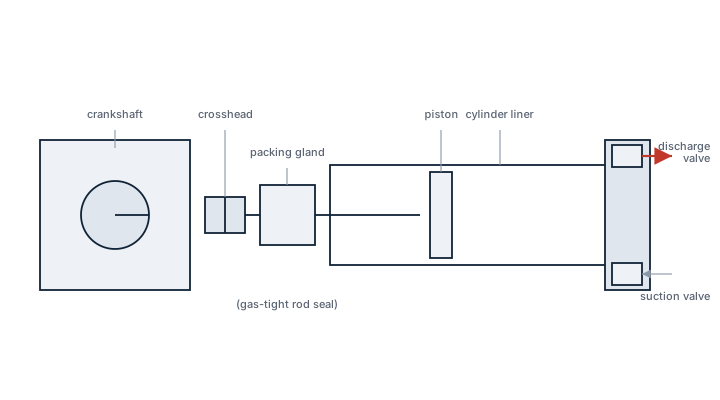
Main components
Cylinder and piston assembly
Typically a two-stage, water-cooled design, with the piston rings and cylinder liner made from materials compatible with the cargo carried; ammonia service in particular restricts material choice because it attacks copper alloys.
Suction and discharge valves
Plate or ring valves open and close on every stroke and are the component most exposed to wear and to damage from liquid carryover; a valve failure is usually the first sign of a compressor problem, audible as a change in knock pattern.
Crankcase and lubrication system
A separate, cargo-tight crankcase keeps lubricating oil away from the cargo side; oil that migrates into the cargo vapour stream contaminates the product and can also foul heat exchangers downstream.
Liquid separator (knock-out drum)
Fitted on the suction line ahead of the compressor to remove any liquid cargo carried over in the vapour, since liquid entering a reciprocating cylinder causes a hydraulic lock that can break valves, rods or even the cylinder head.
Selection and sizing
Cargo compressors are sized around the vessel's operating profile rather than a single duty point:
- Required vapour handling capacity in cubic metres per hour at the design suction and discharge pressures for loading, discharging and reliquefaction duty.
- Cargo compatibility of cylinder, valve and seal materials, particularly for ammonia, vinyl chloride or other reactive cargoes carried under the IGC Code.
- Number of stages and intercooling arrangement needed to reach the required compression ratio without excessive discharge temperature.
- Redundancy, since most gas carriers fit two or three compressors so cargo operations can continue with one machine down for maintenance.
Regulations and class
The IGC Code sets the design and material requirements for cargo compressors and their piping, including the compatibility of materials with each cargo the ship is certified to carry, listed in the ship's Certificate of Fitness. Class surveys include periodic opening up of the compressor for internal examination of valves, pistons and bearings, on an interval agreed with the class society based on running hours and manufacturer recommendation rather than a fixed calendar period alone.
Typical faults
| Fault | Consequence |
|---|---|
| Liquid carryover from a saturated knock-out drum | Hydraulic lock in the cylinder, risking a broken connecting rod or cracked cylinder head |
| Worn or broken suction/discharge valve plates | Falling volumetric efficiency and rising discharge temperature for the same load |
| Oil carryover into the cargo vapour stream | Cargo contamination and fouling of downstream heat exchangers and condensers |
| Piston rod packing gland wear | Cargo vapour leakage into the compressor room, a gas hazard requiring immediate shutdown |
| Excessive discharge temperature from a fouled intercooler | Reduced compression efficiency and accelerated valve and lubricant breakdown |
What to look for in a supplier
- Spare parts and materials certified for the specific cargo list the ship carries, not a generic industrial compressor part.
- Documented experience overhauling the exact make, since Sabroe, Burckhardt, Hamworthy and similar builders differ enough in valve and packing design to matter.
- Ability to supply piston rod packing sets sized to the actual rod, since a mismatched packing gland is a recurring source of cargo vapour leaks.
- Support for gas-freeing and purging procedures during overhaul, given the compressor room remains a hazardous area throughout the work.
Log discharge temperature and pressure at the same load point on every watch; a slow upward creep in discharge temperature at constant suction conditions is usually a valve or intercooler problem long before it trips an alarm.