Foam Extinguisher
A portable foam extinguisher works by starving a Class B fire of oxygen and cooling the fuel surface, which is why it is standard beside fuel manifolds and in engine rooms while CO2 units cover enclosed electrical spaces instead.
What to check on a Foam Extinguisher.
11 models from Amerex in Foam Extinguisher. Below: the full model list.
What Makes This Type Different
A portable foam extinguisher discharges an aqueous film-forming foam (AFFF) concentrate mixed with water and expelled by a propellant gas. The foam blanket spreads across the surface of a burning liquid, cutting off oxygen and cooling the fuel below its flash point, which makes it effective on Class B fires — fuel, oil, paint — that a water jet would simply spread. It differs from CO2 units, which smother by displacing oxygen and suit enclosed electrical or engine spaces, and from dry powder units, which knock down the flame quickly but leave no lasting vapour seal and allow re-ignition.
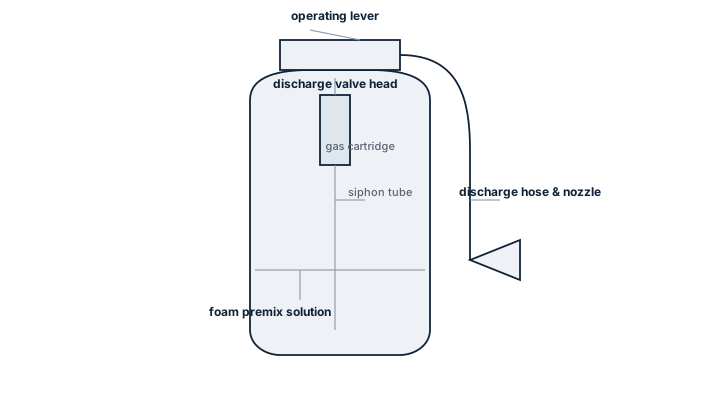
Legend
- operating lever
- discharge valve head
- siphon tube
- discharge hose & nozzle
- foam premix solution
- gas cartridge
Main Components
Cylinder and Charge
Steel cylinder holding the premixed foam concentrate and water solution, pressurised either by a stored-pressure gauge or by a separate CO2 cartridge that the operator pierces to charge the unit at the point of use.
Discharge Valve and Hose
Squeeze-grip or lever valve, short hose and a foam-making nozzle that aerates the solution as it leaves the nozzle — a plain jet nozzle without aeration wastes most of the extinguishing effect.
Read the full guide
Pressure Gauge
Fitted to stored-pressure types only; a needle in the red band means the unit will not deliver a full, sustained discharge even though it looks intact.
Mounting Bracket
Quick-release bracket at a fixed, marked location per the fire control plan — an extinguisher stowed anywhere else is a finding on both internal rounds and port state inspections.
Selection and Sizing
- Capacity: typically 9 litres for portable foam units on merchant ships, chosen to match the fire control plan's coverage for a given space, not swapped in ad hoc.
- Discharge type: stored-pressure for immediate readiness versus gas-cartridge for long-term storage in less accessible locations.
- Location: near fuel oil manifolds, purifier rooms and paint lockers, where Class B risk is highest and CO2 would be the wrong choice for a manned space.
- Foam type: AFFF versus fluorine-free formulations — several flag states and port authorities now restrict PFAS-containing AFFF, which affects what can be legally recharged.
Regulations and Class
SOLAS Ch. II-2 and the Fire Safety Systems (FSS) Code set the minimum number, type and placement of portable extinguishers per space. Each unit carries a maker's test certificate and a service due date; class and flag surveys check the annual visual inspection tag and the hydrostatic test interval, generally every five years for the cylinder, alongside the vessel's own fire control plan. A missing service tag is treated the same as a missing extinguisher during survey.
Typical Faults
| Fault | Consequence |
|---|---|
| Pressure gauge in red zone, unit not recharged | Extinguisher discharges weakly or not at all when needed |
| Foam concentrate past its shelf life | Reduced foam quality, poor blanket formation on the fuel surface |
| Safety pin missing or seal broken without record | Unit may have been partially discharged and not reported |
| Corroded cylinder base | Risk of cylinder failure under internal pressure during use |
| Nozzle blocked or aerating screen missing | Solution leaves as a jet instead of foam, poor fire knockdown |
What to Look for in a Supplier
- Servicing station approved by the extinguisher's original manufacturer and by the vessel's flag or class, with traceable service records.
- Fluorine-free foam concentrate available where AFFF is being phased out under port or flag restrictions.
- Cylinders that meet the hydrostatic test interval documented on the body stamp, not just a fresh paint job.
- Same foam type across the fleet where practical, to avoid mixing concentrates that behave differently in cold weather.
Check the pressure gauge and the tamper seal on every fire round — a foam extinguisher that looks untouched can still have a spent charge if the gauge was never read.
Models in this type.
The best-documented model of each manufacturer first, then the next — 11 of 11 models in Foam Extinguisher. Every row links to full specifications, documents and service notes.
Manufacturers.
All 13 manufacturers with models of Foam Extinguisher. Names with a manufacturer page open it; the others open a search across the full library.
All manufacturers in the libraryAlso in Portable Fire Extinguishers.
The other equipment types in this category.
Write to us about this model — the answer comes by e-mail.
Name the make and the model and what the job is: a spare, a service call, a second opinion on a data sheet. We answer by e-mail.
No details at hand? A photo of the rating plate or the part is enough — simply attach it to the request.
Questions that come up with this equipment.
Is Foam Extinguisher data free?
Yes. Every model page, every guide and every datasheet for this type is readable without an account. An account adds saved searches and requests, nothing is taken away.
My model is missing — what now?
Send us the nameplate. We identify it by hand, add it to the library, and if you need a part or a service, the request is already on our desk.
Can you source a Foam Extinguisher part?
Yes. Tell us the manufacturer, the model and what you need — a person reads every request and replies by e-mail.