DCP Extinguisher
Dry chemical powder (DCP) extinguishers knock down a fire by interrupting the chemical chain reaction rather than cooling or smothering it, giving the fastest portable knockdown against a fuel or electrical fire but leaving a corrosive residue on anything it touches.
Read more — DCP Extinguisher explained ▾
What Makes DCP Different from Other Portable Extinguishers
Dry chemical powder extinguishers discharge a fine powder, typically monoammonium phosphate (ABC powder) or sodium/potassium bicarbonate (BC powder), that interrupts the combustion chain reaction on contact with the flame. This gives DCP the fastest knockdown of any portable extinguisher type against a running liquid fire, which is why it is the standard choice for engine room bilges, fuel handling stations and workshop areas where flammable liquid fires are the main risk. Unlike CO2, DCP leaves no cooling effect and the fire can reflash if hot surfaces remain; unlike foam, it does not form a vapour-sealing blanket over a pooled liquid fire, so it is chosen for speed of knockdown rather than for securing a fire against reignition.
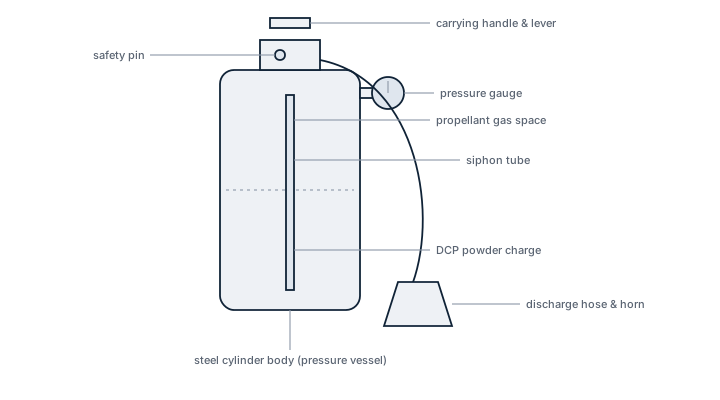
Main Components
Cylinder and Powder Charge
A steel cylinder, typically 6, 9 or 12 kg on merchant ships, holds the powder charge dry and separated from moisture -- powder that has caked from humidity ingress will not discharge properly, which is the most common in-service failure.
Pressurisation
Stored-pressure units hold the propellant gas, usually nitrogen, in the same vessel as the powder and show pressure on a gauge; cartridge-operated units keep a separate small CO2 cartridge that is pierced on operation, common on larger wheeled units.
Discharge Hose and Nozzle
A flexible hose and horn-type or fan nozzle directs the powder cloud; the nozzle must stay clear of caked powder or moisture ingress at the tip.
Powder Classification
ABC powder covers ordinary combustibles, flammable liquids and live electrical equipment; BC powder is limited to liquid and gas fires and is less common on modern tonnage since ABC covers a wider range of onboard risks with one product.
Selection Considerations
Placement and sizing follow the fire risk of the space rather than a single ship-wide standard: engine rooms, paint lockers, galleys and fuel oil purifier rooms typically carry 9-12 kg units, while accommodation spaces more often rely on water or foam types, with DCP reserved for the machinery and technical spaces where liquid and electrical fires are the real risk.
| Space | Typical Extinguisher Size |
|---|---|
| Engine room / purifier room | 9-12 kg DCP |
| Paint locker | 6-9 kg DCP |
| Galley (secondary, alongside wet chemical) | 6 kg DCP |
| Deck workshop | 6-9 kg DCP |
Regulations and Class
Portable fire extinguishers, including DCP units, must comply with SOLAS Chapter II-2 requirements for number, type and distribution, and with the Fire Safety Systems (FSS) Code, which sets minimum discharge duration and range. Each unit requires a type approval certificate, must be serviced and pressure-tested according to the manufacturer's schedule, commonly an annual visual inspection and a more thorough service or hydrostatic test at longer intervals, and is checked at every port state control and class survey against the ship's fire control plan.
Typical Faults
| Fault | Cause | Consequence |
|---|---|---|
| Caked powder, no discharge | Moisture ingress, unit stored in a humid or poorly ventilated space | Extinguisher fails when needed, only found at inspection or worse, at a fire |
| Loss of pressure | Slow leak past the gauge seal or valve seat | Reduced range and discharge time |
| Corroded cylinder | Salt air exposure without adequate coating or drainage of the mounting bracket | Condemned at survey, needs replacement |
| Missing or expired inspection tag | Servicing schedule missed | Deficiency at port state control |
What to Look for in a Supplier
- Valid type approval for the flag state and trading area the vessel operates in.
- Access to servicing agents in the ports the vessel actually calls at, for recharge and hydrostatic testing.
- Corrosion-resistant cylinder finish suited to continuous marine exposure, particularly for deck-mounted units.
- Clear compatibility of the powder type with the fire risks in each space it is assigned to, not a blanket single product for the whole ship.
Weigh every DCP cylinder against its stamped gross weight at each monthly inspection -- a stored-pressure unit can look fine on the gauge while the powder inside has caked solid, and weight is the only check that catches it.
3 manufacturers · 9 models
Gloria
3- Powder caking
- Gauge inaccuracy
- Handle mechanism wear
- SOLAS compliant and accepted for all vessel types
- Compact 9 kg weight makes it handheld yet substantial enough for effective discharge
- Effective on Class A (solid) and Class B (liquid) fires common in shipboard environments
- German engineering reputation for reliability
- Simple maintenance routine – monthly inversion to prevent powder caking
- Powder can cake if not inverted regularly, reducing discharge performance
- Pressure gauge may become inaccurate over time, requiring frequent checks
- Handle mechanism reported to wear with repeated use
- Limited effectiveness on Class C (electrical) and Class K (cooking oil) fires
- Heavier than newer clean‑agent extinguishers, affecting crew handling
- Powder compaction
- Pressure loss
- Handle mechanism wear
- Compact 6 kg size fits easily in confined spaces and on small vessels
- German build quality with reliable valve design
- SOLAS‑approved, meeting international safety requirements
- Effective on solid (Class A), flammable liquid (Class B) and electrical (Class C) fires
- Limited extinguishing capacity may require multiple units for large fire scenarios
- Powder residue can cause cleanup and equipment damage after discharge
- Known failure modes include powder compaction, pressure loss and handle wear
- Not optimal for high‑energy fuel oil fires where foam or CO₂ is preferred
- Powder agglomeration
- Valve corrosion
- Handle wear
- High 12 kg charge provides longer discharge time than smaller units
- SOLAS‑compliant, meeting mandatory safety regulations for sea‑going ships
- German engineering reputation for robust construction and reliability
- Effective on solid, liquid and gas fires (Class A/B/C)
- Compact handheld form factor suitable for fixed emergency stations
- Powder agglomeration can impair discharge performance in high humidity
- Valve corrosion reported under marine exposure if not regularly maintained
- Handle wear may affect ergonomics after repeated use
- Relatively heavy (12 kg) compared with smaller 6‑9 kg units, impacting manual handling
- DCP agent is less suitable for pure electrical fires where CO₂ or clean agents are preferred
Kidde
3- Powder caking
- Pressure gauge failure
- Nozzle blockage
- O-ring deterioration
- Small footprint and low weight (6 kg) suitable for confined spaces on board
- Dual Class A/B rating (21A/113B) covers most common shipboard fire scenarios
- SOLAS‑compliant and USCG Type Approved, ensuring regulatory acceptance
- 5‑year discharge test interval provides a clear maintenance schedule
- Monthly inversion procedure helps prevent powder caking
- Powder can cake if not inverted regularly, affecting discharge performance
- Pressure gauge may drift or fail, giving inaccurate pressure indication
- Nozzle blockage is possible after prolonged storage or exposure to moisture
- O‑ring deterioration over time can lead to leakage or loss of pressure
- Less effective on energized electrical (Class C) fires compared with CO₂ units
- Powder compaction
- Valve corrosion
- Gauge failure
- Compact 9 kg size fits tight accommodation/bridge locations
- SOLAS approved with a 27A/144B rating covering most onboard fire scenarios
- Lightweight for easy handling and rapid deployment
- Simple mechanical operation – no power source required
- Annual service interval aligns with typical vessel maintenance cycles
- Powder can compact over time, reducing discharge efficiency
- Valve components may corrode in salty marine atmospheres
- Pressure gauge is prone to failure, requiring regular checks
- Limited to Class A and B fires – not suitable for electrical (Class C) or metal (Class D) fires
- Discharge duration is short compared to larger 12 kg units
- Powder caking
- Valve stiffness
- Gauge failure
- SOLAS‑approved for mandatory marine safety compliance
- Effective on flammable liquids, solids and energized electrical equipment
- Compact size suitable for mounting in confined machinery spaces
- Long service interval (annual inspection, 5‑year overhaul) reduces downtime
- Kidde’s proven brand reputation and worldwide support network
- Powder residue can damage sensitive electronic or ventilation equipment
- Potential for powder caking if stored in humid conditions
- Valve may become stiff after prolonged inactivity, requiring regular checks
- Pressure gauge failures have been reported on some units
- Not suitable for Class D (metal) fires or high‑temperature furnace incidents
Minimax
3- Powder agglomeration
- Valve corrosion
- Heavy for single-person use
- SOLAS‑approved for mandatory safety equipment on commercial vessels
- High extinguishing capacity suitable for Class B and C fires in engine rooms
- Robust steel cylinder with integrated pressure gauge for reliable operation
- 12 kg charge provides a longer discharge time than smaller handheld units
- Powder can agglomerate under high humidity, reducing effectiveness
- Valve corrosion reported after prolonged exposure to marine atmosphere
- Weight (12 kg) makes it cumbersome for single‑person handling and rapid deployment
- Bulkier size limits placement in confined spaces compared with lighter 6 kg units
- Powder caking
- Gauge failure
- O-ring deterioration
- Lightweight 6 kg unit – easy to handle and mount on small vessels
- SOLAS‑compliant, suitable for mandatory safety equipment lists
- Fast discharge rate provides quick knock‑down of flammable liquid and electrical fires
- Simple annual inspection procedure
- Compact dimensions allow installation in tight crew quarters or machinery spaces
- Powder can cake in humid environments, reducing effectiveness
- Pressure gauge may become inaccurate over time
- O‑ring deterioration can lead to leakage if not replaced regularly
- Limited extinguishing capacity compared with larger fixed systems
- Not effective on Class A (solid) fires
- Powder compaction
- Valve mechanism wear
- Gauge inaccuracy
- SOLAS‑compliant, meeting mandatory maritime safety regulations
- Compact 9 kg unit suitable for limited storage spaces on board
- Effective on multiple fire classes (A, B, C) with a single agent
- Integrated pressure gauge provides visual status at a glance
- Robust steel cylinder designed for the marine environment
- Powder compaction can impair discharge performance over time
- Valve mechanism wear may require more frequent maintenance
- Gauge accuracy is known to drift, potentially misleading the operator
- Residue cleanup after use can be labor‑intensive on decks and accommodation areas
- Limited extinguishing duration compared with larger fixed systems