CO2 Extinguisher
A CO2 extinguisher fights fire by smothering it with inert gas rather than cooling or chemical inhibition, which makes it the standard choice for electrical spaces where water, foam or powder residue would cause its own damage.
What to check on a CO2 Extinguisher.
13 models from Buckeye Fire in CO2 Extinguisher. Below: the full model list.
What defines this type
A CO2 extinguisher fights fire by displacement, not by cooling or chemical inhibition: it floods the fire with carbon dioxide gas, pushing oxygen away from the flame until combustion cannot continue. That makes it the extinguisher of choice for electrical and electronic spaces — switchboards, engine control rooms, radio equipment — because CO2 leaves no residue and does not conduct electricity back through the horn to the operator, unlike water or foam types, and it does not leave the abrasive powder residue of a dry powder unit that can itself damage sensitive contacts.
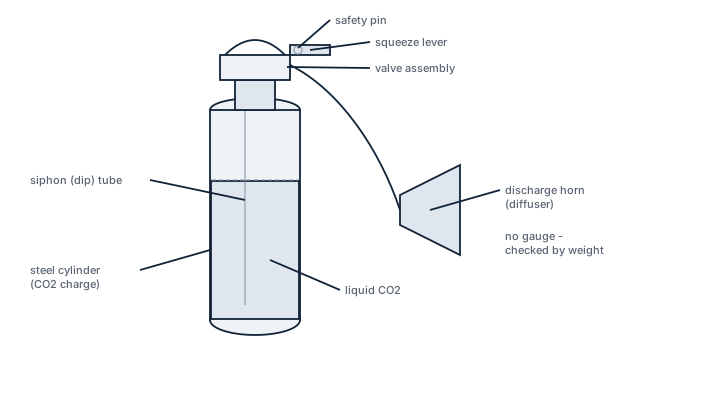
Legend
- safety pin
- squeeze lever
- valve assembly
- siphon (dip) tube
- discharge horn (diffuser)
- no gauge - checked by weight
- steel cylinder (CO2 charge)
- liquid CO2
Main components
Cylinder
A steel pressure vessel holding CO2 as a liquefied gas under its own vapour pressure, typically around 50-60 bar at normal ambient temperature — it is a pressure vessel first and an extinguisher second, which is why it falls under periodic hydrostatic testing rules separate from foam or water units.
Siphon tube
Draws liquid CO2 from the bottom of the cylinder when inverted or held upright with a dip tube, so the discharge delivers liquid that flashes to gas and dry ice snow at the horn, not just residual headspace gas.
Read the full guide
Valve and safety pin
A lever-operated valve released by pulling a tamper-evident safety pin; the pin is the first thing checked on a monthly inspection because a missing or broken seal means the unit may already have been discharged or tampered with.
Discharge horn
A wide plastic or composite horn, deliberately non-metallic so it does not become a static discharge or cold-contact burn hazard as the expanding gas drops the horn's surface temperature sharply.
Selection / Sizing
| Capacity | Typical use |
|---|---|
| 2 kg | Small electrical panels, local first-response units |
| 5 kg | Standard engine room and machinery space placement |
| Larger wheeled units | Fixed high-risk points such as paint lockers or large switchboard rooms |
Sizing follows the fire class and space, not a single fixed rule: CO2 units are rated for Class B (flammable liquid) and electrical fires, and are placed by risk assessment against the FSS Code table for number and spacing of portable extinguishers per compartment type, not by an arbitrary count per deck.
Regulations / Class
SOLAS Chapter II-2 and the IMO Fire Safety Systems (FSS) Code, Chapter 4, set the carriage, placement and performance requirements for portable extinguishers, including minimum extinguishing medium quantity and maximum spacing between units in machinery and accommodation spaces. Cylinders require periodic hydrostatic pressure testing at an interval set by the flag administration and the cylinder's design code, commonly every ten years, alongside an annual visual and weight-check servicing by a certified service agent. A unit found below its rated charge weight at inspection is treated as unserviceable, not topped up and returned to service without proper recharge.
Typical faults
- Low charge weight — CO2 escapes slowly through valve seals over years; the only reliable check is weighing the cylinder against its stamped full weight, since the pressure gauge that a dry powder unit uses does not apply the same way here.
- External corrosion — engine room humidity and salt air attack the cylinder shell; visible pitting or rust is grounds for hydrostatic retest before further service, not just a repaint.
- Valve seizure — infrequently used units can seize at the valve, especially after long periods in a cold or damp locker, and fail to discharge when the lever is pulled.
- Missing or broken tamper seal — indicates possible prior discharge or interference and should trigger an immediate weight check, not be waved past on the monthly round.
- Frost-cracked horn — repeated discharge testing or a manufacturing defect can crack the horn, which then fails to direct the gas properly at the seat of a fire.
What to look for in a supplier
- MED wheelmark approval (or equivalent flag-recognised type approval) on the specific model, not just the manufacturer's general catalogue.
- A stamped hydrostatic test date and cylinder design code visible on the vessel, so the next test due date is unambiguous at survey.
- A servicing agent recognised by the vessel's flag or class society, since a service tag from an unrecognised agent can be rejected at port state control.
- Recharge parts and replacement cylinders that match the existing valve thread and horn fitting, avoiding a mixed-fleet spares problem.
Weigh every CO2 extinguisher at the monthly inspection, not just at the annual service — a slow leak past the valve seal shows up on a scale weeks before it shows up on any visual check.
Models in this type.
The best-documented model of each manufacturer first, then the next — 13 of 13 models in CO2 Extinguisher. Every row links to full specifications, documents and service notes.
Manufacturers.
All 14 manufacturers with models of CO2 Extinguisher. Names with a manufacturer page open it; the others open a search across the full library.
All manufacturers in the libraryAlso in Portable Fire Extinguishers.
The other equipment types in this category.
Write to us about this model — the answer comes by e-mail.
Name the make and the model and what the job is: a spare, a service call, a second opinion on a data sheet. We answer by e-mail.
No details at hand? A photo of the rating plate or the part is enough — simply attach it to the request.
Questions that come up with this equipment.
Is CO2 Extinguisher data free?
Yes. Every model page, every guide and every datasheet for this type is readable without an account. An account adds saved searches and requests, nothing is taken away.
My model is missing — what now?
Send us the nameplate. We identify it by hand, add it to the library, and if you need a part or a service, the request is already on our desk.
Can you source a CO2 Extinguisher part?
Yes. Tell us the manufacturer, the model and what you need — a person reads every request and replies by e-mail.