Stern Tube Seal
A stern tube seal keeps seawater out of the shaft tunnel and, on oil-lubricated systems, keeps lubricating oil from escaping into the sea - a dual job that makes it the shaft line's single point most likely to cause an environmental incident.
What to check on a Stern Tube Seal.
1 models from Thordon Bearings in Stern Tube Seal. Below: the full model list.
What defines a stern tube seal
The stern tube seal sits where the propeller shaft exits the hull through the stern tube, and it does two jobs at once: keep seawater from flooding into the shaft tunnel, and, on oil-lubricated stern tube bearings, keep the lubricating oil from escaping into the sea. This second duty is why stern tube seals draw regulatory attention that other shaft line components do not - an oil leak here is a direct pollution event, not just a maintenance concern, and it is the reason environmentally acceptable lubricants and seal monitoring systems have become standard fitment on newer tonnage. Water-lubricated stern tube systems remove the oil pollution risk entirely by running the bearing in seawater, but they trade that for higher bearing wear rates and different seal duty - keeping the bearing supplied with clean water rather than keeping oil contained.
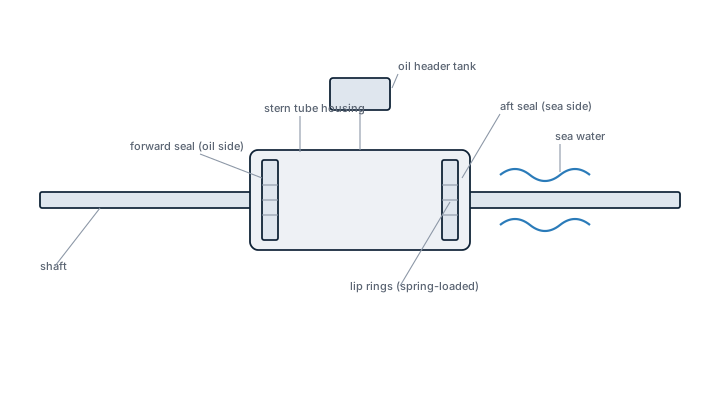
Legend
- oil header tank
- stern tube housing
- forward seal (oil side)
- aft seal (sea side)
- sea water
- shaft
- lip rings (spring-loaded)
Main components
Forward and aft seal assemblies
Most stern tubes carry seals at both ends of the tube; the aft seal keeps seawater out, the forward seal keeps oil from migrating into the engine room, each typically built from multiple lip seal rings for redundancy.
Sealing rings / lip seals
Synthetic rubber rings running against a wear-resistant liner on the rotating shaft; multiple rings are stacked so a single ring's wear does not immediately result in a leak.
Read the full guide
Shaft liner
A replaceable sleeve, historically bronze and increasingly synthetic composite, fitted over the shaft at the seal location so the seal rings run against a renewable wear surface rather than the shaft itself.
Lubricating oil system (oil-lubricated types)
A header tank feeding oil to the stern tube bearing at a pressure slightly above sea pressure, so any leak path runs oil out rather than water in, with oil level monitored as a leak indicator.
Air seal (on some designs)
A compressed air barrier between the forward and aft seal sets on some designs, providing an additional buffer and an early warning if either seal set starts to pass fluid.
Selection and sizing
- Shaft diameter and rotational speed, which determine seal ring size and the surface speed the lip seals must tolerate.
- Lubrication type - oil versus water-lubricated - driven by environmental regulation in the vessel's trading area as much as by mechanical preference.
- Environmentally acceptable lubricant (EAL) compatibility where required by the trading area, since not all seal materials tolerate every EAL formulation equally.
- Draft and immersion depth at the stern tube location, which sets the external sea pressure the seal must hold against.
Regulations and class
MARPOL Annex I addresses oil pollution prevention, and stern tube oil leakage is treated as a reportable discharge if it reaches the sea, which drives most flag states and charterers toward requiring EAL use or leak monitoring in environmentally sensitive areas. US EPA Vessel General Permit requirements specifically call out EAL use in stern tube lubrication for vessels operating in US waters where technically feasible. Class societies require periodic survey of the stern tube seal, typically opened for inspection at the shaft survey interval tied to the vessel's special survey cycle, with continuous monitoring arrangements available to extend that interval where oil condition and seal performance are logged.
Typical faults
| Fault | Cause | Consequence |
|---|---|---|
| Oil leakage into the sea | Worn lip seal rings or liner scoring from a previous seal failure | Pollution event, reportable discharge, potential fine or detention |
| Water ingress into the shaft tunnel | Aft seal failure, often following undetected liner wear | Bilge alarm activation, risk to bearing lubrication if oil is diluted |
| Rising oil consumption without visible leak | Slow seepage past a worn ring, not yet a visible drip | Early indicator often missed until the header tank needs frequent topping |
| Liner scoring | Debris ingress or a seal ring that has already failed and is cutting the liner | Repeated seal failure after replacement unless the liner is also renewed |
What to look for in a supplier
- Seal material confirmed compatible with the lubricant, EAL or mineral oil, actually in use aboard.
- Matched liner supply alongside the seal rings, since fitting new rings against a worn liner shortens the new seal's life sharply.
- Class-recognised type approval for the seal assembly matching the vessel's shaft diameter and speed.
- Monitoring system compatibility if the vessel uses continuous shaft survey arrangements requiring logged seal performance data.
Track oil top-up volume over time, not just oil level at a point in time - a seal that needs topping up more often each month is failing gradually, and that trend line will show it weeks before a visible leak does.
Models in this type.
The best-documented model of each manufacturer first, then the next — 1 of 1 models in Stern Tube Seal. Every row links to full specifications, documents and service notes.
Manufacturers.
All 10 manufacturers with models of Stern Tube Seal. Names with a manufacturer page open it; the others open a search across the full library.
All manufacturersAlso in Shaft Line Equipment.
The other equipment types in this category.
One request. A person reads it and replies by e-mail.
Tell us the manufacturer, the model and what you need — a part, a service call, a second opinion. A person reads every request and replies by e-mail.
No details at hand? A photo of the rating plate or the part is enough — simply attach it to the request.
Three things people ask first.
Is Stern Tube Seal data free?
Yes. Every model page, every guide and every datasheet for this type is readable without an account. An account adds saved searches and requests, nothing is taken away.
My model is missing — what now?
Send us the nameplate. We identify it by hand, add it to the library, and if you need a part or a service, the request is already on our desk.
Can you source a Stern Tube Seal part?
Yes. Tell us the manufacturer, the model and what you need — a person reads every request and replies by e-mail.