What to check on a RoRo Ramp.
Hatch covers seal a cargo hold and are rarely opened outside port; a RoRo ramp is a working piece of machinery cycled every port call, carrying the full weight of trucks, trailers and container handling equipment as they drive on and off. Stern ramps, quarter ramps and side ramps handle the connection to the quay or another vessel, while internal ramps move vehicles between decks once aboard. When closed and secured, the outer ramp also forms part of the ship's watertight or weathertight boundary, so a ramp fault is a…
What sets a RoRo ramp apart
Hatch covers seal a cargo hold and are rarely opened outside port; a RoRo ramp is a working piece of machinery cycled every port call, carrying the full weight of trucks, trailers and container handling equipment as they drive on and off. Stern ramps, quarter ramps and side ramps handle the connection to the quay or another vessel, while internal ramps move vehicles between decks once aboard. When closed and secured, the outer ramp also forms part of the ship's watertight or weathertight boundary, so a ramp fault is a stability and flooding concern, not just a cargo-handling inconvenience.
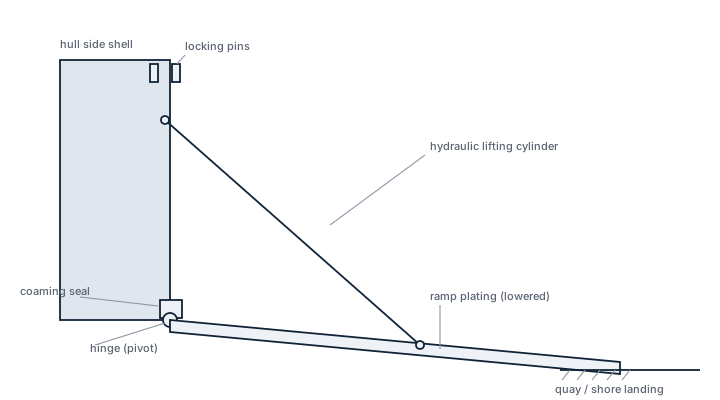
Main components
Ramp platform
A steel structure sized for the design axle loading, often reinforced along wheel-track lines where repeated point loads concentrate wear.
Hoisting and actuation
Hydraulic cylinders or wire hoists raise, lower and, on stern ramps, luff the platform to match varying quay heights and tidal range.
Hinges and locking devices
Heavy pintle hinges carry the ramp's weight and the cargo load transmitted through it; locking pins or cleats secure the ramp in the closed, watertight position.
Hydraulic power pack
Supplies pressure to the actuating cylinders, typically with a manual backup pump for operation during a power failure.
Selection and sizing
Load rating is set by the heaviest vehicle or unit expected to cross the ramp, expressed as axle load and total distributed load, not just gross vehicle weight. Ramp length and achievable angle must suit the quay heights and tidal range of the ship's regular ports; a ramp too short for the trade forces a steep, difficult crossing angle for wheeled cargo. Width is set by the widest vehicle class the ship is designed to carry, with clearance margin for driver error.
Regulations and class requirements
SOLAS Chapter II-1 sets special stability and structural requirements for RoRo vessels, recognizing the flooding risk a large open vehicle deck represents. Ramps that form part of the watertight or weathertight boundary are treated as closing appliances under class rules, with position indicators and alarms required on the bridge to confirm the ramp is fully closed and secured before departure. Structural and hydraulic system surveys follow class intervals tied to the ramp's role in the vessel's damage stability case.
Typical faults
- Hydraulic cylinder seal leakage, causing slow ramp creep or loss of holding pressure when stopped mid-travel.
- Hinge and pintle wear from repeated heavy cycling, introducing play that shows up as misalignment when closing.
- Structural corrosion on the ramp plating and stiffeners, accelerated by seawater spray and vehicle traffic wearing through protective coating.
- Locking mechanism failure or misalignment, the single fault most directly tied to flooding risk if the ramp cannot be confirmed fully secured.
- Position indicator or alarm sensor faults, which can mask a genuine closure problem from the bridge.
What to look for in a supplier
- Structural design verified against the vessel's actual axle loading and the ramp's role in the approved stability case.
- Hydraulic components rated for continuous heavy-duty cycling, not a light industrial equivalent.
- Class-approved design documentation for any ramp modification or renewal, since this affects the ship's damage stability certificate.
- Spare parts availability for hinges, locking pins and hydraulic seals without a full system replacement.
Never accept a ramp position indicator reading without confirming the physical lock visually at least once per voyage cycle; a stuck sensor and a genuinely secured ramp look identical on the bridge panel.