What to check on a Side Rolling Hatch Cover.
A side-rolling hatch cover is made up of individual steel panels that ride on wheels along a rail track fitted to the top of the hatch coaming, opening by travelling sideways to stack clear of the opening at one or both sides. That differs from a folding cover, whose panels hinge upward and telescope on top of each other, and from a piggyback cover, whose panels stack lengthwise on rails running fore and aft. The side-rolling arrangement suits hatches that are wide relative to their length, where there is no…
What sets the side-rolling type apart
A side-rolling hatch cover is made up of individual steel panels that ride on wheels along a rail track fitted to the top of the hatch coaming, opening by travelling sideways to stack clear of the opening at one or both sides. That differs from a folding cover, whose panels hinge upward and telescope on top of each other, and from a piggyback cover, whose panels stack lengthwise on rails running fore and aft. The side-rolling arrangement suits hatches that are wide relative to their length, where there is no room to stack panels end to end without blocking part of the opening, and where coaming height is limited so a hinge-up folding cover would foul deck cranes or cargo gear.
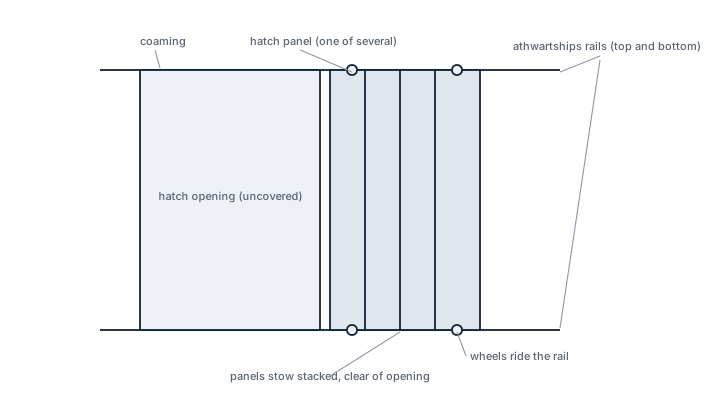
Main components
Panels
Individual rectangular steel panels, each stiffened with longitudinal and transverse webs to carry deck loads (green water, stacked cargo, walking loads) without excessive deflection. Panel width is set by the number of panels needed to clear the hatch and by transport and handling limits during dry-docking.
Wheels and rail track
Each panel carries several wheel sets, usually mounted on the panel underside, running on a rail welded along the coaming top. Wheels are typically forged steel with sealed bearings; rails are hardened wear strips that take the repeated rolling load. Corrosion and abrasive cargo dust, such as ore or coal, are the main wear drivers here.
Drive and compression system
A hydraulic power pack or an electric motor with reduction gearing drives the panels along the track, usually through a chain, wire rope, or rack-and-pinion arrangement. Around the panel and coaming perimeter, cam-type compression cleats or a hydraulic wedge system pull the panel down onto a rubber gasket to achieve the weathertight seal once the cover is closed.
Cross joints and seals
Where adjacent panels meet, a cross-joint seal, a rubber strip compressed between panels and sometimes fitted with a drainage channel, prevents water tracking between panels and down into the hold.
Selection and sizing
Choice between side-rolling and other hatch cover types starts with hold geometry: hold length-to-width ratio, coaming height available for stowed panels, and deck space needed on either side of the hatch for parked panels. Other sizing drivers include the uniform deck load the panels must carry when stacked cargo bears on them, the design wave and green water head used for the strength calculation, drive type (hydraulic suits larger, heavier covers; chain or wire drive suits lighter covers on smaller vessels), and the opening speed required for the vessel's port turnaround targets.
Regulations and class
Hatch cover strength and weathertightness fall under the International Convention on Load Lines, which ties minimum design loads to a weathertight closing arrangement as part of the freeboard assessment. Classification societies apply their own structural standards, commonly aligned with IACS Unified Requirement S21 for hatch cover strength on ships subject to the Common Structural Rules. Weathertightness is verified periodically by hose testing or ultrasonic tightness testing, and surveyors check wheel, rail, compression bar, and gasket condition at intermediate and renewal surveys.
Typical faults
- Worn or flat-spotted wheels: panels bind or run unevenly on the track, increasing drive load and accelerating rail wear.
- Corroded or deformed rail track: panels can jump the track or fail to seal evenly along their length, letting water into the hold.
- Perished or compressed-flat rubber gasket: loses its seal, allowing water ingress that wets cargo or causes hold corrosion.
- Compression cleats seized or worn: uneven hold-down force, causing local leakage even when the panel closes fully.
- Stretched drive chain or wire rope: panels no longer close in the intended sequence, leaving a gap at the last panel.
What to look for in a supplier
- Wheel and rail material proven for the trade, with higher corrosion resistance for open dusty cargoes such as ore or coal.
- Documented weathertight test method and pass criteria supplied with the delivery.
- Ability to supply matching spare wheels, seals, and compression cleats for hatch covers already installed, not only new-build sets.
- Hydraulic power pack built with commonly available components rather than a proprietary system with long spare part lead times.
- Design load calculation traceable to the class rule set applicable to the vessel's hatch cover strength.
Test hatch cover weathertightness before loading a moisture-sensitive cargo, not after: an ultrasonic test takes a fraction of the time a wet cargo claim needs to settle.