What to check on a Ramp (Stern/Side).
A stern or side ramp is not a variant of a hatch cover, even though it closes an opening in the hull. Its main job while open is structural: it has to carry the weight of trucks, trailers and self-propelled cargo rolling across it, often at axle loads that exceed anything a hatch cover ever sees. Its main job while closed is different again — sealing that same opening watertight against green water and, on many designs, forming part of the shell plating that contributes to the ship's longitudinal strength…
What sets a stern or side ramp apart
A stern or side ramp is not a variant of a hatch cover, even though it closes an opening in the hull. Its main job while open is structural: it has to carry the weight of trucks, trailers and self-propelled cargo rolling across it, often at axle loads that exceed anything a hatch cover ever sees. Its main job while closed is different again — sealing that same opening watertight against green water and, on many designs, forming part of the shell plating that contributes to the ship's longitudinal strength. Stern ramps span the full beam at the transom and usually double as the aft shell door; side ramps are narrower, fitted amidships or near the bow, and typically serve as a secondary access point rather than the primary one.
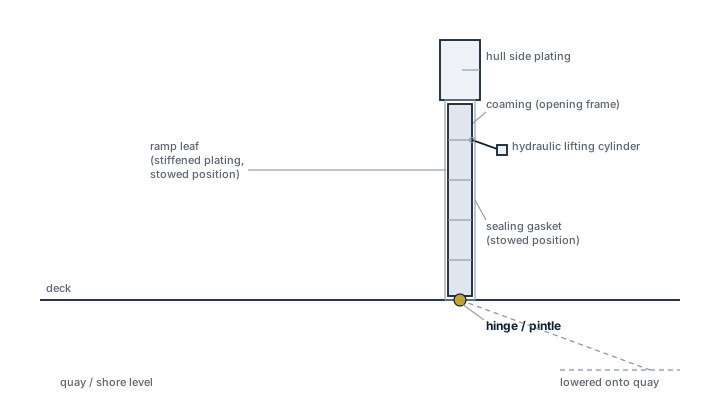
Main components
Ramp platform
A stiffened steel plate structure with a deck surface designed for tire and track loads, often incorporating hinged extension flaps at the outboard end to bridge the gap to a quay or linkspan of varying height.
Hinges and pivot structure
Heavy pintle-and-gudgeon hinges, or a pivoting trunnion arrangement, that carry both the static weight of the ramp itself and the dynamic rolling load while open, and that also form part of the watertight boundary when the ramp closes against its seat.
Hydraulic operating system
Hydraulic cylinders raise, lower and, on stern ramps that double as a door, swing the structure closed. Most installations carry a separate locking system that takes the sealing load off the hydraulics once the ramp is shut, so the cylinders are not left holding pressure against sea loads.
Locking and sealing arrangement
Cleats or hook bolts that pull the ramp tight against a rubber gasket at the coaming, distributing the closing load evenly enough to avoid local overstress that would break the seal in a seaway.
Selection and sizing
- Maximum axle load and total vehicle weight the ramp must carry, which sets plate thickness and stiffener spacing.
- Span and the tidal or quay-height range the ramp must reach, which determines whether a simple hinged ramp is enough or a telescopic or folding design is needed.
- Hull location: a stern ramp integrated into the transom shell door carries additional watertight-integrity requirements that a side ramp usually does not.
- Hydraulic power available from the ship's system versus the cylinder force needed to lift the ramp against its own weight plus any residual cargo.
Regulations and class
SOLAS Chapter II-1 sets watertight integrity requirements for shell doors on ro-ro ships, tightened after a series of losses where bow and stern doors failed at sea. Class societies require ramps that also serve as shell doors to be assessed under the applicable ro-ro access door regulations, with positive indication of closed and locked status led back to the bridge. Periodic survey covers the hinge pins, locking devices and hydraulic system, and class typically requires operational testing of the closing and locking sequence at each survey, not just a visual check of the structure.
Typical faults
| Fault | Consequence |
|---|---|
| Worn hinge pins or bushings | Ramp misaligns with its seat, seal no longer closes evenly, water ingress in a seaway |
| Locking cleats not fully engaged | Ramp held only by hydraulic pressure, a known failure mode behind several ro-ro losses |
| Corroded or cracked deck plating from vehicle traffic and salt | Reduced load capacity, risk of local structural failure under a loaded truck |
| Bridge indicator not wired to the actual locking pin position | False closed-and-locked signal, ship sails with the ramp effectively unsecured |
What to look for in a supplier
- Structural certification for the actual axle loads the ramp will see in service, not a generic rating.
- Position indication that reads the locking device itself, not just the hydraulic cylinder stroke.
- Track record with the class society that will survey the installation, since ro-ro access doors get closer regulatory attention than most hull openings.
- Available spare hinge pins, seals and cleat components matched to the specific ramp model.
Never treat the closed indicator light as proof the ramp is locked — walk the locking pins visually before departure, because a jammed cleat can still let the light show closed.