Electric Motor
Marine electric motors drive pumps, fans, compressors, winches and thrusters, from small low-voltage induction machines to large propulsion motors. What makes them marine is the surroundings: salt air, high ambient temperature, hull vibration and a supply that is often a frequency converter instead of a clean sine wave.
What to check on an Electric Motor.
91 models from Rotor B.V. in Electric Motor. Below: the full model list.
What sets a marine electric motor apart
An electric motor turns electrical power from the switchboard or a frequency converter into shaft power, and on a typical vessel it is the most numerous rotating machine on board: pumps, fans, compressors, separators, steering gear, winches and cranes all depend on one. Industrial motors are built for a dry, temperate factory floor. On a ship the same machine sits in an engine room with high ambient temperature and oil mist, or on an open deck in spray, bolted to a hull that vibrates. Marine versions therefore differ in the details that decide service life: insulation system, enclosure, corrosion protection, bearing design and cooling arrangement.
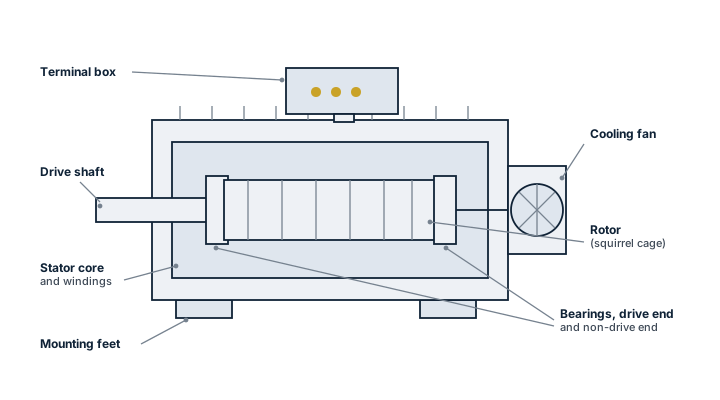
Legend
- Terminal box
- Cooling fan
- Drive shaft
- Rotor (squirrel cage)
- Stator core and windings
- Bearings, drive end and non-drive end
- Mounting feet
Main designs
- Squirrel-cage induction motors - the standard workhorse for auxiliary drives; simple and robust, with no brushes or slip rings to maintain
- Wound-rotor (slip-ring) motors - found on older installations where controlled starting torque or speed was needed without a converter
- Permanent-magnet synchronous motors - compact and efficient, increasingly used for thrusters, pods and electric propulsion, and always run from a converter
- DC motors - still present on older winches, cranes and legacy drives; commutator and brushes need regular attention
- Explosion-protected (Ex) motors - certified enclosures for gas-hazardous areas such as pump rooms and tanker decks, where the protection concept must match the zone and gas group
Main components
- Stator winding and insulation system, the part that sets the thermal limit of the whole machine
- Rotor with cage or magnets, balanced to the speed range it will see
- Bearings and their lubrication arrangement, either greased for life, regreasable or oil-lubricated on larger machines
- Terminal box with gland plates and seals, sized for the cable and the connection method
- Cooling: a shaft-mounted fan on self-ventilated machines, or a separate motor-driven fan when the motor must run at low speed under load
- Anti-condensation space heaters and winding temperature sensors, usually PT100 elements or thermistors
Selection and sizing
- Power and torque for the driven machine, including the starting duty: high-inertia loads such as large fans need a long run-up that heats the rotor
- Supply voltage, frequency and pole number, matched to the switchboard or the converter
- Duty type, continuous or intermittent, as defined in IEC 60034-1; winches and cranes are not continuous loads
- Enclosure protection and cooling method, see IEC 60034-5 and IEC 60034-6
- Insulation class and permitted temperature rise, with margin for the engine room ambient rather than the standard laboratory reference
- Mounting arrangement and frame size, so a replacement fits the existing foundation and shaft height
- For converter-fed machines: confirmation that insulation and bearings are suited to inverter duty
Regulations and class
Motors for essential services must be built and tested to the rules of the classification society. Larger machines normally need a class certificate issued after witnessed testing, while smaller ones are accepted on a type approval or a manufacturer's test report. The IEC 60034 series defines ratings, enclosure protection, cooling and test methods, and the IEC 60092 series covers electrical installations in ships. Ex motors additionally carry certification under IECEx or ATEX for the zone in which they are fitted, and the marking on the nameplate must be checked against the hazardous-area drawing.
Typical faults
- Bearing failure from aged grease, over- or under-greasing or, on converter-fed machines, circulating bearing currents that flute the races
- Winding insulation breakdown after moisture ingress when the motor stood idle without its space heater switched on
- Overheating from a blocked cooling-air path, a failed external fan or an overloaded drive
- Damaged rotor bars or a loose rotor on repeated heavy starts, showing as vibration, noise and falling speed
- Terminal box problems: loose connections, hardened seals and water inside the box
- Coupling misalignment, which wears bearings and shaft seals long before the motor itself fails
What to look for in a supplier
- A class certificate or type approval that matches the exact frame, power and enclosure being ordered
- Nameplate data (power, voltage, frequency, speed, duty, enclosure, insulation class) identical to the unit being replaced, or the differences documented in writing
- For converter duty, a statement from the maker on insulation strength and bearing protection
- Bearings, fans, seals, space heaters and encoders available as spares for that frame size
- For Ex motors, the certificate with the full marking, not just the word explosion-proof
Measure and record the insulation resistance before every restart after a long lay-up. A single reading says little, but the trend over the years shows a damp or ageing winding long before it trips.
Models in this type.
The best-documented model of each manufacturer first, then the next — 91 of 91 models in Electric Motor. Every row links to full specifications, documents and service notes.
Manufacturers.
All 55 manufacturers with models of Electric Motor. Names with a manufacturer page open it; the others open a search across the full library.
All manufacturers in the library- Rotor B.V.91
- SEIPEE S.p.A.2
- Shanghai Top Motor Co., Ltd.2
- Svend Hoyer27
- Taiyo Electric Co., Ltd. Gifu Factory2
- VEM71
- Wabtec Transportation Systems, LLC2
- WEG (Nantong) Electric Motor Manufacturing Co., Ltd.2
- WEG EQUIPAMENTOS ELETRICOS S/A2
- WEG Marine46
- WEGeuro, S.A.2
- Zhejiang Jinlong Electrical Machinery Stock Co.,LTD.2
Show all 55 manufacturers
Also in Motor Control.
The other equipment types in this category.
Write to us about your machine — the answer comes by e-mail.
Name the make and the model and what the job is: a spare, a service call, a second opinion on a data sheet. We answer by e-mail.
No details at hand? A photo of the rating plate or the part is enough — simply attach it to the request.
Questions that come up with this equipment.
Is Electric Motor data free?
Yes. Every model page, every guide and every datasheet for this type is readable without an account. An account adds saved searches and requests, nothing is taken away.
My model is missing — what now?
Send us the nameplate. We identify it by hand, add it to the library, and if you need a part or a service, the request is already on our desk.
Can you source a Electric Motor part?
Yes. Tell us the manufacturer, the model and what you need — a person reads every request and replies by e-mail.