What to check on a Frequency Converter / VFD.
A direct-on-line or star-delta starter gives a motor essentially one running speed: full speed, throttled downstream by a valve, damper or pitch control. A VFD instead rectifies incoming AC to DC and then inverts it back to AC at a variable frequency, so the motor itself runs at whatever speed the process actually needs. On a ballast pump, a cooling water pump or an engine room fan this cuts energy use sharply compared with throttling a fixed-speed pump, and it also softens starting current, which matters on a ship's limited…
What sets a VFD apart
A direct-on-line or star-delta starter gives a motor essentially one running speed: full speed, throttled downstream by a valve, damper or pitch control. A VFD instead rectifies incoming AC to DC and then inverts it back to AC at a variable frequency, so the motor itself runs at whatever speed the process actually needs. On a ballast pump, a cooling water pump or an engine room fan this cuts energy use sharply compared with throttling a fixed-speed pump, and it also softens starting current, which matters on a ship's limited generator capacity. The tradeoff is a more complex, electronics-heavy unit that introduces harmonics and needs its own cooling and filtering.
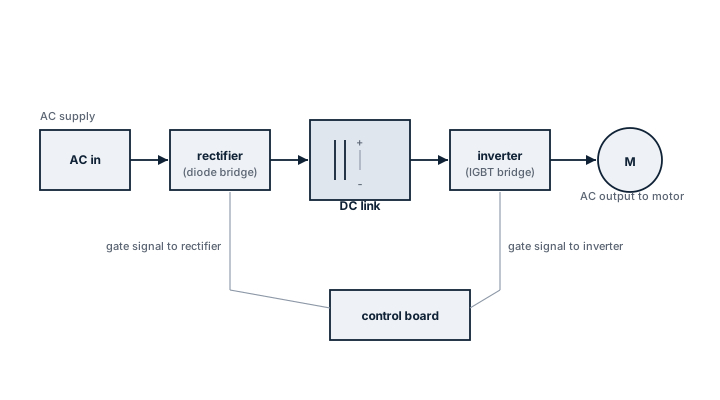
Main components
Rectifier stage
Converts incoming three-phase AC to DC, typically with a diode bridge or, on regenerative units, an active front end that can feed energy back to the network during braking.
DC bus and capacitors
Smooths the rectified voltage; the electrolytic or film capacitors here are a known wear item and a common cause of drive failure as they age.
Inverter stage (IGBTs)
Insulated-gate bipolar transistors switch the DC bus at high frequency using pulse-width modulation to synthesise a variable-frequency AC output to the motor.
Control board and cooling
Runs the switching algorithm, motor protection functions and communication interfaces, and relies on fan or heatsink cooling that must stay unobstructed in a hot engine room.
Output filter
On longer cable runs, an output filter reduces voltage reflection and dv/dt stress on the motor windings, which otherwise shortens insulation life.
Selection and sizing
- Power rating: matched to motor kW with margin for the actual load curve, since pumps and fans have very different torque-speed profiles than winches or thrusters.
- Voltage class: matched to the ship's distribution voltage, and rated for the harmonic environment of a shipboard generator rather than an infinitely stiff shore grid.
- Overload capability: short-time overload rating matters for loads like thrusters that need torque spikes.
- Enclosure rating: engine room installations need dust and moisture protection; some drives are mounted in dedicated ventilated switchboard rooms instead.
Regulations and class
Class societies require type approval for VFDs used in essential services, and harmonic distortion injected back into the ship's electrical network is checked against class rules for power quality, since multiple drives on one generator can distort the supply enough to affect other equipment. Drives on essential services such as steering-related pumps or fire pumps face additional redundancy and failure-mode requirements under SOLAS-driven class rules for essential and emergency services.
Typical faults
| Fault | Consequence |
|---|---|
| DC bus capacitor degradation with age and heat | Drive trips on undervoltage or fails outright, often without warning |
| Cooling fan failure or blocked heatsink | Thermal trip under load, reduced service life of power electronics |
| Poor cable shielding or grounding | Electromagnetic interference affecting nearby instrumentation and communications |
| Harmonics not filtered on a heavily loaded generator | Voltage distortion affecting other connected equipment |
What to look for in a supplier
- Class type approval certificate matching the specific drive model and rating.
- Documented harmonic performance and, where needed, compatible input filtering.
- Local service and spares support, since a failed drive on an essential pump is not something to wait weeks for.
- Clear guidance on cable length and filtering requirements for the actual motor run length on board.
Log drive trip codes and DC bus voltage trends over time rather than just resetting after a trip — a capacitor bank in decline gives warning trips for weeks before it fails outright.