What to check on a CO₂ Fixed System (Engine Room + Cargo).
4 models from fike in CO₂ Fixed System (Engine Room + Cargo). Below: the full model list.
What defines this type
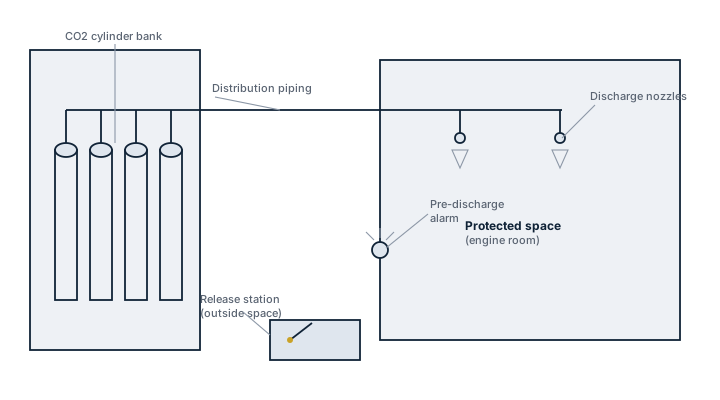
A fixed CO2 system is a total flooding fire suppression installation: CO2 is stored as a liquid under pressure in cylinders and, on release, discharged through a fixed pipe network to nozzles distributed through the protected space until the oxygen concentration falls low enough to stop combustion. Unlike water-based systems it suppresses by displacing oxygen rather than cooling the fire, which is why it is chosen for spaces where water would spread burning fuel or damage machinery beyond the fire itself — the engine room, and cargo holds where hoses or sprinklers are impractical. It only works if the space can actually hold the gas, which is why boundary integrity — closed doors, sealed penetrations, shut ventilation — is as much a part of the system as the cylinders.
Read the full guide
Main components
- CO2 cylinder bank — high-pressure cylinder storage, the bulk of the system's volume, usually located in a dedicated room outside the protected space.
- Pilot cylinder — a smaller cylinder whose release initiates the main bank discharge.
- Distribution manifold and pipework — carries the gas from the cylinder room to the nozzles.
- Release nozzles — sized and positioned to achieve even distribution through the protected volume.
- Alarm and time-delay unit — sounds an audible and visual pre-discharge warning and holds the release for a set period to allow evacuation.
- Boundary closures — fire dampers and ventilation shutdowns that must close, automatically or manually, before or during release.
Selection / sizing
The protected space's net volume sets the required CO2 quantity, calculated to reach the design flooding concentration for that space type within the required discharge time. Cylinder count and pipe sizing both follow from that figure — enough cylinders to deliver the total quantity, and pipework sized to deliver it within the time the standard requires. Spaces with a particular fire hazard concentrated in one area, such as a paint locker or a specific piece of cargo equipment, may need local application nozzles in addition to the total flooding arrangement for the main space.
Regulations / Class
SOLAS Chapter II-2 together with the Fire Safety Systems (FSS) Code sets the requirements for fixed CO2 systems: the quantity required per protected volume, the discharge time, the sequence and duration of the pre-discharge alarm, required signage at entrances and at the release station, and the location of the manual release control outside the protected space in a position that stays accessible during a fire. Class survey checks cylinder weight or pressure at periodic intervals and requires hydrostatic testing of cylinders on the schedule the rules set.
Typical faults
- Cylinder weight loss from a leaking valve — found only at periodic weighing, means the system would under-dose on release and never reach flooding concentration.
- Corroded or seized release valve — the system fails to discharge on demand when actually needed.
- Damaged or blocked nozzles — uneven gas distribution leaves pockets of the space where the fire is not suppressed.
- Faulty alarm sequencing — either no pre-discharge warning, a genuine safety risk, or nuisance alarms that lead crew to distrust and bypass the system.
- Boundary leakage — open doors or dampers that fail to close mean the flooding concentration is never reached even with a full, correct discharge.
What to look for in a supplier
- A cylinder testing and weighing service that actually reaches the vessel's ports of call.
- A documented quantity calculation against the vessel's actual protected volumes, not a generic figure.
- Compatibility with existing pipework where only part of an older system is being replaced.
- Spares held for release valves and pilot cylinders, which are the parts most often found faulty at survey.
CO2 is lethal in the space it protects — the pre-discharge alarm, headcount and evacuation procedure matter as much as the cylinders themselves, and crew drills should treat them that way.