Self-Contained Breathing Apparatus (SCBA)
Self-contained breathing apparatus supplies its own compressed air rather than air fed from an external line, which is what lets the wearer enter a smoke-filled engine room without depending on a hose that can kink, burn through or be dragged out from behind.
What to check on a Self-Contained Breathing Apparatus (SCBA).
48 models from MSA Safety in Self-Contained Breathing Apparatus (SCBA). Below: the full model list.
What defines SCBA against other breathing protection
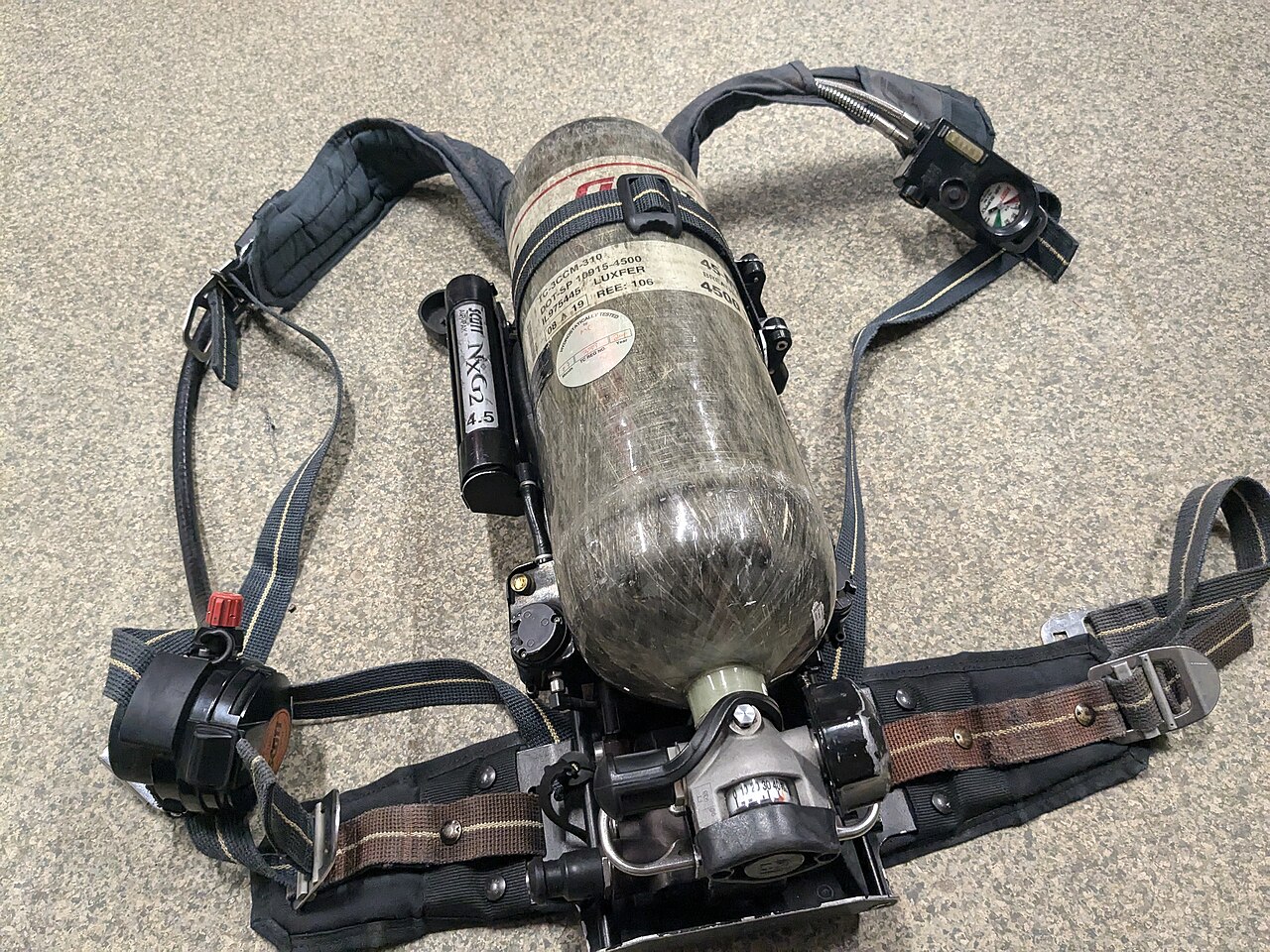
SCBA carries the wearer's entire air supply on their back in a compressed-air cylinder, feeding a demand valve through a hose to a full-face mask. That is the difference from a fireman's outfit fed by a hose from a compressor or manifold outside the space, and from an escape set, which is a smaller cylinder rated for exit only, not for working inside a hazard. SCBA is the equipment a fire party takes into a smoke-logged or oxygen-deficient compartment because it carries no dependency on anything outside the door.

Legend
- pressure reducer, first stage
- cylinder valve
- pressure gauge
- low-pressure whistle
- medium-pressure hose
- face mask
- compressed air cylinder
- demand valve, second stage
- backplate and harness
Main components
Cylinder
Steel or composite cylinder, typically 6 to 9 litres water capacity charged to 200 or 300 bar, giving a nominal duration of around 30 to 60 minutes depending on the wearer's work rate. Composite cylinders are lighter but have a hydrostatic test and service-life expiry stamped on the shoulder that crews routinely miss.
Reducer and demand valve
The reducer steps cylinder pressure down to a working pressure of a few bar; the demand valve at the mask delivers air only on inhalation, which is what makes the cylinder last as long as it does compared with a constant-flow system.
Read the full guide
Face mask
Full-face mask sealing against the skin, with a speech diaphragm and often a fitting compatible with a radio microphone. A poor seal against facial hair, or a mask sized wrong for the wearer, is the single most common reason SCBA fails in a drill.
Harness and warning whistle
Backplate and harness carry the cylinder; a low-pressure whistle or electronic alarm sounds at roughly 50 bar remaining, the cue to leave the space, not to keep working.
Selection and sizing
- Cylinder capacity and charge pressure against the expected duration of entry, with a safety margin for the return route
- Positive-pressure demand valve so a mask leak pushes air out rather than drawing smoke in
- Mask size range carried on board, since one size does not fit every crew member and a bad seal defeats the set
- Compatibility with the ship's existing charging compressor or cascade system pressure
Regulations and class
SOLAS Ch. II-2 sets the minimum number of SCBA sets carried according to ship type, with spare cylinders and a means of recharging them onboard specified separately. Sets are subject to periodic servicing and hydrostatic testing of cylinders on a class-approved interval, and fire drills exercising SCBA use are a standing SOLAS training requirement, checked at survey through drill records rather than the hardware alone.
Typical faults
| Fault | Consequence |
|---|---|
| Cylinder not recharged after a drill | Set found empty in an actual emergency |
| Mask seal perished or facial hair against the seal | Smoke ingress, wearer unaware until symptoms appear |
| Low-pressure warning whistle not tested | No warning before air runs out, no margin for the return route |
| Cylinder past hydrostatic test date still in service | Set condemned or unsafe under pressure, discovered only at inspection |
What to look for in a supplier
- Approval certificate valid for the flag and class the ship sails under, not just a generic CE mark
- Spare cylinders and seals stocked in the sizes actually fitted, not a nearest match
- Service network able to reach the ship's trading pattern for hydrostatic testing on schedule
Check the low-pressure whistle on every set at the start of a watch, not just at the annual service — a whistle that does not sound is discovered by the wearer at the worst possible moment.
Models in this type.
The best-documented model of each manufacturer first, then the next — 48 of 48 models in Self-Contained Breathing Apparatus (SCBA). Every row links to full specifications, documents and service notes.
Manufacturers.
All 21 manufacturers with models of Self-Contained Breathing Apparatus (SCBA). Names with a manufacturer page open it; the others open a search across the full library.
All manufacturers in the libraryAlso in Breathing Apparatus.
The other equipment types in this category.
Write to us about this model — the answer comes by e-mail.
Name the make and the model and what the job is: a spare, a service call, a second opinion on a data sheet. We answer by e-mail.
No details at hand? A photo of the rating plate or the part is enough — simply attach it to the request.
Questions that come up with this equipment.
Is Self-Contained Breathing Apparatus (SCBA) data free?
Yes. Every model page, every guide and every datasheet for this type is readable without an account. An account adds saved searches and requests, nothing is taken away.
My model is missing — what now?
Send us the nameplate. We identify it by hand, add it to the library, and if you need a part or a service, the request is already on our desk.
Can you source a Self-Contained Breathing Apparatus (SCBA) part?
Yes. Tell us the manufacturer, the model and what you need — a person reads every request and replies by e-mail.