"> EEBD - Equipment Database

EEBD

medium 10 models total

An EEBD gives a crew member a fixed few minutes of breathing air to escape a smoke-filled or contaminated space, nothing more. Unlike self-contained breathing apparatus, it needs no fit test or donning drill and must never be used to enter a space or fight a fire.

Read more — EEBD explained

What sets an EEBD apart

An emergency escape breathing device exists for one purpose only: getting a person out of a smoke-logged or contaminated space to a place of safety. It is not rated, and must never be used, for firefighting or for entering a space to work or rescue someone, which is the job of self-contained breathing apparatus with its full facepiece, demand valve and much larger cylinder. An EEBD instead uses a loose-fitting hood or a lightweight mask fed by a small cylinder, sized to give a defined minimum duration, usually stated as at least ten minutes, and it needs no fit test or trained donning drill because it has to be usable by any crew member in seconds, under smoke, without prior instruction.
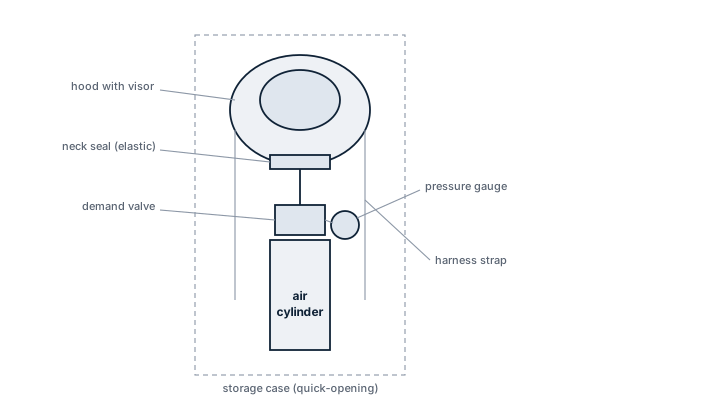
EEBD component layout
Cutaway of an emergency escape breathing device showing the protective hood with visor, the neck seal, the demand valve, the compressed air cylinder with pressure gauge, the harness strap and the quick-opening storage case.

Main components

Hood or mask

Most EEBDs use a clear plastic hood that seals around the neck with an elastic band, covering the whole head so the wearer keeps eye protection along with breathing air. Mask-type units cover only nose and mouth and rely on the wearer's own eye protection.

Cylinder and regulator

A small compressed air cylinder, commonly rated for around ten to fifteen minutes of use, supplies air through either a constant-flow regulator, which feeds a steady stream into the hood regardless of breathing rate, or a demand valve similar to a scaled-down SCBA system.

Harness and storage bracket

A simple shoulder or waist harness lets the wearer carry the device while moving, and each unit is stowed in a quick-release wall bracket at a fixed, marked location so it can be found in darkness or smoke.

Selection and sizing

The number and location of EEBDs on board is fixed by SOLAS, not chosen freely, but the duration rating and don time of the specific model still matter operationally:

  • Rated duration, since a device good for exactly the regulatory minimum leaves no margin if the escape route is blocked
  • Don time, EEBDs are expected to be put on and working within roughly one minute without assistance
  • Hood versus mask type, hoods suit crew who wear glasses or have facial hair that would break a mask seal

Regulations and class

SOLAS Chapter II-2 requires EEBDs in the machinery spaces of most cargo ships, positioned so at least one is usable from a normally manned control position, plus additional units in accommodation spaces on ships carrying more than a stated number of persons. Devices must carry Marine Equipment Directive wheelmark or equivalent flag-state type approval, and cylinders are subject to periodic hydrostatic testing under the same pressure-vessel rules as other compressed gas cylinders on board.

Typical faults

  • Slow cylinder pressure loss from a worn valve seat, only caught if gauges are checked on schedule rather than assumed full
  • Hood elastic perishing with age or heat exposure, breaking the seal exactly when smoke is present
  • Cylinder past its hydrostatic test date, taken out of service or condemned without a spare on hand
  • Units stowed behind other equipment or relocated informally, so crew cannot find them under time pressure

What to look for in a supplier

  • Wheelmark or flag-approved type certificate matching the exact model on order, not a family approval
  • Confirmed rated duration under the applicable standard, tested at a stated breathing rate rather than a best-case figure
  • Cylinder refill or exchange service compatible with the ship's trading pattern, since EEBDs are one-time-use per activation
  • Spares support for hood elastics and harness webbing, the parts that actually degrade in service

An EEBD is an escape device, not a work device; the moment someone treats it as a licence to go further into a compartment to search or fight a fire, it has run out before they are back out.

6 manufacturers · 10 models

Dräger

4
Dräger Saver CF15
Saver CF15
15 min · Compressed Air (Breathing) · self-contained emergency escape breathing device
Type
eebd
Duration min
15
Solas
ja
Common Failures & Inspection Points
  • Cylinder pressure loss over time
  • Hood seal degradation
  • Activation mechanism stiffness
Service: Replace cylinder every 5 years. Annual visual inspection. One-time use.
Spare Parts: Dräger: Ersatz-Masken, Atemluftflaschen und Prüf-Kits an Bord vorhalten. Lead time: 1-3 Wochen.
Strengths
  • Compact, lightweight design fits in limited spaces on deck and in cabins
  • Integrated hood gives immediate protection against smoke and water ingress
  • 15‑minute air supply meets SOLAS requirements for most vessel classes
  • One‑time use eliminates the need for refilling or complex servicing after each activation
  • Simple pull‑cord activation, operable even when wet
Weaknesses
  • Cylinder pressure can drop over time, requiring replacement every five years
  • Hood seal may degrade with age, affecting protection against smoke/water
  • Activation mechanism can become stiff if not inspected regularly
  • Limited to a single 15‑minute use; not suitable for prolonged rescue operations
  • Disposal of used units generates waste and recurring replacement cost
Typical Vessels: TankerContainer shipBulk carrierPassenger ferryCruise shipOffshore supply vessel
Certifications: SOLAS Chapter II‑1 Regulation 15 complianceUSCG Type Approval
Decision Guide: Choose if you need a compact, low‑maintenance EEBD that meets SOLAS requirements and provides a reliable 15‑minute air supply for rapid escape from fire or immersion. Avoid if longer breathing duration, reusable cylinders, or higher endurance in rescue scenarios are required.
Use Cases: Deployed on ships for emergency crew escape during fire, smoke, or flooding events; used for abandon‑ship drills, man‑overboard situations where short‑term breathable air is needed, and confined‑space entry where immediate protection from toxic atmosphere is essential.
Dräger Saver PP15
Saver PP15
15 min · Compressed Air (Breathing) · positive-pressure EEBD
Type
eebd
Duration min
15
Solas
ja
Positive pressure
ja
Common Failures & Inspection Points
  • Cylinder valve seal failure
  • Hood material degradation
  • Regulator failure
Service: Positive-pressure version. Same service intervals.
Spare Parts: Dräger: Ersatz-Masken, Atemluftflaschen und Prüf-Kits an Bord vorhalten. Lead time: 1-3 Wochen.
Strengths
  • Meets SOLAS Chapter II‑2 requirements for escape breathing apparatus
  • Positive‑pressure hood reduces inhalation of contaminants and smoke
  • Compact, lightweight design suitable for confined spaces on board
  • Integrated regulator and hood simplify donning under stress
  • Long service intervals identical to the non‑positive‑pressure version
Weaknesses
  • Limited air supply (15 min) – not intended for prolonged rescue operations
  • Hood material can degrade in harsh marine environments if not inspected regularly
  • Cylinder valve seal failures have been reported, requiring vigilant maintenance
  • Only provides breathing support; no thermal protection against heat
  • Regulator failure, though rare, would render the unit unusable
Typical Vessels: Passenger shipsCruise linersFerriesTankersOffshore supply vesselsContainer ships (crew areas)
Certifications: SOLAS Chapter II‑2 approvalUSCG Type ApprovalDNV class approval
Decision Guide: Choose if you need a compact, SOLAS‑compliant escape breathing device that provides positive‑pressure protection for up to 15 minutes and fits in limited storage spaces. Avoid if longer duration or rescue‑breathing capability is required, or if the operating environment accelerates hood material wear.
Use Cases: Deployed during fire emergencies, smoke‑filled compartment evacuations, abandon‑ship drills, and lifeboat boarding where crew must quickly escape without inhaling toxic gases. Commonly installed in crew quarters, engine rooms, and navigation bridges of SOLAS‑regulated vessels.
Dräger Saver CF unverified
Equipment Type
eebd
Solas type
SOLAS
Model code
Saver CF
EEBD — constant flow EEBD
Dräger Saver PP unverified
Equipment Type
eebd
Solas type
SOLAS
Model code
Saver PP
EEBD — positive pressure EEBD

MSA

2
S-CAP EEBD
15 min · Compressed Air (Breathing) · single-use emergency escape breathing device
Type
eebd
Duration min
15
Solas
ja
Common Failures & Inspection Points
  • Air supply depletion
  • Hood seal failure
  • Activation delay
Service: Annual inspection. Single-use device.
Spare Parts: MSA: Ersatz-Masken, Atemluftflaschen und Prüf-Kits an Bord vorhalten. Lead time: 1-3 Wochen.
Strengths
  • Meets SOLAS requirements for all merchant vessels
  • Lightweight and compact – easy to store near escape routes
  • No routine maintenance beyond annual inspection
  • Quick, hands‑free activation with a pull‑cord mechanism
  • Reliable 15‑minute air supply calibrated for most escape scenarios
Weaknesses
  • Limited to 15 minutes of air – unsuitable for prolonged rescue or firefighting
  • Single‑use design increases consumable cost over time
  • Hood seal must be correctly positioned; improper fit can reduce protection
  • No built‑in communication or thermal protection features
  • Activation delay possible if crew are not regularly trained
Typical Vessels: Passenger shipTankersContainer vesselsBulk carriersOffshore supply vesselsGeneral cargo ships
Certifications: SOLAS approvedUSCG Type ApprovalCE marking (EN 13757 compliance)
Decision Guide: Choose if: you need a low‑maintenance, SOLAS‑compliant escape device that can be stored in large numbers and deployed quickly for short‑duration evacuations. Avoid if: longer breathing time, reusable systems, or additional fire‑fighter protection are required.
Use Cases: Deployed in emergency escape routes, near machinery spaces, cargo holds, and deck areas where rapid egress from toxic gas, smoke, or low‑oxygen environments may be needed; also used for man‑overboard rescue drills on passenger and commercial vessels.
MSA PremAire Escape EEBD
PremAire Escape EEBD
10-15 min · Compressed Air (Breathing) · face‑mask SCBA
Type
eebd
Duration min
15
Solas
ja
Style
face_mask
Common Failures & Inspection Points
  • Mask seal failure
  • Cylinder pressure drop
  • Regulator malfunction
Service: Face mask type (not hood). Annual inspection.
Spare Parts: MSA: Ersatz-Masken, Atemluftflaschen und Prüf-Kits an Bord vorhalten. Lead time: 1-3 Wochen.
Strengths
  • Meets SOLAS and USCG Type Approval requirements for merchant vessels
  • Compact, low‑profile design suitable for confined spaces
  • Quick donning – mask and regulator are integrated for rapid deployment
  • 15 minute air supply sufficient for most escape routes
  • Annual inspection schedule aligns with typical shipboard maintenance cycles
Weaknesses
  • Limited to 15 minutes of air; not suitable for prolonged rescue operations
  • Face‑mask seal can be a failure point if not fitted correctly
  • Cylinder pressure drop incidents reported in the field
  • Regulator malfunction risk requires strict inspection discipline
  • No hood protection – unsuitable where full head coverage is required
Typical Vessels: Passenger shipsTankersContainer vesselsBulk carriersOffshore supply vesselsGeneral cargo ships
Certifications: IMO SOLASUSCG Type Approval
Decision Guide: Choose if: you need a compact, SOLAS‑compliant EEBD with fast donning for short‑duration escape on vessels where space is at a premium. Avoid if: longer air supply or full hood protection is required, or if the operational profile involves extended rescue work beyond 15 minutes.
Use Cases: Deployed in emergency escape scenarios such as fire, toxic gas release, or flooding in engine rooms, accommodation spaces, and other enclosed compartments where crew must evacuate quickly to a safe area.

Avon Protection

1
NH15 EEBD
15 min · Compressed Air (Breathing) · self-contained emergency escape breathing apparatus
Type
eebd
Duration min
15
Solas
ja
Common Failures & Inspection Points
  • Cylinder pressure drop
  • Hood material aging
  • Mouthpiece valve failure
Service: Avon (formerly Scott) product. Annual inspection.
Spare Parts: Avon Protection: Ersatz-Masken, Atemluftflaschen und Prüf-Kits an Bord vorhalten. Lead time: 1-3 Wochen.
Strengths
  • Provides 15 minutes of breathable air, meeting SOLAS EEBD requirements
  • Compact and lightweight, easy to stow on decks and in cabins
  • Simple one‑hand operation for quick donning under stress
  • Low maintenance regime – annual inspection only
  • Proven track record from Avon (formerly Scott) in offshore and merchant vessels
Weaknesses
  • Limited duration (15 min) unsuitable for prolonged rescue scenarios
  • Hood material can age, requiring periodic visual checks
  • Potential cylinder pressure drop if not serviced on schedule
  • Mouthpiece valve failure reported in field service notes
  • Annual inspection adds scheduled downtime
Typical Vessels: Passenger shipCruise linerOffshore platformTankerContainer vesselBulk carrier
Certifications: SOLAS (IMO)EN ISO 14571
Decision Guide: Choose if you need a compact, SOLAS‑compliant EEBD that provides up to 15 minutes of air for rapid crew escape on passenger or offshore vessels. Avoid if the operation requires longer breathing time, rescue assistance beyond self‑escape, or if maintenance intervals cannot be met.
Use Cases: Deployed at muster stations, engine rooms, and accommodation areas to allow crew to evacuate safely from fire, toxic gas release, or flooding situations where immediate escape is required.

Honeywell

1
Honeywell ER2000 EEBD
ER2000 EEBD
15 min · Compressed Air (Breathing) · Self-contained EEBD
Type
eebd
Duration min
15
Solas
ja
Common Failures & Inspection Points
  • Cylinder pressure loss
  • Hood seal degradation
  • Carrying case damage
Service: Honeywell Safety product. Annual inspection.
Spare Parts: Honeywell: Ersatz-Masken, Atemluftflaschen und Prüf-Kits an Bord vorhalten. Lead time: 1-3 Wochen.
Strengths
  • Compact and lightweight, easy to store in confined spaces
  • Provides the minimum 15‑minute duration required by SOLAS for escape
  • Simple donning procedure with integrated hood and mask
  • Annual inspection routine is straightforward and well documented
Weaknesses
  • Limited to a single 15‑minute use; not suitable for prolonged rescue operations
  • Cylinder pressure loss can occur if inspections are missed
  • Hood seal may degrade over time, affecting fit and protection
  • Carrying case damage reduces impact resistance and can compromise device integrity
Typical Vessels: TankersContainer shipsBulk carriersCruise linersFerriesOffshore supply vessels
Certifications: SOLAS
Decision Guide: Choose if: you need a compact, SOLAS‑compliant escape device that delivers the required 15 min air supply and can be inspected annually with minimal effort. Avoid if: extended rescue duration is needed, or if you require a reusable rebreather system rather than a single‑use unit.
Use Cases: Deployed in engine rooms, cargo holds, accommodation spaces and any enclosed area where fire, toxic gas release, or flooding could trap crew; stored in ready‑to‑use cases for rapid evacuation during emergencies.

Interspiro

1
Interspiro Spiroscape EEBD
Spiroscape EEBD
15 min · Compressed Air (Breathing) · chemical oxygen generator EEBD
Type
eebd
Duration min
15
Solas
ja
Origin
Sweden
Common Failures & Inspection Points
  • Cylinder valve seal failure
  • Hood material deterioration
  • Activation mechanism jam
Service: Swedish manufacturer. Annual visual inspection.
Spare Parts: Interspiro: Ersatz-Masken, Atemluftflaschen und Prüf-Kits an Bord vorhalten. Lead time: 1-3 Wochen.
Strengths
  • Provides the minimum 15‑minute duration required by SOLAS for rapid evacuation
  • Compact and lightweight design typical of Swedish‑engineered safety gear
  • Simple pull‑handle activation for quick donning under stress
  • Annual visual inspection is straightforward, reducing maintenance downtime
  • Robust construction suited to harsh marine environments
Weaknesses
  • Historical reports of cylinder valve seal failures requiring careful inspection
  • Hood material can deteriorate over time, especially in high‑UV or salty conditions
  • Activation mechanism may jam if not serviced regularly
  • Limited duration compared with longer‑lasting escape units (e.g., 30 min models)
  • No integrated CO₂ scrubber; relies solely on chemical oxygen generation
Typical Vessels: TankersContainer shipsBulk carriersPassenger ferriesOffshore supply vesselsFishing vessels
Certifications: SOLAS (International Convention for the Safety of Life at Sea)CE marked (European conformity) – typical for Swedish safety equipment
Decision Guide: Choose if: you need a compact, SOLAS‑compliant EEBD with a proven 15‑minute supply and prefer a device that can be inspected visually on an annual basis. Avoid if: extended escape duration (>20 min) is required, or if your operation cannot guarantee the strict inspection regime needed to mitigate known valve‑seal and hood‑material issues.
Use Cases: Deployed on vessels where rapid crew evacuation from enclosed spaces (engine rooms, cargo holds, passenger cabins) is critical. Commonly installed in lifeboat stations, fire‑control panels, and near escape routes on merchant ships and offshore platforms to provide immediate breathable air during fire or flooding emergencies.

Ocenco

1
Ocenco M-20.2 EEBD
M-20.2 EEBD
20 min · Compressed Air (Breathing) · chemical oxygen generator EEBD
Type
eebd
Duration min
20
Solas
ja
Oxygen source
chemical
Common Failures & Inspection Points
  • KO2 canister moisture ingress
  • Hood seal degradation
  • Activation mechanism failure
Service: Chemical oxygen generator (KO2). No compressed gas. Annual inspection.
Spare Parts: Ocenco: Ersatz-Masken, Atemluftflaschen und Prüf-Kits an Bord vorhalten. Lead time: 1-3 Wochen.
Strengths
  • 20‑minute duration meets SOLAS minimum for escape breathing devices
  • No high‑pressure gas cylinders – eliminates cylinder maintenance and leak hazards
  • Compact and lightweight, suitable for confined spaces on board
  • Single‑use unit that automatically activates when needed
  • Annual inspection is straightforward and documented
Weaknesses
  • KO₂ canister can suffer moisture ingress, reducing oxygen output
  • Hood seal material may degrade over time, affecting fit and protection
  • Mechanical activation mechanism may fail if not exercised regularly
  • Single‑use only; must be replaced after each deployment
  • Chemical reaction generates heat, requiring adequate ventilation
Typical Vessels: Passenger ShipCruise VesselFerryTankerBulk CarrierOffshore Supply Vessel
Decision Guide: Choose if you need a low‑maintenance, SOLAS‑compliant escape breathing set that avoids high‑pressure cylinders and provides at least 20 min of air. Avoid if the vessel operates in very humid environments where moisture ingress could compromise the KO₂ canister, or if regular activation drills cannot be guaranteed.
Use Cases: Installed in crew quarters, engine rooms, and other enclosed workspaces on vessels subject to SOLAS Chapter III requirements, providing emergency breathing capability during fire, smoke, or toxic atmosphere incidents.