SCBA
Self-contained breathing apparatus supplies air from a cylinder carried on the wearer's back, unlike an emergency escape breathing device sized only for a short escape, which is why SCBA is the equipment fire teams actually enter a compartment wearing.
Read more — SCBA explained ▾
What sets this type apart
SCBA is built for entry, not just escape. An emergency escape breathing device (EEBD) gives a crew member a few minutes of air to get clear of a smoke-logged space; SCBA gives a trained fire party enough duration, typically around 30 minutes at rated capacity under working exertion, to actually advance into a compartment, locate a casualty or fight a fire, and withdraw. That duration, the full facepiece with a wide field of view, and the harness built to carry the cylinder through physical firefighting work are what separate SCBA from lighter escape-only equipment carried throughout the accommodation.
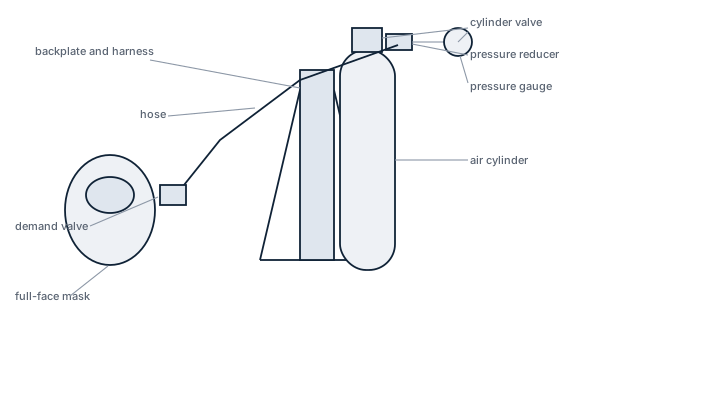
Main components
Cylinder
Compressed air cylinder, steel or composite, most modern sets at 300 bar for a better duration-to-weight ratio than older 200 bar cylinders of the same physical size.
Pressure reducer and demand valve
Steps cylinder pressure down to a usable level and delivers air to the facepiece only on inhalation, conserving the air supply and keeping duration predictable.
Full facepiece
Seals against the face, protects the eyes from smoke and heat, and normally carries a positive pressure inside relative to the surrounding atmosphere so any leak pushes air out rather than letting smoke in.
Harness and back plate
Carries the cylinder weight on the shoulders and hips so the wearer can work, climb and crawl without the set shifting or restricting movement.
Pressure gauge and low-pressure warning whistle
A visible or audible warning, usually mechanical rather than electronic so it works regardless of battery state, that alerts the wearer to withdraw while enough air remains for the return route.
Selection and sizing
Cylinder capacity and pressure rating set nominal duration, but actual duration in service depends heavily on the wearer's exertion and breathing rate, so duration figures on the label are a planning maximum, not a guarantee. Facepiece size range and compatibility with communication equipment matter for crews of varying face sizes and where fire teams need to talk to each other or to a control point during entry.
Regulations and class
SOLAS Ch. II-2 sets minimum numbers of SCBA sets to be carried according to ship type, along with spare cylinder requirements and stowage near fire control stations. Sets must be maintained and function-tested per the maker's schedule and class survey requirements, and personnel using them require training recorded under the vessel's safety management system. Cylinders themselves are subject to periodic hydrostatic testing on a fixed interval regardless of how lightly they have been used.
Typical faults
- Facepiece seal degradation -- rubber or silicone seals age and lose their seal over time; the consequence is smoke ingress into the facepiece during use, defeating the entire purpose of the set.
- Cylinder pressure not checked before stowage -- a set returned after use without recharging; the consequence is a set that reads full on a quick glance but fails within minutes of the next donning.
- Low-pressure whistle not functioning -- corrosion or damage to the mechanical warning; the consequence is a wearer running out of air with no advance warning to withdraw.
- Expired hydrostatic test on cylinder -- missed periodic testing; the consequence is a cylinder that must be taken out of service regardless of its physical condition.
What to look for in a supplier
- Facepiece sizes and harness adjustment covering the actual range of crew who will wear the sets.
- Spare cylinders and seal kits stocked locally, since a set out of service for parts is a set the fire party cannot use.
- Compatibility with the vessel's existing recharge compressor and fill station pressure rating.
- Documented maker service intervals that match what the crew can realistically carry out onboard versus what needs a shore technician.
Check cylinder pressure and facepiece seal condition at every set after a drill, not just before the next one -- a set stowed half-charged after training is the single most common reason SCBA fails when it is actually needed.
5 manufacturers · 15 models
Dräger
7
- Mask seal degradation
- Cylinder valve O-ring leak
- Demand valve diaphragm failure
- Pressure gauge inaccuracy
- Integrated low‑profile full‑face mask with quick‑donning design
- 300 bar cylinder provides longer runtime (≈30 min) than many lower‑pressure units
- Built‑in pressure gauge and demand valve for reliable air flow monitoring
- Meets SOLAS requirements and EN 137‑5 certification, ensuring regulatory compliance
- Robust construction with easy access for annual service by certified technicians
- Runtime limited to ~30 min; not suitable where >45 min endurance is required
- Known wear points: mask seal degradation and cylinder valve O‑ring leaks if maintenance lapses
- Mask diaphragm failure can occur under extreme demand conditions
- Pressure gauge may drift, requiring regular calibration checks
- Weight and bulkier profile compared with ultra‑light tactical SCBAs
- Mask strap deterioration
- Demand valve failure
- Cylinder valve leak
- Low acquisition cost – budget option within Dräger’s SCBA range
- Meets SOLAS requirements for shipboard fire‑fighting equipment
- Compact and relatively lightweight compared with larger models
- Same service interval schedule as the higher‑spec PSS 5000, simplifying maintenance planning
- Proven brand reputation for reliability in maritime environments
- Mask strap material prone to deterioration, requiring regular inspection
- Demand valve design less robust than premium models – occasional failure reports
- No integrated PASS (Personal Alert Safety System) device; must be added separately
- Runtime limited to ~45 min at standard flow, shorter than some higher‑capacity SCBAs
- Cylinder valve leak incidents reported in field service bulletins
- Electronics module failure
- HUD display malfunction
- Cylinder valve issue
- Integrated HUD provides real‑time pressure, remaining time and alarm status at a glance
- Electronic module enables data logging for post‑incident analysis and maintenance tracking
- Compact 9 L cylinder at 300 bar offers sufficient runtime while keeping the unit lightweight
- SOLAS‑approved design meets international fire‑fighting requirements on board ships
- Quick‑change valve system reduces turnaround time during emergencies
- Electronic module and HUD are additional failure points (e.g., display malfunction)
- Higher acquisition cost compared with basic analog SCBAs
- Mandatory annual service; downtime can affect readiness if not scheduled properly
- Battery life limits continuous operation to the cylinder runtime plus a short reserve
- HUD screen may be less visible in extremely smoky or low‑light conditions
- Telemetry transmitter failure
- Cylinder valve O-ring leak
- Demand valve freeze
- Real‑time air‑supply monitoring via wireless telemetry improves crew safety and allows centralized tracking.
- SOLAS‑approved design meets mandatory passenger‑ship regulations.
- Ergonomic harness and head‑mounted display enable quick donning and comfortable wear for extended operations.
- Robust demand valve with 45 min nominal runtime at standard flow rates.
- Integrated voice communication option available for coordinated emergency response.
- Telemetry transmitter can fail, requiring manual checks or backup monitoring.
- Demand valve may freeze in very cold environments, limiting use in Arctic conditions.
- Cylinder valve O‑ring leaks have been reported, increasing maintenance requirements.
- Higher acquisition and service cost compared with basic non‑telemetry SCBAs.
- Electronic components add complexity to routine inspections.
MSA
5
- Mask lens fogging
- Demand valve freeze in cold
- Electronics failure
- Cylinder gauge inaccuracy
- Low‑profile design allows easy storage in confined spaces on board
- Quick donning with integrated face mask reduces response time
- SOLAS compliant, meeting international safety regulations
- Optional thermal imaging camera enhances fire detection capability
- Smaller air cylinder limits endurance compared with larger SCBAs
- Mask lens fogging reported in humid or high‑temperature conditions
- Demand valve may freeze in very cold environments
- Electronic components (e.g., PASS device) can be prone to failure
- Demand valve diaphragm wear
- Mask seal degradation
- Harness buckle failure
- Lightweight design reduces fatigue during extended use
- Ergonomic harness with easy donning and adjustable straps
- Quick‑change cylinder system speeds re‑charging in emergencies
- Integrated pressure gauge gives real‑time air supply readout
- SOLAS compliant, meeting international safety standards
- Limited air capacity compared with larger industrial SCBAs
- Demand valve diaphragm wear reported in field service
- Mask seal degradation can affect fit over time
- Harness buckle failure noted in some maintenance records
- Higher upfront cost than basic entry‑level models
- Regulator first-stage failure
- Cylinder retention mechanism
- Low-pressure alarm malfunction
- Lightweight and low‑profile design reduces crew fatigue and improves mobility
- Ergonomic harness system allows quick donning and comfortable wear during extended operations
- Integrated low‑pressure alarm provides early warning of air depletion
- SOLAS‑compliant first‑stage regulator designed for maritime fire‑fighting conditions
- Annual full service interval simplifies maintenance planning
- Cylinder capacity is smaller than bulkier SCBA models, limiting duration of use
- Reported occasional failures of the cylinder retention mechanism under high‑impact conditions
- Low‑pressure alarm has been noted to malfunction if not inspected regularly
- Regulator first‑stage may be sensitive to extreme temperature swings common on deck
- Not suitable for prolonged underwater or saturation rescue scenarios
- Mask seal deterioration
- Regulator first-stage failure
- Battery for alarm
- Budget‑friendly price point compared with premium SCBAs
- Meets SOLAS certification for maritime use
- Standard service intervals identical to higher‑end models, simplifying maintenance planning
- Robust construction suitable for typical shipboard fire scenarios
- Compact and relatively lightweight for rapid donning
- Shorter air cylinder capacity (typically ~30 min) than premium units
- Mask seal durability issues reported in long‑term service
- Alarm battery may require more frequent replacement
- Limited ergonomic adjustments and accessory options
- Not ideal for prolonged or high‑intensity firefighting operations
Honeywell
1
- Demand valve diaphragm failure
- Harness buckle wear
- Cylinder retention issue
- Low‑profile, lightweight unit improves mobility in confined spaces
- Quick‑change cylinder reduces turnaround time during drills or emergencies
- Integrated demand valve diaphragm offers reliable air delivery under high flow rates
- SOLAS‑approved for maritime use, meeting IMO fire‑fighting requirements
- Ergonomic harness and face mask designed for extended wear on deck
- Air capacity (typically ~30 min) may be insufficient for prolonged firefighting without cylinder swaps
- Known issues with demand valve diaphragm fatigue require vigilant inspection
- Harness buckles can wear, leading to potential fit problems over time
- Cylinder retention mechanism has reported failures if not serviced regularly
- Limited visual field compared with full‑face mask alternatives
Interspiro
1- Demand valve failure
- Mask communication device failure
- Cylinder valve leak
- SOLAS‑compliant and certified to EN 137 standards
- Ergonomic low‑profile mask with built‑in communication headset
- Robust Swedish engineering noted for reliability in harsh marine environments
- Quick‑release cylinder coupling for fast change‑over during emergencies
- Documented demand valve and mask communication device failures in service reports
- Cylinder valve leaks have been reported, requiring vigilant maintenance
- Spare parts and technical support are primarily concentrated in Scandinavia
- May lack USCG Type Approval for vessels operating under U.S. jurisdiction
Scott Safety (Tyco)
1
- Mask seal wear
- PASS device battery failure
- Regulator freeze
- SOLAS‑approved, meeting international maritime fire‑fighting requirements
- Integrated Personal Alert Safety System (PASS) with audible/visual alarms
- Lightweight aluminum frame for easier donning and maneuverability
- Robust regulator designed for marine environments
- Annual service by certified technicians ensures reliability
- Mask seal wear can reduce protection if not inspected regularly
- PASS device battery failure may occur, requiring periodic replacement
- Regulator freeze risk in very cold or wet conditions
- Limited air supply (typically 30‑45 minutes) for prolonged operations
- Higher upfront cost compared with basic non‑integrated SCBAs