What to check on a Electrochlorination BWMS.
An electrochlorination ballast water treatment system generates its own biocide on board by passing a side stream of seawater through an electrolytic cell, producing sodium hypochlorite from the chloride already in seawater. That is the key difference from a UV-based system, which disinfects with light and needs no chemical, and from systems that dose a stored chemical from a tank: electrochlorination needs no consumable to be bunkered, but it does need a working electrolytic cell, a power supply for that cell, and a neutralisation dose at discharge to bring residual…
What sets an electrochlorination system apart from other BWMS technologies
An electrochlorination ballast water treatment system generates its own biocide on board by passing a side stream of seawater through an electrolytic cell, producing sodium hypochlorite from the chloride already in seawater. That is the key difference from a UV-based system, which disinfects with light and needs no chemical, and from systems that dose a stored chemical from a tank: electrochlorination needs no consumable to be bunkered, but it does need a working electrolytic cell, a power supply for that cell, and a neutralisation dose at discharge to bring residual chlorine down to a safe level before the water leaves the ship.
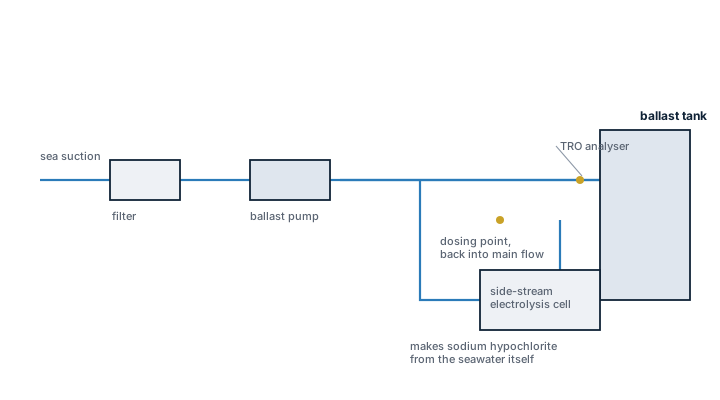
Main components
Filter
Automatic backwashing filter, typically 40-50 micron, removing larger organisms and sediment before the electrolytic stage, exactly as most other BWMS technologies also require during uptake.
Electrolytic cell
Titanium electrodes, often coated, arranged so a side stream of ballast water is electrolysed to produce sodium hypochlorite; scaling on the electrodes from calcium and magnesium salts is the main wear mechanism.
Dosing and mixing system
Injects the generated hypochlorite into the full ballast flow at a controlled concentration, with a static mixer or injection point sized to achieve even distribution.
TRO (total residual oxidant) analyser
Continuously measures chlorine concentration at dosing and again before discharge, the parameter the control system actually manages against.
Neutralisation dosing (discharge side)
Sodium bisulphite or similar reducing agent injected before overboard discharge to bring TRO down below the discharge limit, since untreated residual chlorine is itself an environmental hazard.
Selection and sizing
- Ballast pump capacity in m³/h, since the BWMS must treat at the same rate as the ballast system pumps, not a reduced rate.
- Salinity range of the trading area — electrolytic hypochlorite generation depends on chloride content, so systems intended for low-salinity or brackish trades need a supplementary chemical dosing arrangement or a different technology.
- Power demand of the electrolytic cell and rectifier, which draws meaningfully on ship's electrical generation during ballasting.
- Footprint and hazardous area classification, since chlorine gas can be generated and the cell room needs mechanical ventilation and gas detection.
Regulations and class
Electrochlorination BWMS are approved under the IMO Ballast Water Management Convention, either under the original G8 Guidelines or the revised BWMS Code, and ships trading to the United States also need a separate USCG type approval, which has historically been harder for some active-substance systems to obtain than for UV systems. Since September 2024 the Convention applies to essentially the entire world fleet, and port state control checks the type approval certificate, the ballast water record book, and increasingly takes water samples for indicative analysis at some ports.
Typical faults
| Fault | Cause | Consequence |
|---|---|---|
| Falling TRO output at constant cell current | Scale build-up on electrode surfaces reducing active area | System cannot reach the target dose, and the control logic should stop ballasting rather than discharge under-treated water |
| High power draw for the same output | Electrode ageing or coating degradation nearing end of service life | Increasing electrical load on generators and, eventually, cell replacement |
| Failure to reach discharge TRO limit | Neutralisation dosing pump fault or empty neutralising agent tank | Discharge must be held or the event logged as a deviation, with possible PSC scrutiny at next port |
| Low chlorine generation in brackish water | Insufficient chloride concentration for the electrolytic process to work at rated output | System defaults to a documented exception procedure rather than treating normally, which crews must know in advance |
What to look for in a supplier
- Both IMO BWMS Code and USCG type approval if the trading pattern includes US waters, since one does not substitute for the other.
- Documented minimum salinity for full-rated operation, and what the system does below that threshold.
- Electrode and cell service life and replacement cost pattern, since this is the main recurring cost of the technology.
- Availability of remote diagnostic support, given how often TRO and cell faults need expert interpretation rather than a simple part swap.
Log every low-salinity or low-temperature exception exactly as the manual describes it — a missing or vague ballast water record book entry is one of the fastest ways to turn a routine PSC inspection into a detention.