LED Light Fitting
An LED light fitting replaces the lamp and starter of older fluorescent or filament fittings with a solid-state light source and a driver board, cutting power draw and lamp changes sharply but shifting the failure point to the driver electronics and its heat management.
What to check on a LED Light Fitting.
11 models from Daniamant in LED Light Fitting. Below: the full model list.
What sets an LED fitting apart from the lighting it replaces
A fluorescent or incandescent fitting fails at the lamp: change the tube or bulb and the fitting works again. An LED fitting puts the light-emitting diodes and their driver circuit together as a sealed or semi-sealed unit, so the common failure mode shifts to the driver electronics or to heat building up inside a housing that was not designed to shed it. Against that trade-off, LED fittings draw a fraction of the current of the equivalent fluorescent or halogen fitting, run cooler at the light source itself, and switch instantly without the flicker or delayed strike of a fluorescent tube, which matters for emergency and escape lighting that must be at full output immediately.
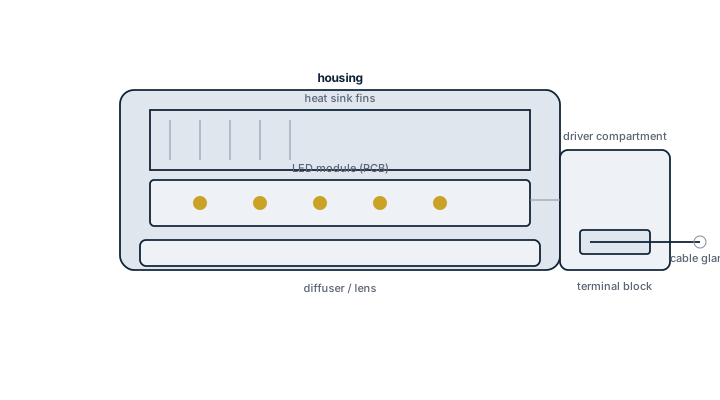
Legend
- Heat sink fins
- Housing
- LED module (PCB)
- Driver compartment
- LED driver
- Terminal block
- Diffuser / lens
- Cable gland
- Light output
Main components
LED array or module
The diodes themselves, mounted on a metal-core board for heat conduction rather than the glass tube of a fluorescent fitting.
Driver
Converts the ship's supply to the low-voltage, constant-current feed the diodes need. This is the part most likely to fail, and the part most sensitive to the ship's supply quality — voltage spikes and poor power factor correction on the ship's network shorten driver life.
Read the full guide
Housing and heat sink
Enclosed or watertight housings, commonly rated for wet or exposed deck locations, with an integral heat sink; undersized heat sinks are a common cause of early LED degradation even when the diodes themselves are rated for a long service life.
Lens or diffuser
Polycarbonate or glass cover controlling beam spread; UV-stabilised polycarbonate is used where the fitting sits in direct sunlight to avoid yellowing.
Selection and sizing
Selection is driven by the location's duty, not just lumen output:
- Ingress protection rating matched to the space (engine room, exposed deck, accommodation)
- Colour temperature appropriate to the space — warmer tones in accommodation, cooler daylight tones in working spaces
- Vibration rating for engine room and steering gear compartment fittings
- Compatibility with the emergency lighting circuit's switchover arrangement where the fitting serves an escape route
Regulations and class
Navigation light fittings must meet COLREG intensity, colour and arc-of-visibility requirements and carry type approval to IEC 60945 or the applicable IALA/national standard referenced by class. General shipboard fittings follow IEC 60092 series requirements for electrical installations, and emergency and escape route lighting must meet SOLAS Ch. II-2 provisions on low-location lighting and emergency power changeover time. Electromagnetic compatibility matters more for LED drivers than for older lighting, since a poorly filtered driver can radiate interference into nearby navigation or communication equipment.
Typical faults
| Fault | Consequence |
|---|---|
| Driver failure from voltage transients on the ship's supply | Fitting goes dark even though the LEDs themselves are undamaged |
| Heat sink fouled with dust or paint overspray | Reduced LED lifespan and gradual dimming well before the rated hours are reached |
| Seal degradation on exposed deck fittings | Moisture ingress causing corrosion of the driver board |
| Mismatched replacement driver during a repair | Flicker, reduced output or repeated early failure |
What to look for in a supplier
- Type approval certificate for the specific fitting, not a general manufacturer statement
- Driver rated for the ship's actual supply quality, including any known transient or harmonic issues on board
- Stocked, compatible replacement drivers rather than a fitting that requires full replacement on driver failure
- Documented lumen maintenance curve, not just an initial output figure
When an LED fitting goes dark, check the driver before condemning the whole unit — on most fittings the driver is a separate, replaceable part and swapping it is far cheaper than a new fitting.
Models in this type.
The best-documented model of each manufacturer first, then the next — 11 of 11 models in LED Light Fitting. Every row links to full specifications, documents and service notes.
Manufacturers.
All 57 manufacturers with models of LED Light Fitting. Names with a manufacturer page open it; the others open a search across the full library.
All manufacturersShow all 57 manufacturers
Also in Lighting.
The other equipment types in this category.
One request. A person reads it and replies by e-mail.
Tell us the manufacturer, the model and what you need — a part, a service call, a second opinion. A person reads every request and replies by e-mail.
No details at hand? A photo of the rating plate or the part is enough — simply attach it to the request.
Three things people ask first.
Is LED Light Fitting data free?
Yes. Every model page, every guide and every datasheet for this type is readable without an account. An account adds saved searches and requests, nothing is taken away.
My model is missing — what now?
Send us the nameplate. We identify it by hand, add it to the library, and if you need a part or a service, the request is already on our desk.
Can you source a LED Light Fitting part?
Yes. Tell us the manufacturer, the model and what you need — a person reads every request and replies by e-mail.