Stern Tube Bearing
The stern tube bearing carries the propeller shaft at the one point it exits the hull, combining a load-bearing duty with a sealing duty that plain line bearings elsewhere in the shaft line never have to handle.
What to check on a Stern Tube Bearing.
10 models from SKF Marine in Stern Tube Bearing. Below: the full model list.
What defines this type
The stern tube bearing supports the propeller shaft at the single point where it exits the hull, carrying the weight of the shaft and propeller overhang while sealing against seawater ingress on the outside and lubricant loss on the inside. That combination of load-bearing and sealing duty at a rotating hull penetration is what separates it from the plain line bearings further forward in the shaft line, which only carry radial load and see no sealing duty at all.
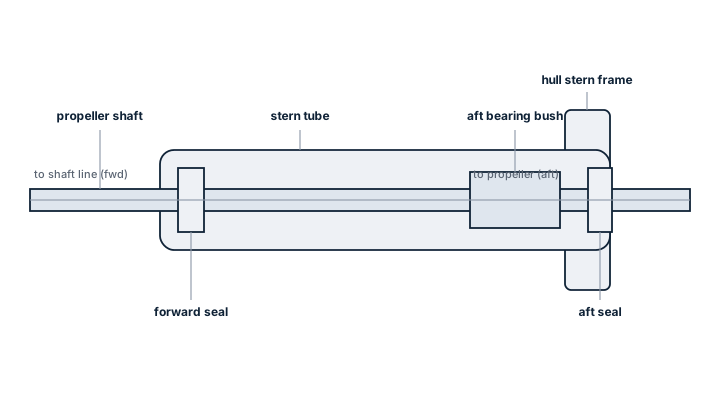
Legend
- hull stern frame
- stern tube
- propeller shaft
- aft bearing bush
- to shaft line (fwd)
- to propeller (aft)
- forward seal
- aft seal
Main components
Bearing bush
Either white metal (babbitt) running in oil, or a synthetic rubber or polymer compound running in water — oil-lubricated white metal gives lower friction and less wear but depends entirely on seal integrity; water-lubricated synthetic bearings tolerate seal wear better since the lubricant is seawater itself, at the cost of higher sensitivity to grit and sand ingestion.
Forward and aft bearings
Most stern tubes carry two bearings, one at each end of the tube; the aft bearing takes the larger share of load from the propeller overhang and wears faster as a result, which is why wear-down readings are taken and logged separately for each.
Read the full guide
Sealing arrangement
Lip seals or face seals at the forward and aft ends of the tube keep oil in (or, on water-lubricated systems, keep the lubrication water contained to the intended path) and keep the open sea out; seal condition and lubricant type together set the vessel's oil-to-sea pollution risk at this single point.
Lubrication system
Oil-lubricated tubes run from a header tank with a static head sufficient to keep tube pressure above surrounding sea pressure at the aft seal, with a sight glass and level alarm; water-lubricated tubes rely on grooved bearing surfaces to distribute seawater and carry away wear particles.
Selection / Sizing
| Parameter | Why it matters |
|---|---|
| Shaft diameter | Sets the bearing bore and load-carrying requirement |
| Length-to-diameter (L/D) ratio | Governs specific bearing pressure and heat generation |
| Lubrication type | Oil for lower friction/wear; water for pollution-risk reduction |
| Specific bearing load | Compared against the bush material's rated pressure limit |
| Shaft alignment tolerance | Poor alignment concentrates load at one edge of the bearing rather than spreading it evenly |
Regulations / Class
IACS Unified Requirements (the M-series covering shafting) set wear-down limit criteria and the survey basis for stern tube bearings, and class rules require periodic wear-down measurement — commonly at intermediate and special surveys, or on a continuous survey basis for vessels enrolled in that scheme — comparing measured clearance against the bearing's original and maximum permissible clearance. Where oil lubrication is used, MARPOL Annex I governs any discharge risk at the stern tube seal, and several port states and the US Vessel General Permit framework require environmentally acceptable lubricants (EAL) in oil-to-sea interfaces including stern tubes operating in their waters, which has pushed many owners toward EAL-compatible oils or water-lubricated systems entirely.
Typical faults
- Wear beyond class limit — gradual bush wear increases shaft clearance and vibration; caught late, it risks contact between shaft and bearing housing rather than a clean bush surface.
- Seal leakage — a worn or damaged seal on an oil-lubricated tube causes a slow oil-to-sea leak that can go undetected until a sheen is reported or a header tank level drops faster than expected.
- Overheating — insufficient lubrication flow or a misaligned bearing concentrates friction and heat at one point of the bush, accelerating wear at that spot specifically rather than evenly.
- Edge loading from misalignment — a shaft line out of alignment loads one edge of the bearing far harder than the rest, wearing a taper into the bush that a straightforward diameter check can miss.
- Abrasive wear on water-lubricated bearings — sand or grit drawn in with the lubrication water scores the synthetic bush surface, a failure mode oil-lubricated systems do not share.
What to look for in a supplier
- A bearing design with class type approval or design assessment for the vessel's shaft diameter and expected load.
- Clearly stated original and maximum permissible wear-down figures, matching what the class surveyor will measure against.
- EAL compatibility data if the vessel trades into waters requiring environmentally acceptable lubricants.
- A bush material recommendation based on the vessel's actual lubrication type and operating draft variation, not a default catalogue choice.
Log wear-down readings against the same reference marks every time, not just against the class limit — a bearing wearing unevenly across its length shows up as a trend long before it shows up as an out-of-limit single reading.
Models in this type.
The best-documented model of each manufacturer first, then the next — 10 of 10 models in Stern Tube Bearing. Every row links to full specifications, documents and service notes.
Manufacturers.
All 17 manufacturers with models of Stern Tube Bearing. Names with a manufacturer page open it; the others open a search across the full library.
All manufacturersAlso in Shaft Line Equipment.
The other equipment types in this category.
One request. A person reads it and replies by e-mail.
Tell us the manufacturer, the model and what you need — a part, a service call, a second opinion. A person reads every request and replies by e-mail.
No details at hand? A photo of the rating plate or the part is enough — simply attach it to the request.
Three things people ask first.
Is Stern Tube Bearing data free?
Yes. Every model page, every guide and every datasheet for this type is readable without an account. An account adds saved searches and requests, nothing is taken away.
My model is missing — what now?
Send us the nameplate. We identify it by hand, add it to the library, and if you need a part or a service, the request is already on our desk.
Can you source a Stern Tube Bearing part?
Yes. Tell us the manufacturer, the model and what you need — a person reads every request and replies by e-mail.