What to check on a Freshwater Generator / Watermaker.
36 models from RWO/Veolia in Freshwater Generator / Watermaker. Below: the full model list.
What sets this type apart
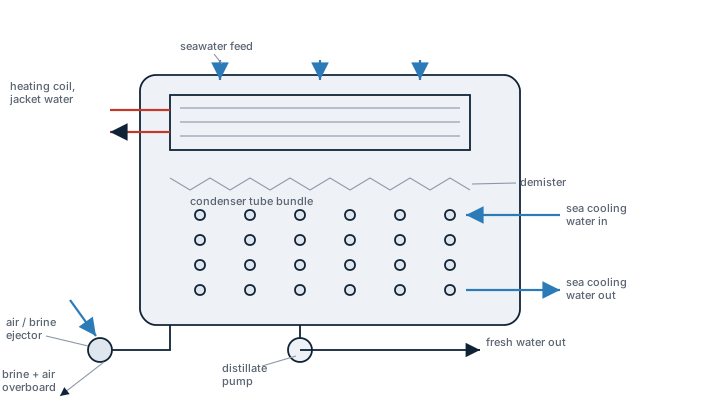
Two distinct technologies share the "freshwater generator" and "watermaker" names aboard ship, and they work on completely different principles. A vacuum flash-type freshwater generator (FWG) boils seawater at low temperature by dropping the pressure inside an evaporator shell, using waste heat recovered from main engine jacket cooling water, so it produces water essentially for the cost of the electricity running its ejector or vacuum pump. A reverse osmosis (RO) watermaker instead forces seawater at high pressure, commonly 55-70 bar, through semi-permeable membranes that reject dissolved salt, and it needs no waste heat source but consumes significant electrical power to drive the high-pressure pump. FWG units depend on the main engine running to have waste heat available, which is why they cannot produce water in port on some vessels; RO units run independently of the propulsion plant and are the standard choice on ships that spend long periods at anchor or alongside.
Read the full guide
Main components
Vacuum flash-type freshwater generator
- Evaporator shell under vacuum, heated by jacket cooling water through a plate or tube heat exchanger.
- Condenser section, cooled by seawater, where the flashed vapour condenses back to distillate.
- Ejector or vacuum pump, maintaining the low pressure that lets seawater boil at 40-70 degrees C instead of 100.
- Salinometer and dump valve, diverting product water overboard automatically if salinity rises above the set limit.
Reverse osmosis watermaker
- Pre-filtration stage (cartridge filters, sometimes a media or ultrafiltration pre-treatment) to protect membranes from suspended solids.
- High-pressure pump, the main power consumer in the system.
- Membrane pressure vessels containing spiral-wound RO membrane elements.
- Energy recovery device on larger units, recovering pressure from the reject brine stream to cut power consumption.
Selection and sizing
| Parameter | FWG (evaporator) | RO watermaker |
|---|---|---|
| Energy source | waste heat plus small electric load | electric power to high-pressure pump |
| Typical output | scaled to jacket water heat available | scaled to membrane area and pressure |
| Feed water sensitivity | tolerant of turbidity, sensitive to oil contamination of heating water | sensitive to suspended solids and biological fouling of membranes |
| Operable in port/at anchor | only if an alternative heat source is available | yes, independent of main engine |
Regulations and class
Product water quality for drinking purposes must meet the flag state's or WHO-referenced potable water standard, checked by periodic sampling rather than by a single class rule. Class societies review the pressure design of RO high-pressure sections and the vacuum/heat exchanger design of evaporators as part of standard machinery approval; there is no dedicated IMO convention for freshwater generation equipment itself. Where potable water is made near coastal or contaminated water, port state and public health authorities may require the salinometer/dump valve function to be demonstrated at survey.
Typical faults
- Scaling on evaporator heating surfaces - reduces heat transfer and output over weeks of operation, needing periodic acid cleaning.
- Membrane fouling or biological growth (RO) - falling permeate flow and rising salt passage, usually from inadequate pre-filtration or a feed pump left idle without flushing.
- Salinometer drift - an uncalibrated sensor lets off-spec water into the potable tank undetected, or dumps good water needlessly.
- Vacuum leaks (FWG) - air ingress at shell joints or the ejector raises the boiling point needed and output falls even though heat input is unchanged.
What to look for in a supplier
- Documented output at the actual jacket water temperature and flow available on the specific engine, not a generic rated figure (for FWG).
- Membrane element compatibility and availability for the specific pressure vessel, since RO elements are not universally interchangeable (for RO).
- Materials resistant to seawater corrosion throughout, particularly titanium or cupro-nickel in the evaporator/condenser shell.
Never run a freshwater generator while manoeuvring in coastal or turbid water - silt and pollutants drawn in with the seawater feed foul the plant far faster than open-ocean operation, on both evaporator and RO types.