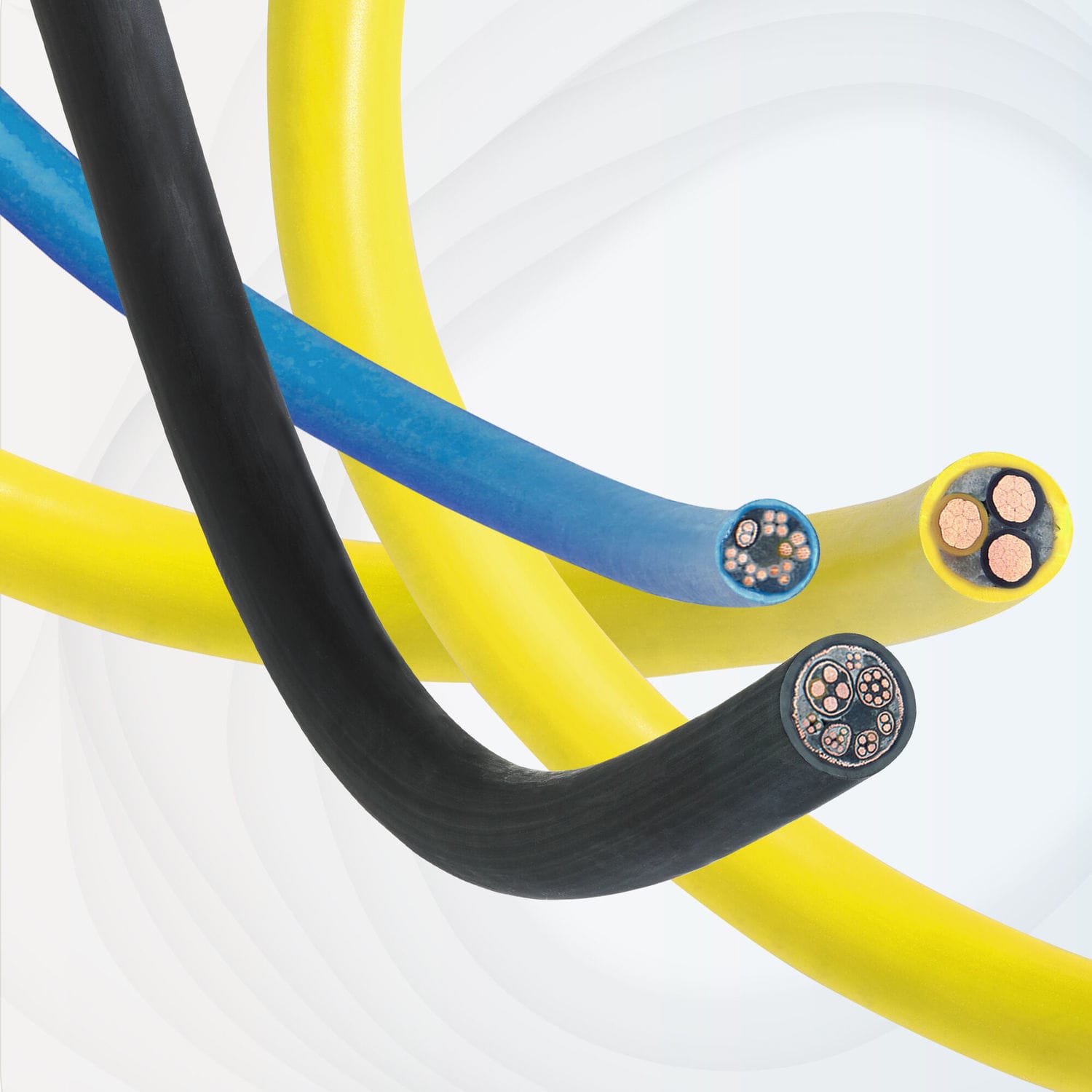
Fire-Resistant Cables
Fire-resistant cable, tested to IEC 60331 or BS 6387, keeps conducting for a defined time while burning so circuits like emergency lighting, fire pumps and public address stay powered during the fire they are meant to fight, unlike ordinary flame-retardant cable, which only resists the fire spreading along it.
Read more — Fire-Resistant Cables explained ▾
What sets fire-resistant cable apart from flame-retardant cable
Flame-retardant cable is designed so a fire does not propagate along the cable run from one space to another; it says nothing about whether the cable still conducts once it is burning. Fire-resistant cable is tested under IEC 60331 or the equivalent BS 6387 categories to keep circuit integrity, meaning it must go on carrying current, for a defined period, commonly 90 minutes to 3 hours depending on the standard and test category, while directly exposed to flame, and in some test categories while also being subjected to water spray or mechanical shock. Every circuit that must function during a fire, not just survive one nearby, needs this cable specifically.
Main components
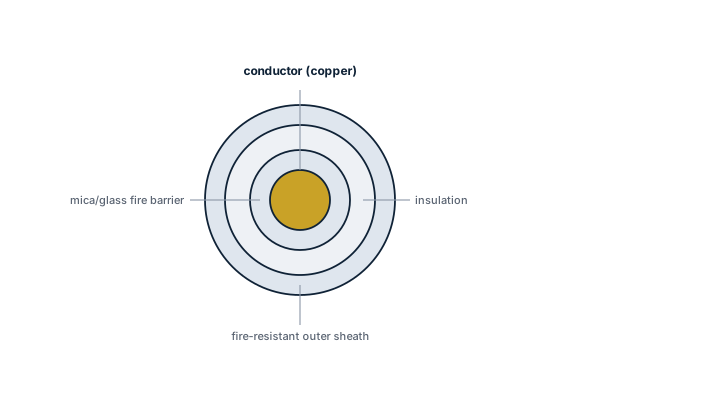
Conductor
Usually copper, sized as for any power or control circuit, but the conductor itself is not what survives the fire; the insulation system around it is.
Fire barrier layer
A mica tape or ceramifiable silicone layer wrapped directly around the conductor forms a rigid insulating barrier once the surrounding material has burned away, keeping the conductors from shorting against each other or against the armour.
Insulation and sheath
Low smoke and halogen-free (LSZH) compounds form the outer insulation and sheath, limiting toxic and corrosive smoke generation, which matters as much for escape routes as the fire resistance itself.
Armour
Braid or wire armour protects against mechanical damage during installation and service and, on some designs, contributes to maintaining circuit geometry once the outer sheath has burned off.
Selection and sizing
Selection is driven by which circuits are classed as fire-critical, not by the same load and voltage-drop calculation used for ordinary power cable, though that calculation still applies underneath the fire-resistance requirement.
- Which SOLAS-mandated services the circuit serves: emergency lighting, fire detection, fire pumps, public address, steering gear.
- Required fire resistance duration and test category (IEC 60331-21 for cables rated over 1kV differs from -11 and -25 for lower voltage cable).
- Smoke and toxicity performance (LSZH) for cable routed through escape routes.
- Route: fire-resistant cable loses its point if routed through the exact space most likely to burn early, so routing away from high fire-risk spaces is part of the design, not just the cable spec.
Regulations and class requirements
SOLAS Ch. II-2 identifies the essential services that must remain operational during a fire and, by extension, requires the cables feeding them to maintain circuit integrity for a defined period. Class rules for electrical installations reference IEC 60331 and IEC 60332 (flame propagation) test standards and specify which circuits on board must use fire-resistant cable versus ordinary flame-retardant cable. Cable certification is checked against a type approval certificate during initial survey, and cable routing drawings are reviewed to confirm fire-critical circuits do not run through a single fire zone without redundancy.
Typical faults
| Fault | Cause | Consequence |
|---|---|---|
| Mechanical damage to fire barrier layer | Rough handling or tight bend radius during installation | Loss of circuit integrity rating at that point, undetectable until a fire occurs |
| Wrong cable used on a fire-critical circuit | Substitution with standard flame-retardant cable during a repair | Circuit fails during the fire it was meant to support |
| Routing through a single fire zone | Design or later modification ignoring segregation rules | One fire disables both the circuit and its intended backup |
| Termination not fire-rated | Standard glands or terminal blocks used at cable ends | Circuit fails at the termination even though the cable itself survives |
What to look for in a supplier
- Type approval certificate stating the exact test standard and category (IEC 60331-21, BS 6387 CWZ, etc.), not just a general fire resistant claim.
- LSZH compliance documentation for cable routed through accommodation and escape routes.
- Consistency of construction batch to batch, since fire-resistant performance depends on the barrier layer being applied correctly, not just on the compound used.
- Compatible fire-rated glands and terminations supplied or specified alongside the cable itself.
A fire-resistant cable run that passes through the same fire zone as its backup circuit has not actually bought any redundancy; check the routing drawing, not just the cable spec sheet.