"> Marine Power Cable - Equipment Database

Marine Power Cable

medium 2 models total

A marine power cable carries current from switchboard to consumers and is built for a fire and a flooded bilge a shoreside industrial cable never has to survive, with low smoke sheathing and, on critical circuits, fire-resistant construction.

Read more — Marine Power Cable explained

What sets a marine power cable apart

A marine power cable carries current from switchboard or distribution board to motors, heaters and other consumers, and it is built for a fire and a flooded bilge that a shoreside industrial cable never has to survive. Low smoke, zero halogen sheathing, flame-retardant construction and, on critical circuits, fire-resistant construction that keeps conducting through a fire are what separate it from an equivalent-rated cable sold for a factory floor.

Marine power cable cross-section
Cross-section of a marine power cable showing the copper conductor, its insulation, common bedding, steel wire armour and the outer low-smoke sheath, drawn as one representative core inside the shared outer layers.

Main components

Conductor

Stranded copper, sized by cross-sectional area to the rated current with derating for the number of cables run together in a bunch and for ambient engine room temperature, since heat from neighbouring cables and machinery both reduce the safe current a cable can carry.

Insulation

Cross-linked polyethylene (XLPE) or ethylene propylene rubber (EPR) is standard for marine power cables, chosen for its temperature rating and resistance to oil and moisture over long service life in an engine room or weather-exposed run.

Bedding, armour and sheath

A bedding layer protects the insulation from the armour, a braid or wire armour gives mechanical protection against impact and an earth continuity path, and an outer sheath, low smoke zero halogen on modern ships, is the final barrier against oil, water and abrasion.

Fire-resistant variants

For circuits that must keep working during a fire, such as emergency fire pumps or steering gear, mineral-insulated or specially compounded fire-resistant cable maintains circuit integrity for a defined time under flame exposure, tested to a recognised fire survival standard.

Selection and sizing

Cable size follows rated current with voltage drop and short-circuit withstand checked separately, not assumed from current rating alone; a cable long enough to reach a remote consumer can need up-sizing purely to keep voltage drop within limits even though its current rating alone would suffice. Segregation is as much a selection question as sizing: power and control cables for duplicated essential systems must run by separate routes so a single fire or flooding event cannot take out both the main and the backup.

Regulations and class

  • SOLAS Chapter II-1 and II-2 set requirements for cable construction, fire performance and the segregation of duplicated essential services.
  • IEC 60092 series is the reference standard most class societies apply for marine cable construction, testing and current-carrying capacity tables.
  • Cables for essential and emergency services must meet flame-retardant or fire-resistant test standards recognised by class, verified at the type approval stage rather than left to the installer's judgement.

Typical faults

FaultConsequence
Overloaded bunch derating ignored during installationInsulation overheating and premature ageing, hidden fire risk
Armour or gland not properly earthed at terminationLoss of earth fault protection, shock hazard
Cable routed through a space without correct segregationSingle fire or flood event disables duplicated systems
Sheath abrasion where cable passes through a bulkhead penetrationMoisture ingress, insulation breakdown over time

What to look for in a supplier

  • Type approval certificate referencing IEC 60092 or the equivalent standard for the specific cable construction ordered.
  • Fire test certification appropriate to the circuit's duty: flame-retardant for general power, fire-resistant for emergency circuits.
  • Consistent conductor sizing and colour coding across a batch, since mismatched deliveries complicate as-built documentation later.

Voltage drop over a long run to a remote consumer is easy to overlook when sizing by current rating alone; check it separately, especially on steering gear and windlass feeders where a motor already starts under heavy load.
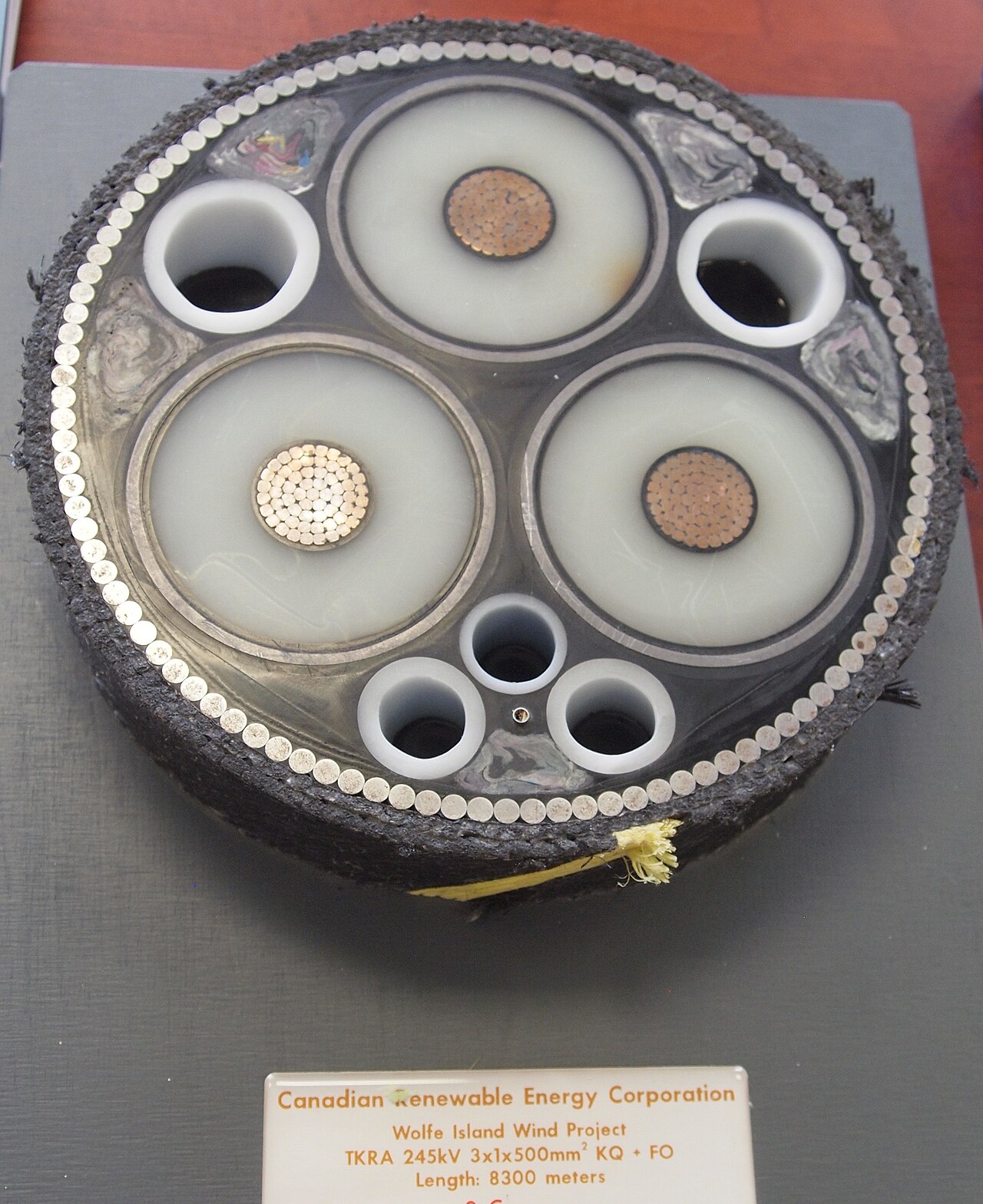
Submarine power cable
Submarine power cable. Photo: Z22, CC BY-SA 3.0, via Wikimedia Commons

2 manufacturers · 2 models

Nexans

1
Nexans MPRX Marine Power Cable
MPRX Marine Power Cable
1.5-300mm², 0.6/1kV · Electrical Cabling · XLPE marine power cable
Type
XLPE Marine Power Cable
Common Failures & Inspection Points
  • Insulation aging from heat/vibration
  • Armor corrosion in bilge areas
  • Gland termination failure
  • Conductor damage from bending
Service: IEC 60092 / class-approved. Insulation resistance test annually. Replace damaged cables — no splicing in marine.
Spare Parts: Ersatzteile über Nexans oder zugelassene Vertriebspartner. Lead time: 2-6 Wochen.
Strengths
  • High temperature resistance of XLPE insulation (up to 90 °C) reduces risk of heat‑related aging
  • Armoured construction provides mechanical protection against vibration and impact in ship environments
  • IEC 60092 class‑approved, ensuring suitability for offshore and vessel installations
  • Nexans brand reputation for long‑term reliability and extensive marine service support
Weaknesses
  • Rigid armouring can limit flexibility; tight bend radii may cause conductor damage
  • Armor corrosion risk in high‑humidity bilge areas if not properly maintained
  • Termination requires specialized glands; field splicing is prohibited, increasing installation time
  • Higher upfront cost compared with generic non‑marine cables
Typical Vessels: TankerContainer shipBulk carrierOffshore support vesselCruise linerNaval auxiliary ship
Decision Guide: Choose if: you need a cable that meets IEC 60092 marine standards, requires robust mechanical protection, and will operate in high‑temperature or vibration‑prone areas. Avoid if: the installation space is extremely confined (tight bend radii) or budget constraints preclude premium‑grade marine cables.
Use Cases: The MPRX cable is typically installed for main power distribution between generators, switchboards, and propulsion equipment on large commercial vessels and offshore support ships, especially where exposure to heat, vibration, and moisture is expected.

Prysmian

1
Prysmian Shipboard FRLSHF Cable
Shipboard FRLSHF Cable
0.75-50mm², 0.6/1kV · Electrical Cabling · Fire‑retardant low‑smoke halogen‑free marine power cable
Type
FRLSHF Marine Cable
Common Failures & Inspection Points
  • Jacket damage from mechanical abuse
  • Conductor overheating from overload
  • Cable gland water ingress
Service: FRLSHF = Fire Retardant Low Smoke Halogen Free. SOLAS requirement for accommodation. Route clear of hot surfaces.
Spare Parts: Ersatzteile über Prysmian oder zugelassene Vertriebspartner. Lead time: 2-6 Wochen.
Strengths
  • Meets SOLAS Chapter II‑1 requirements for fire safety in accommodation areas
  • Low smoke emission and no toxic halogen gases during combustion, enhancing crew safety
  • Fire‑retardant jacket limits flame spread and heat release
  • Designed for marine environments with resistance to moisture and salt spray
  • Flexible construction suitable for routing through confined shipboard spaces
Weaknesses
  • Higher material cost compared with standard PVC or XLPE power cables
  • Larger overall diameter may require larger conduit or cable trays
  • Limited overload tolerance; must be sized correctly to avoid conductor overheating
  • Mechanical protection required in high‑traffic areas to prevent jacket damage
  • Installation requires careful handling to preserve fire‑performance characteristics
Typical Vessels: Passenger shipsCruise linersFerriesOffshore support vesselsNaval auxiliary ships
Certifications: SOLAS Chapter II-1 (Fire safety)IEC 60332-1 (Flame propagation test)IEC 61034 (Low smoke emission)
Decision Guide: Choose if the installation must comply with SOLAS fire‑safety rules for accommodation spaces, when low smoke and halogen‑free performance are critical, or when crew safety during a fire event is a priority. Avoid if budget constraints dominate, the routing area is subject to heavy mechanical abuse, or the required current rating exceeds what FRLSHF cable can safely carry without larger conduit.
Use Cases: Typically installed for powering lighting, HVAC, galley equipment, emergency systems and other auxiliary loads within passenger accommodation decks, crew quarters, and other fire‑sensitive compartments on modern vessels.