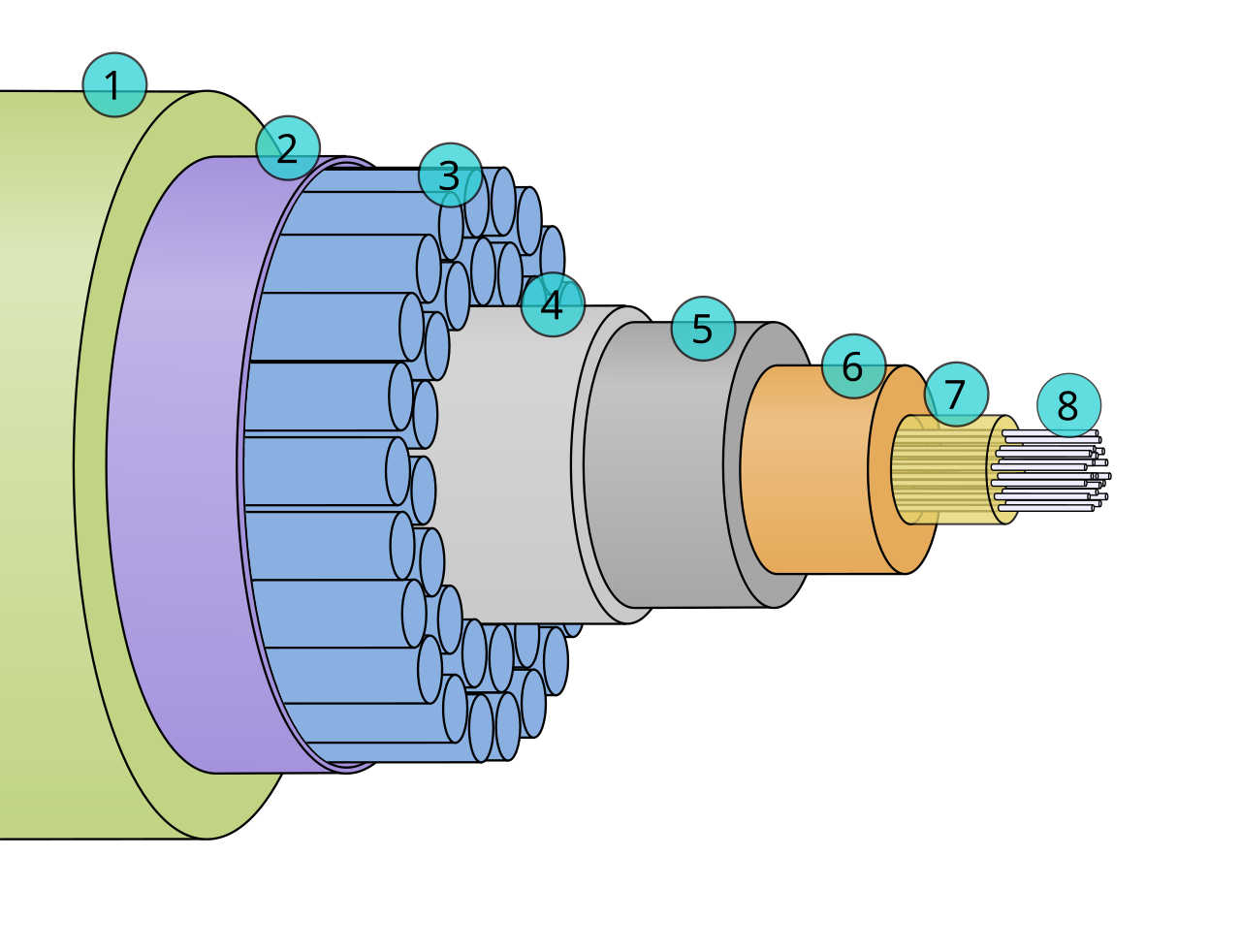
What to check on a Communication Cable.
Where a power cable is sized to carry current without overheating, a communication cable is sized to preserve a clean signal over distance. Twisted pairs, coaxial cores or optical fibres replace the single conductor logic of power wiring, and the outer construction is built around screening rather than heat dissipation. On board a ship this covers everything from telephone and public address wiring to radar data links, alarm monitoring buses and bridge network cabling, all running alongside heavy power runs that would otherwise induce noise into a weak signal.
What sets a communication cable apart
Where a power cable is sized to carry current without overheating, a communication cable is sized to preserve a clean signal over distance. Twisted pairs, coaxial cores or optical fibres replace the single conductor logic of power wiring, and the outer construction is built around screening rather than heat dissipation. On board a ship this covers everything from telephone and public address wiring to radar data links, alarm monitoring buses and bridge network cabling, all running alongside heavy power runs that would otherwise induce noise into a weak signal.
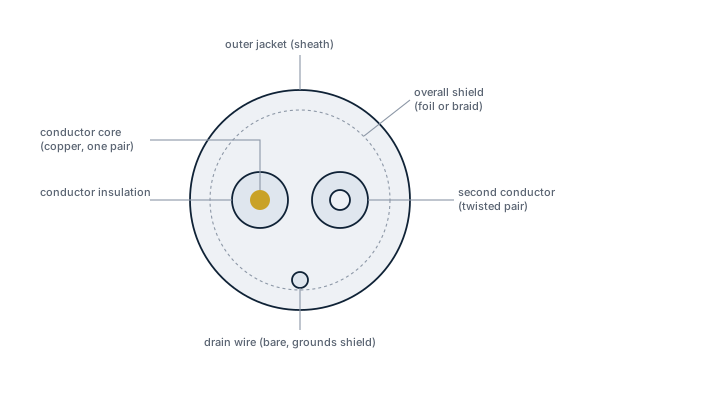
Main components
Conductors and pairs
Tinned or bare copper conductors are stranded for flexibility and grouped as twisted pairs or quads to cancel induced interference. Pair count ranges from a single pair for a simple alarm circuit to multi-pair cables serving an entire automation bus.
Screening
An overall foil or braid screen, sometimes both, drains induced noise to earth at one end only. Individually screened pairs are used where several circuits share one cable and must stay isolated from each other, such as multiplexed alarm and monitoring wiring.
Insulation and sheath
Low-smoke, halogen-free compounds are standard for cables run through accommodation and machinery spaces, matching the fire and smoke requirements applied to power cable in the same routes.
Armour
Braided or wire armour is fitted where the cable runs through areas with mechanical risk, and it also serves as an additional earth path for the screen.
Selection and sizing
- Signal type: analogue, digital serial (RS-422/485), Ethernet or fibre, each with its own impedance and bandwidth needs.
- Pair count and screening, matched to how many independent circuits the cable carries and how sensitive they are to noise.
- Fire performance class, matched to the cable route through main vertical zones.
- Routing distance, since copper data links have practical length limits before signal loss forces a repeater or a switch to fibre.
Regulations and class
SOLAS Ch. II-2 sets the fire performance requirements for cables run through accommodation, service and machinery spaces, including flame-retardant and low-smoke properties for bunched cable runs. Class societies additionally require segregation of essential communication circuits from power cable trunking where practicable, and duplicated systems such as main and emergency communication are expected to run by separate routes so a single cable fire cannot take both out together.
Typical faults
| Fault | Consequence |
|---|---|
| Screen not earthed at one end, or earthed at both | Induced hum or data errors, intermittent alarm faults that are hard to trace |
| Cable run parallel and close to a power feeder | Crosstalk corrupting signal or data, especially on unscreened pairs |
| Sheath damage from chafing at cable transits | Moisture ingress, corroded conductors, gradual rise in circuit resistance |
| Undersized bend radius during installation | Cracked insulation or broken conductor strands, intermittent open circuit |
What to look for in a supplier
- Type approval certificates matching the flag and class combination for the vessel, not just a general product datasheet.
- Documented fire test results for the actual cable construction, not a related product in the same range.
- Consistent core colour coding and marking across a large order, which matters when a yard is pulling hundreds of runs.
- Technical support for termination practice, since data cable performance is as much about the connector as the cable.
Before pulling a new data or alarm cable alongside an existing power trunk, check the screen earthing plan first: a screen earthed at both ends turns the cable into a ground loop antenna, and the resulting noise is often blamed on the equipment rather than the wiring.