Refrigeration Plant
A provisions refrigeration plant is not one machine but two independent circuits sharing a compressor room — one holding a chill room a few degrees above freezing, the other holding a freeze room well below it — and losing either one for more than a day or two turns stored food into a write-off, not a maintenance item.
What to check on a Refrigeration Plant.
4 models from Metos Marine in Refrigeration Plant. Below: the full model list.
What sets a provisions refrigeration plant apart
Unlike a single cold store, a ship's provisions plant runs at least two separate temperature duties from the same compressor package: a chill room held close to 0 to +4 degrees Celsius for dairy, vegetables and short-life goods, and a freeze room held around -18 to -20 degrees Celsius for meat and long-storage items. The two duties are usually served by the same compressors switched between evaporator loads by solenoid valves, or by dedicated compressors per duty on larger vessels, with a common condenser cooled by seawater. The plant has no redundancy of use — there is no shore cold store to fall back on mid-voyage — so its reliability is judged over weeks, not hours.
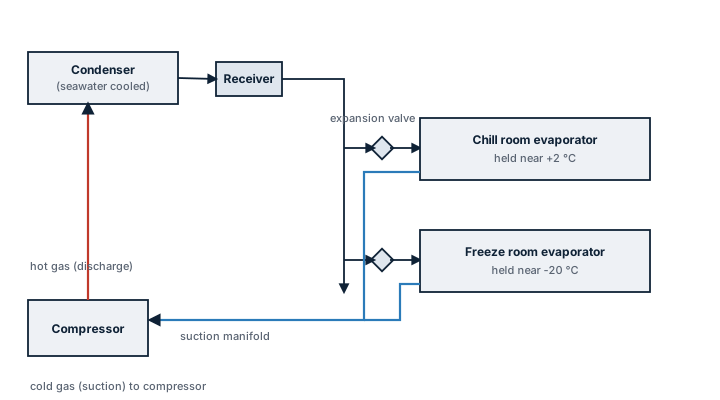
Legend
- Condenser (seawater cooled)
- Receiver
- expansion valve
- Chill room evaporator held near +2 °C
- Freeze room evaporator held near -20 °C
- hot gas (discharge)
- suction manifold
- Compressor
- cold gas (suction) to compressor
Main components
Compressors
Typically reciprocating, semi-hermetic units running on R404A, R507A or increasingly R448A/R449A as older HFCs are phased down under refrigerant regulations; duplicated so one duty can be served if a compressor is down for repair.
Condenser
Shell-and-tube, seawater-cooled, rejecting heat from both circuits; fouling here is one of the most common causes of high head pressure trips.
Read the full guide
Evaporators
Air-cooling units inside each room, fitted with electric or hot-gas defrost to clear ice buildup that would otherwise choke airflow over time.
Expansion valves and solenoids
Meter refrigerant into each evaporator and switch flow between chill and freeze duty depending on the compressor arrangement.
Control and alarm panel
Monitors room temperature, suction and discharge pressure, and raises an alarm on high temperature drift before spoilage begins, not after.
Selection and sizing
- Total insulated volume of chill and freeze rooms combined with expected provisions load for the vessel's endurance between ports.
- Compressor capacity margin above calculated heat load, allowing for tropical seawater temperatures reducing condenser efficiency.
- Refrigerant choice against current phase-down schedules for high-GWP HFCs, which affects long-term parts and top-up availability.
- Defrost method suited to ambient humidity in the trading area, since heavy icing in humid routes needs more frequent defrost cycles.
Regulations and class requirements
Refrigerant handling and leak reporting fall under MARPOL Annex VI provisions on ozone-depleting substances and controlled greenhouse gases, with a mandatory logbook of any refrigerant added or removed. Class societies require periodic survey of pressure vessels and piping in the refrigeration system, and food storage temperature is checked against flag state or port health requirements during inspections, particularly on passenger and crew-heavy vessels.
Typical faults
| Fault | Consequence |
|---|---|
| Fouled seawater condenser | High discharge pressure, compressor trips on high-pressure cutout, room temperature drifts up unnoticed until the alarm fires. |
| Refrigerant undercharge from a slow leak | Compressor short-cycles, evaporator frosts unevenly, room struggles to reach setpoint in warm weather. |
| Defrost timer failure | Evaporator ices solid, airflow drops, chill or freeze room temperature rises gradually over days. |
| Door seal or gasket failure | Constant moisture ingress accelerates icing and increases compressor run time far above design duty. |
What to look for in a supplier
- Parts and refrigerant compatible with the vessel's current charge, not requiring a full retrofit for a single component swap.
- Compressor models with a documented service history on similar tonnage, since provisions plants run near-continuously.
- Alarm and monitoring package that reports to the bridge or engine control room, not only locally at the panel.
- Support for refrigerant recovery and logging that matches Annex VI documentation requirements.
Check the defrost log, not just the room thermometer — a freeze room can read within range for days while the evaporator quietly ices over, and by the time the temperature actually moves the defrost cycle is often too far behind to catch up before spoilage starts.
Models in this type.
The best-documented model of each manufacturer first, then the next — 4 of 4 models in Refrigeration Plant. Every row links to full specifications, documents and service notes.
Manufacturers.
All 11 manufacturers with models of Refrigeration Plant. Names with a manufacturer page open it; the others open a search across the full library.
All manufacturers in the libraryAlso in Refrigeration.
The other equipment types in this category.
Write to us about this model — the answer comes by e-mail.
Name the make and the model and what the job is: a spare, a service call, a second opinion on a data sheet. We answer by e-mail.
No details at hand? A photo of the rating plate or the part is enough — simply attach it to the request.
Questions that come up with this equipment.
Is Refrigeration Plant data free?
Yes. Every model page, every guide and every datasheet for this type is readable without an account. An account adds saved searches and requests, nothing is taken away.
My model is missing — what now?
Send us the nameplate. We identify it by hand, add it to the library, and if you need a part or a service, the request is already on our desk.
Can you source a Refrigeration Plant part?
Yes. Tell us the manufacturer, the model and what you need — a person reads every request and replies by e-mail.