What to check on a Provision Refrigeration Plant.
A provisions plant differs from cargo refrigeration or the ship's air conditioning plant in scale and in what a fault costs: it is small, typically one or two compressor sets serving a handful of insulated rooms, but a breakdown risks the crew's entire food supply rather than a cargo claim or a comfort complaint. The plant must hold two or more distinct temperature zones simultaneously, chill rooms near 0 to plus 4 degrees C for dairy, vegetables and short-life items, and freeze rooms at minus 18 degrees C or colder…
What makes this type distinct
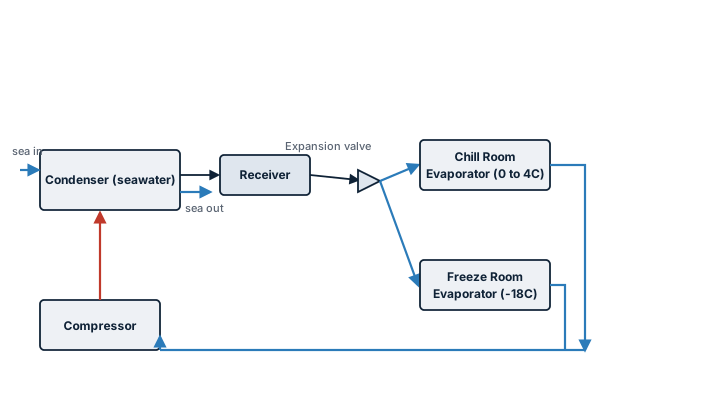
A provisions plant differs from cargo refrigeration or the ship's air conditioning plant in scale and in what a fault costs: it is small, typically one or two compressor sets serving a handful of insulated rooms, but a breakdown risks the crew's entire food supply rather than a cargo claim or a comfort complaint. The plant must hold two or more distinct temperature zones simultaneously, chill rooms near 0 to plus 4 degrees C for dairy, vegetables and short-life items, and freeze rooms at minus 18 degrees C or colder for meat and fish, from the same compressor plant, which is normally done with multiple evaporator coils on separate expansion valves feeding from a shared or dual-stage compressor arrangement.
Main components
Compressor set
Usually two independent compressors for redundancy, sized so either one alone can hold the freeze rooms at temperature if the other is down for maintenance.
Condenser
Seawater-cooled shell and tube condenser rejecting heat from the refrigerant, sized against the highest seawater temperature the ship will trade in.
Evaporator coils
Separate coils in each chill and freeze room, each with its own thermostatic expansion valve and solenoid so rooms are controlled independently despite sharing compressors.
Room insulation and doors
Insulated panels and gasketed, often heated, doors that stop ice building up around the seal in the freeze rooms; door heater failure is a common, easily missed source of poor sealing.
Defrost system
Electric heater or hot gas defrost clearing ice from freeze room evaporator coils on a timer, since ice buildup on the coil is one of the most common causes of poor cooling that gets blamed on the compressor instead.
Selection and sizing
Sizing is driven by room volume, the number of crew and voyage length the provisions must cover, and the highest ambient and seawater temperature the ship trades in, since a plant that copes in temperate waters can fall behind in the tropics. Refrigerant choice now leans toward lower global warming potential options as older HFCs are phased down under international agreements, which affects both the plant's design and its long-term spare parts and refrigerant availability.
Regulations and class
Class societies apply their machinery rules to the provisions plant's pressure vessels, piping and electrical installation, with periodic survey of the refrigeration system as part of the overall machinery survey. Refrigerant handling falls under MARPOL Annex VI and the Montreal Protocol framework, which restricts the use and release of ozone-depleting and high-GWP refrigerants and requires logged records of any refrigerant added or removed. Food safety, strictly speaking, is a port health and flag state matter rather than a class rule, but surveyors and inspectors both check that chill and freeze rooms are actually holding the temperatures the plant is designed for.
Typical faults
| Fault | Consequence |
|---|---|
| Refrigerant leak from a fitting or evaporator coil | Slow loss of cooling capacity, room temperature creeps up before an alarm necessarily triggers |
| Condenser fouling from seawater side scaling or marine growth | Reduced heat rejection, higher compressor head pressure, higher running cost and eventual trip on high pressure |
| Door seal or heater failure on a freeze room | Ice buildup around the frame, door difficult to close, cold air infiltration raising room temperature |
| Defrost timer or heater failure | Evaporator coil ices over, airflow drops, room temperature rises even though the compressor is running normally |
What to look for in a supplier
- Compressor redundancy suited to the ship's voyage length, since a single-compressor plant leaves no margin if it fails mid-voyage.
- Refrigerant type and its long-term regulatory and availability outlook, not just current price.
- Access and serviceability of evaporator coils and door heaters for routine defrost and seal maintenance without shutting the whole plant down.
Log chill and freeze room temperatures at fixed times every day and watch the trend, a plant that is slowly losing capacity shows up in the log days before an alarm or a spoiled delivery does.