Switchboard/MCC
The main switchboard is where every generator's output meets every consumer's demand, and the motor control centre extends that same busbar down to individual starters, which is why a fault at either point can black out sections the crew never expected to lose.
What to check on a Switchboard/MCC.
11 models from Terasaki Electric in Switchboard/MCC. Below: the full model list.
What makes this type
The main switchboard is the busbar and breaker assembly that generators feed into and that distribution boards draw from; the motor control centre (MCC) is a related but distinct assembly, usually downstream of the switchboard, dedicated to housing individual motor starters for pumps, fans and other rotating machinery. Where the switchboard's job is bulk power handling and generator synchronising, the MCC's job is starting, protecting and controlling many individual motors from one compact, centrally wired location rather than scattering starters around the ship next to each motor.
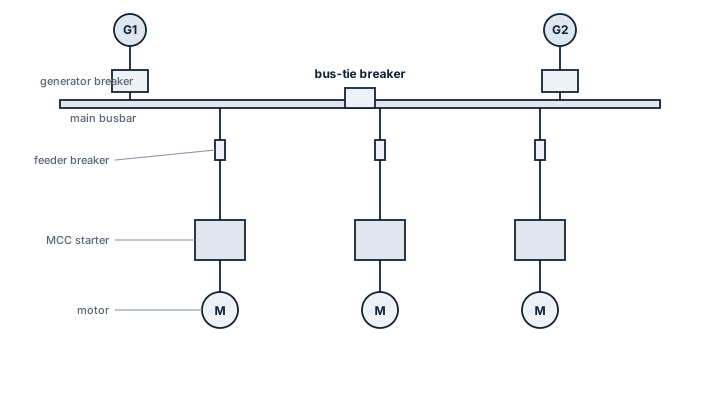
Legend
- bus-tie breaker
- generator breaker
- main busbar
- feeder breaker
- MCC starter
- motor
Main components
Busbars
Copper or aluminium bars carrying the full generated current, split into sections by bus-tie breakers so a fault on one section does not necessarily black out the other.
Generator and bus-tie breakers
Circuit breakers with synchronising and protection relays that allow generators to be paralleled safely and sections to be tied or split.
Read the full guide
Feeder breakers
Individual breakers feeding distribution boards, large consumers and, in the MCC, each motor starter.
Motor starters
Direct-on-line, star-delta or soft-start units, each with overload protection sized to its motor, housed in individual withdrawable or fixed cubicles within the MCC.
Protection relays
Overcurrent, earth fault, reverse power and under/over voltage protection coordinated across switchboard and MCC so a downstream fault trips the nearest breaker first, not the generator breaker.
Selection / sizing
- Total generated capacity and expected load growth, setting busbar current rating with margin.
- Short-circuit fault level the busbar and breakers must withstand, calculated from the generator set's characteristics.
- Number and rating of motor starters needed in the MCC, driven by the machinery list rather than a standard module count.
- Degree of sectionalising (single, split, or fully redundant busbar) matched to the vessel's required level of electrical resilience.
Regulations / Class
SOLAS Ch. II-1 sets requirements for electrical installations including the arrangement of the main switchboard relative to the emergency switchboard and the protection against a single fault disabling both. Class rules require protective device coordination studies (selectivity) to be submitted and verified, and periodic testing of breaker trip settings and insulation resistance is carried out at survey. IACS unified requirements cover short-circuit withstand and type testing of switchgear assemblies.
Typical faults
| Fault | Cause | Consequence |
|---|---|---|
| Protection miscoordination | Relay settings changed locally without updating the selectivity study | Generator breaker trips for a fault that should have been cleared by a feeder breaker, blacking out the whole board |
| Busbar contact overheating | Loose connection or corroded joint | Progressive resistance rise, local burning, risk of fire inside the switchboard |
| Starter overload trip | Motor overload setting too tight or too loose for actual running current | Nuisance trips or, if too loose, undetected motor overheating |
| Insulation degradation | Moisture or dust ingress into an aging cubicle | Reduced insulation resistance, risk of earth fault or flashover |
What to look for in a supplier
- A documented selectivity and short-circuit study delivered with the switchboard, not just the hardware.
- Withdrawable breaker and starter modules where maintenance access without a full shutdown matters to the vessel's operating profile.
- Spares support for individual starter modules, since a single failed starter should not require sourcing an entire MCC section.
After any local change to a breaker or overload setting, update and re-check the selectivity study. An unrecorded setting change is the most common reason a small downstream fault takes down the whole switchboard instead of just one feeder.
Models in this type.
The best-documented model of each manufacturer first, then the next — 11 of 11 models in Switchboard/MCC. Every row links to full specifications, documents and service notes.
Manufacturers.
All 6 manufacturers with models of Switchboard/MCC. Names with a manufacturer page open it; the others open a search across the full library.
All manufacturers in the libraryAlso in Power Distribution.
The other equipment types in this category.
Inspection findings for this equipment
From public port state control and US Coast Guard records; OceanSphere assigns them to this equipment type from the descriptions.
USCG components
- Panelboard – 44 findings
- Switchboard – 16 findings
Write to us about your machine — the answer comes by e-mail.
Name the make and the model and what the job is: a spare, a service call, a second opinion on a data sheet. We answer by e-mail.
No details at hand? A photo of the rating plate or the part is enough — simply attach it to the request.
Questions that come up with this equipment.
Is Switchboard/MCC data free?
Yes. Every model page, every guide and every datasheet for this type is readable without an account. An account adds saved searches and requests, nothing is taken away.
My model is missing — what now?
Send us the nameplate. We identify it by hand, add it to the library, and if you need a part or a service, the request is already on our desk.
Can you source a Switchboard/MCC part?
Yes. Tell us the manufacturer, the model and what you need — a person reads every request and replies by e-mail.