What to check on a Portable Multi-Gas Detector.
9 models from RKI Instruments in Portable Multi-Gas Detector. Below: the full model list.
What makes a portable multi-gas detector different
Fixed gas detection systems monitor set points in machinery spaces and cargo areas continuously, but a portable multi-gas detector goes wherever a person goes: lowered into a tank ahead of the entrant, carried at chest height while walking through a void, or clipped to a harness during the entry itself. It typically reads four or five gases simultaneously from separate sensors in one housing, most commonly oxygen, a combustible gas (lower explosive limit, LEL), hydrogen sulphide, and carbon monoxide, because these four cover the great majority of enclosed space hazards found aboard: oxygen depletion, flammable atmosphere, and the two most common toxic gases.
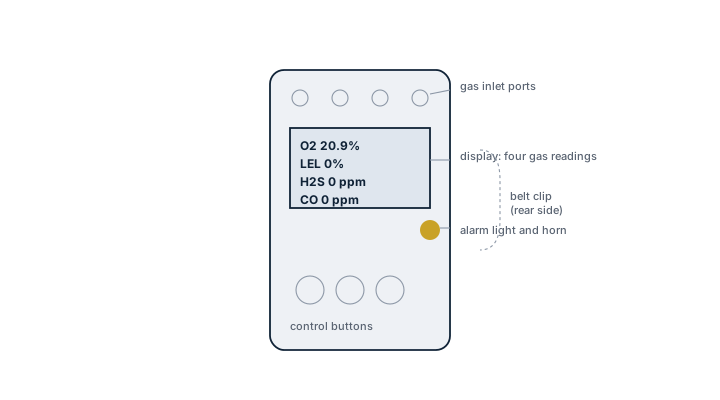
Legend
- gas inlet ports
- display: four gas readings
- O2 20.9% LEL 0% H2S 0 ppm CO 0 ppm
- belt clip (rear side)
- alarm light and horn
- control buttons
Read the full guide
Main components
Oxygen sensor
An electrochemical cell reading percentage by volume, normally alarming low around 19.5 percent and high around 23.5 percent, since both depletion and enrichment are hazardous.
Combustible gas (LEL) sensor
Usually a catalytic bead or, increasingly, an infrared sensor reading percentage of the lower explosive limit; infrared types do not need oxygen present to read correctly and survive oxygen-deficient atmospheres better than catalytic bead sensors, which is why they are now common on marine instruments.
Toxic gas sensors (H2S, CO)
Electrochemical cells specific to each gas, with alarm set points typically well below the level that causes immediate harm, since these gases are dangerous at concentrations far lower than a combustible or oxygen reading would ever flag.
Sampling pump (where fitted)
A motorised pump draws gas up a hose from a remote point, essential for pre-entry checks of a tank from the deck before anyone climbs down, as opposed to diffusion-only instruments that only read the air right at the sensor.
Selection and sizing
The sensor combination must match the actual hazards of the spaces the vessel operates: a tanker needs H2S coverage for crude and some product cargoes, a reefer or fishing vessel needs an ammonia or refrigerant-specific sensor added, and any vessel with a sampling pump needs the hose length rated for the deepest tank aboard. Battery runtime under continuous pump operation, not just diffusion mode, is the figure to check for long confined space jobs.
Regulations and class
- SOLAS Ch. XI-1 Regulation 7 requires ships to carry portable atmosphere testing instruments for enclosed space entry, specifying at minimum oxygen and flammable gas capability, with toxic gas measurement where the risk assessment calls for it.
- IMO's revised recommendations for entering enclosed spaces (resolution A.1050(27)) set out the testing sequence: oxygen first, then flammability, then toxicity, before entry is authorised.
- Class and flag state both check that calibration records and bump-test logs are maintained and that the instrument count matches the number of enclosed spaces requiring simultaneous monitoring.
Typical faults
| Fault | Consequence |
|---|---|
| Sensor past its calibration due date or bump-tested but never fully calibrated | Reading may drift without the crew knowing, giving false confidence in a hazardous space |
| Catalytic bead LEL sensor poisoned by silicone vapour or exposed to an oxygen-deficient atmosphere | Combustible reading understates the real hazard, sometimes reading zero in a dangerous atmosphere |
| Sampling hose left kinked or with a split intake filter | Pre-entry test draws a false sample, missing stratified gas pockets lower in the tank |
| Battery allowed to run flat mid-entry | Loss of continuous monitoring for personnel already inside the space, a serious safety failure |
What to look for in a supplier
- Sensor set matched to the actual cargoes and spaces aboard, not a generic four-gas default.
- Documented bump-test and full calibration intervals with traceable calibration gas and regulator supply reachable at the ship's usual ports.
- Infrared LEL sensor option where oxygen-deficient atmospheres are a realistic risk, given the known limitation of catalytic bead sensors in low oxygen.
- Data-logging models where the vessel's safety management system requires a retrievable record of pre-entry readings.
A bump test before every entry is not optional paperwork; it is the only check that confirms the sensors actually respond to gas on the day, which a calibration certificate from weeks earlier cannot guarantee.