Davit Winch
A davit winch lowers and hoists a lifeboat or rescue boat on its wire falls under a mechanical brake that must hold the boat's full weight indefinitely without drift, and must also permit a controlled, speed-limited descent by gravity even with no power available.
What to check on a Davit Winch.
9 models from Global Davit in Davit Winch. Below: the full model list.
What Sets This Type Apart
The davit winch is the one piece of lifesaving equipment that has to work perfectly on a day when everything else may have already gone wrong: no power, a listing ship, a crew under pressure. Its defining requirement is the fail-safe brake: the winch must lower the boat under gravity at a controlled speed using only the brake, with no reliance on engine power, and that brake must hold the boat stationary at any point in the descent, including fully loaded, without any tendency to creep. This distinguishes it from an ordinary cargo or mooring winch, where the brake is a convenience rather than the entire basis of safe operation.
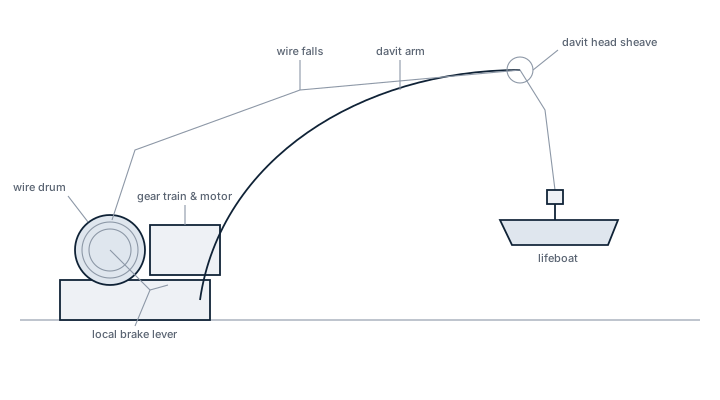
Legend
- wire falls
- davit arm
- davit head sheave
- wire drum
- gear train & motor
- lifeboat
- local brake lever
Main Components
Drum and wire falls
Wire rope falls spooled on the drum, one per fall wire on twin-fall davits, sized and lay-constructed for marine lifesaving service and subject to periodic non-destructive testing or renewal on a fixed schedule.
Centrifugal brake
Governs lowering speed under gravity so the boat descends within the speed range required for the fall length, regardless of load; too fast risks a hard landing or wire runaway, too slow delays launch in an emergency.
Read the full guide
Power drive
Electric or hydraulic motor used for hoisting the boat back aboard and for recovery after drills; not required for lowering, which must work on brake alone.
Manual/emergency release
A hand brake lever or equivalent that lets one crew member control or stop the descent manually if the automatic brake or power system fails, and a means to release the falls at the boat once waterborne.
Selection / Sizing
The winch must be matched to the specific davit and boat it serves rather than selected as a generic component.
- Safe working load matched to the fully loaded lifeboat or rescue boat weight with the required margin, not the boat's empty weight.
- Lowering speed within the regulatory range for the specific fall length fitted on that davit.
- Compatibility with the specific davit's fall arrangement, single or twin fall, and its on-load release gear type.
- Brake holding capacity tested and certified for the maximum load, including a margin above the rated safe working load for the required overload test.
Regulations and Class
SOLAS Chapter III and the LSA Code set the performance requirements for davit winches, including lowering speed limits, brake holding requirements, and the load test regime: a static and dynamic load test on installation, and periodic operational tests and load tests thereafter, typically five-yearly for the full load test under class and flag requirements. Annual thorough examination and periodic winch brake testing are mandatory survey items, and davit-launched lifeboat drills are required at intervals set by SOLAS training and drill requirements.
Typical Faults
| Fault | Cause | Consequence |
|---|---|---|
| Brake slip / drift under load | Worn brake lining or lubricant contamination on the brake surface | Boat creeps or free-falls during lowering, a leading cause of davit-launch injuries and fatalities |
| Excessive lowering speed | Centrifugal brake mechanism worn or incorrectly adjusted | Hard water entry or wire runaway, risking damage to the boat and injury to occupants |
| Wire fall corrosion or broken strands | Inadequate lubrication and inspection, or age beyond the wire's service life | Reduced load capacity, risk of fall failure during launch or recovery |
| Motor fails to hoist | Electrical fault or hydraulic system failure in the power drive | Recovery of the boat after a drill or emergency has to fall back on manual or alternative means |
What to Look for in a Supplier
- LSA Code type approval certificate specific to the winch model and rated load, matched to the davit it will serve.
- Documented brake test and load test certification from installation, not only a manufacturer's data sheet.
- Spare parts availability for brake linings and wire falls specific to that model, since these are the highest-wear items.
- Clear servicing and periodic test procedures aligned with the vessel's class and flag survey schedule.
Treat any change in brake feel, a slightly longer stopping distance, a faint smell, unusual noise, as a reason to stop and inspect immediately, not to note for the next scheduled service, because the failure mode for a davit winch brake is rarely gradual until it is sudden.
Models in this type.
The best-documented model of each manufacturer first, then the next — 9 of 9 models in Davit Winch. Every row links to full specifications, documents and service notes.
Manufacturers.
All 13 manufacturers with models of Davit Winch. Names with a manufacturer page open it; the others open a search across the full library.
All manufacturers in the libraryAlso in Davits.
The other equipment types in this category.
Write to us about this model — the answer comes by e-mail.
Name the make and the model and what the job is: a spare, a service call, a second opinion on a data sheet. We answer by e-mail.
No details at hand? A photo of the rating plate or the part is enough — simply attach it to the request.
Questions that come up with this equipment.
Is Davit Winch data free?
Yes. Every model page, every guide and every datasheet for this type is readable without an account. An account adds saved searches and requests, nothing is taken away.
My model is missing — what now?
Send us the nameplate. We identify it by hand, add it to the library, and if you need a part or a service, the request is already on our desk.
Can you source a Davit Winch part?
Yes. Tell us the manufacturer, the model and what you need — a person reads every request and replies by e-mail.