What to check on a Slewing Davit.
Gravity davits rely on the boat's own weight running down inclined rails to swing it out from its stowed position to over the side; they need a clear straight run of deck and are common on larger cargo ships and tankers with the space to fit them. A slewing davit instead uses a pivoting arm, powered by a hydraulic or electric winch, to rotate the boat out over the ship's side from a compact stowed footprint, which is why slewing davits dominate on passenger ships, offshore vessels and anywhere deck…
What sets a slewing davit apart
Gravity davits rely on the boat's own weight running down inclined rails to swing it out from its stowed position to over the side; they need a clear straight run of deck and are common on larger cargo ships and tankers with the space to fit them. A slewing davit instead uses a pivoting arm, powered by a hydraulic or electric winch, to rotate the boat out over the ship's side from a compact stowed footprint, which is why slewing davits dominate on passenger ships, offshore vessels and anywhere deck arrangement leaves no room for a straight gravity track. The trade-off is more moving machinery: slewing gear, a powered winch, and a boat that is under active mechanical control through the whole launch rather than largely under gravity.
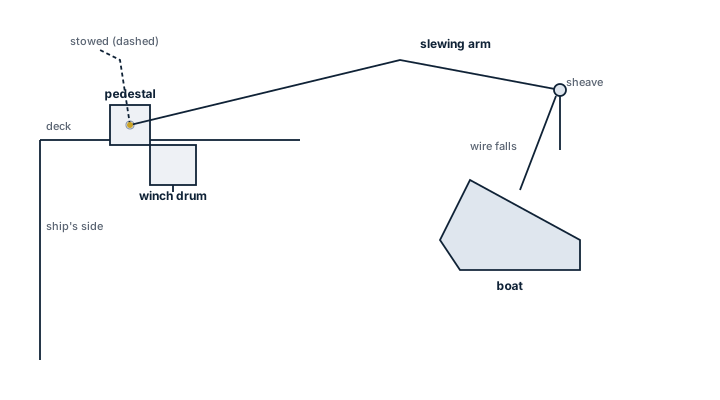
Main components
Slewing arm and pivot
The structural arm that rotates the boat from stowed to launch position, pivoting on a base fixed to the deck or superstructure.
Winch and wire falls
Powered winch controlling the wire falls that raise and lower the boat, fitted with a mechanical brake that must hold the boat's weight without drift even on loss of power.
Hydraulic or electric power unit
Drives both the slewing motion and the hoist, with a manual or gravity-fall backup required so the boat can still be lowered if power is lost.
Limit switches and interlocks
Stop the slewing motion and hoist at their travel limits and prevent the winch running out of control, working alongside the brake rather than replacing it.
Boat release hook
On-load or off-load release gear at the boat itself, separate from the davit, that lets the falls be slipped once the boat is waterborne.
Selection and sizing
- Safe working load against the fully loaded weight of the boat plus its full complement, not the empty boat weight
- Outreach needed to clear the ship's side and any fendering or hull flare at the fitted position
- Available deck footprint for the stowed arm versus the swept area during launch
- Operating angle range the ship's expected list and trim at abandonment, since davits must remain operable within specified limits
Regulations and class
The LSA Code and SOLAS Ch III set the technical requirements for davit-launched survival craft, including load testing, the requirement for the davit to operate at specified angles of list and trim, and the maximum time allowed to launch a fully equipped and manned boat. Class societies require periodic load testing of the davit and winch brake, dynamic testing of the release gear, and confirm that the boat's release hook, a frequent source of past accidents, is maintained to the manufacturer's overhaul schedule rather than just visually inspected.
Typical faults
| Fault | Cause | Consequence |
|---|---|---|
| Winch brake drift | Brake pad wear or hydraulic seal leakage in the power unit | Boat creeps down under its own weight, uncontrolled lowering risk |
| Release hook premature or failed release | Corrosion or lack of maintenance to the on-load release mechanism | Boat drops early during launch, or fails to release once waterborne, both with serious injury risk |
| Slewing arm seized | Corrosion at the pivot bearing from lack of lubrication | Boat cannot be brought to the launch position within the required time |
| Limit switch failure | Water ingress into the switch housing | Winch overruns its travel limit, damaging the falls or the boat |
What to look for in a supplier
- Load test and dynamic release gear test certificates matching the exact davit and hook model fitted
- Manufacturer's overhaul schedule for the release hook, since this component has a documented history of serious incidents when neglected
- Backup lowering method for loss of hydraulic or electric power, confirmed operable without special tools
- Spare parts availability for winch brake components and limit switches given the safety-critical nature of both
A boat that lowers smoothly on drill day tells you little about the release hook — that mechanism needs its own overhaul schedule tracked separately from the general davit maintenance routine.