What to check on a Davit.
Within a launching appliance, the davit itself is the structural member: the arm, track or radial trunnion that moves the boat outboard so it clears the shell plating on the way down. It is not the winch (which pays out the falls) and not the release gear (which lets the boat go once waterborne) - those are separate systems sharing the same installation. What distinguishes one davit design from another is how it gets the boat outboard: a gravity roller-track davit relies on the boat's own weight running down an…
What sets this type apart
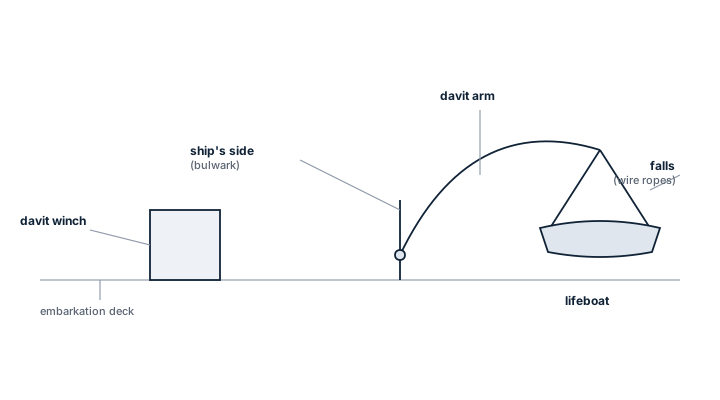
Within a launching appliance, the davit itself is the structural member: the arm, track or radial trunnion that moves the boat outboard so it clears the shell plating on the way down. It is not the winch (which pays out the falls) and not the release gear (which lets the boat go once waterborne) - those are separate systems sharing the same installation. What distinguishes one davit design from another is how it gets the boat outboard: a gravity roller-track davit relies on the boat's own weight running down an inclined track once a brake is released, a luffing (radial) davit swings the boat out on a pivoting arm driven by the winch itself, and a free-fall davit is really just a fixed steel ramp with no launching motion at all - the boat is released and drops.
Main components
Gravity roller-track davit
Twin arms running on curved tracks, a cradle or chocks holding the boat in the stowed position, and a brake that controls the outboard run once tripped. Common for lifeboats on cargo ships and larger passenger areas.
Luffing (radial) davit
A single pivoting arm driven through the winch drum, used widely for smaller rescue boats and liferafts where deck space for a full gravity track is not available.
Free-fall davit
A steel ramp at a fixed angle, typically at the stern, that a free-fall lifeboat slides down under gravity into the water; no swing-out motion, so fewer moving parts but higher structural loads on the ramp and hull at launch.
Selection and sizing
The davit type is fixed early in the ship design by hull form, freeboard and available deck space rather than chosen freely later: free-fall installations need stern clearance and hull strengthening at the ramp, gravity davits need track length matched to boat weight and the distance from stowed position to the waterline at worst-case trim and list. Safe working load is set against the fully equipped lifeboat weight including its full complement, with margin for the list and trim angles required by SOLAS.
Regulations and class
Davit-launched life-saving appliances fall under SOLAS chapter III and the LSA Code, which set launching angles (list and trim conditions the davit must still operate under), maximum lowering speeds and the load test regime. Class surveys require periodic operational tests including a load test of the davit and winch at intervals set by class, plus the five-yearly davit winch brake and structural examination that is a common source of deficiencies at port state control if overdue.
Typical faults
- Track or arm corrosion at the pivot points - reduces free movement and can jam the boat mid-launch, a fault that often only shows up under load.
- Brake linings worn beyond limits on gravity davits - the boat runs out faster than the coxswain can control, especially with list toward the boat.
- Bent arm from a previous hard landing or collision with a passing structure - reduces load capacity without always being visible from deck level.
- Grease or paint buildup in the track - increases friction unevenly across the two arms, causing the boat to launch unevenly rather than in a controlled, level run.
What to look for in a supplier
- Class type-approval certificate for the specific davit model and boat weight range, not just a general LSA compliance statement.
- Documented load test records for the actual unit, not only the design type.
- Availability of matching spare parts - track sections, brake linings, pivot bushings - for the installed model years after original supply.
- Clear maintenance manuals covering the five-yearly and annual test procedures required by class.
A davit that has not been swung out and load-tested recently should be treated as suspect regardless of its paperwork - corrosion inside the track is rarely visible until the boat is already moving.