What to check on a Marine Elevator.
A marine elevator carries the same passenger or goods load as a building lift but must keep running, or fail safely, while the structure it is bolted to rolls, pitches and vibrates. Guide rails, car suspension and control logic all carry extra motion tolerances a land-based lift never sees, and every marine elevator needs a defined means of bringing the car to a floor and releasing passengers if main and emergency power both fail, something a shoreside lift standard does not demand in the same way.
What sets a marine elevator apart from a shoreside lift
A marine elevator carries the same passenger or goods load as a building lift but must keep running, or fail safely, while the structure it is bolted to rolls, pitches and vibrates. Guide rails, car suspension and control logic all carry extra motion tolerances a land-based lift never sees, and every marine elevator needs a defined means of bringing the car to a floor and releasing passengers if main and emergency power both fail, something a shoreside lift standard does not demand in the same way.
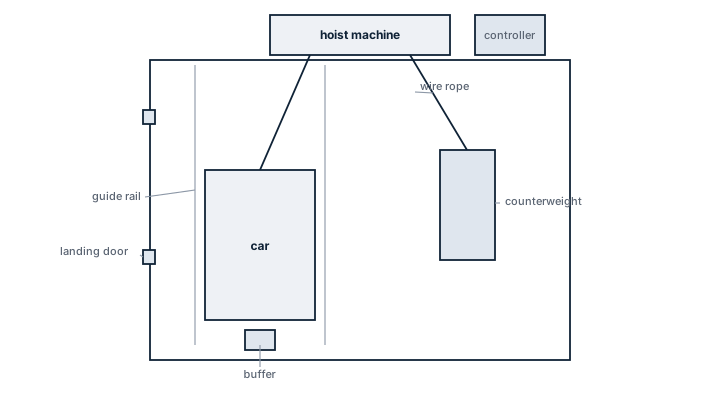
Main components
Car and guide rail system
The car runs on guide rails braced at closer intervals than ashore, and shoes or rollers are set up with extra clearance tolerance to absorb the ship's working movement without binding.
Traction or hydraulic drive
Traction machines with counterweights suit taller runs and passenger service; hydraulic drives, common on lower-rise or offshore installations, avoid overhead machine room space but need a ram and power pack sized for the vessel's roll angles.
Safety gear and buffers
An overspeed governor, safety gear that grips the rails on overspeed, and car and counterweight buffers at the pit are all set to trigger reliably despite the additional accelerations of ship motion, not just vertical overspeed.
Emergency lowering device
An automatic system that, on power loss, moves the car to the nearest floor using stored battery or accumulator energy and opens the doors, so passengers are never left trapped between decks in a blackout.
Selection and sizing
Load and car size follow passenger or stretcher-carrying requirements; many passenger ship elevators are sized to take a standard stretcher plus attendants for medical evacuation between decks. Speed is usually modest compared to shoreside lifts because the number of floors served is small; the harder sizing question is the machine's rated motion envelope, expressed as the roll, pitch and vibration limits the manufacturer certifies the elevator to operate within.
Regulations and class
- SOLAS Chapter II-1 addresses lifts on passenger ships in the context of means of escape and mobility-impaired passenger access.
- Class societies issue a specific lift or elevator notation with type-approved design rules covering motion criteria, safety gear testing and emergency lowering performance.
- Periodic class survey includes load testing, safety gear tripping tests and inspection of the emergency lowering battery system.
Typical faults
| Fault | Consequence |
|---|---|
| Guide rail bracket loosened by vibration over time | Rough running, accelerated shoe or roller wear |
| Emergency lowering battery not load-tested | Car cannot reach a floor during an actual blackout |
| Door interlock contacts corroded in a humid trunk | Nuisance stops, or in the worst case a defeated interlock |
| Hydraulic ram seal wear on a hydraulic-drive unit | Car drifts down from level at rest, tripping the levelling system repeatedly |
What to look for in a supplier
- A documented motion envelope, roll, pitch and vibration, matching the vessel's actual seakeeping figures, not a generic marine rating.
- Class type approval for the safety gear, governor and emergency lowering system as a set, not individually sourced components.
- Spare parts availability for the specific control system, since marine elevator controllers are often a smaller production run than shoreside equivalents.
Test the emergency lowering system under an actual simulated blackout, not just a control-panel self-test; a battery that shows full charge can still fail to deliver the current needed to move a loaded car.