"> Watermaker (Desalinator) - Equipment Database

Watermaker (Desalinator)

medium 5 models total

A reverse-osmosis watermaker pushes seawater through a semi-permeable membrane at 55-70 bar to strip out salt, producing potable water at a fraction of the energy an older evaporator plant needs from waste engine heat.

Read more — Watermaker (Desalinator) explained

What sets an RO watermaker apart

A reverse-osmosis desalinator forces pre-filtered seawater through a spiral-wound semi-permeable membrane at high pressure, typically 55 to 70 bar for seawater feed. The membrane passes water molecules but rejects dissolved salts and most organics, so permeate on the low-pressure side comes out as fresh water while a concentrated brine stream is discharged overboard. This differs fundamentally from the older evaporator (flash or plate) plants still found on steam and larger motor ships, which boil off fresh water using waste heat from jacket cooling water and need no high-pressure pump, but are heavier, slower to start and less suited to small vessels or intermittent operation.
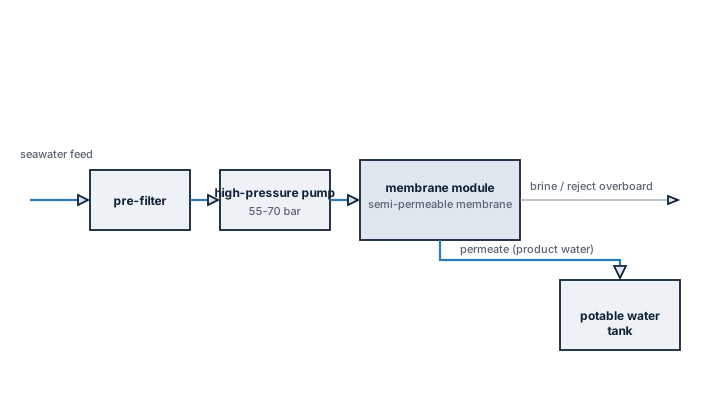
Reverse-osmosis watermaker process
Flow diagram of a reverse-osmosis watermaker: seawater feed through a pre-filter and high-pressure pump into the membrane module, splitting into permeate product water to a storage tank and brine reject overboard.

Main components

Pre-filtration

Sediment and cartridge filters ahead of the high-pressure pump remove particulates that would otherwise scour or foul the membrane surface.

High-pressure pump

A piston or multistage centrifugal pump that raises feed pressure to membrane operating range; this is the highest-wear, highest-energy component in the system.

Membrane vessels

Pressure vessels holding one or more spiral-wound membrane elements in series, sized by the daily production rate required.

Energy recovery device

On larger units, a pressure exchanger or turbine recovers energy from the brine discharge stream and feeds it back into the high-pressure side, cutting specific energy consumption significantly compared with a plant with no recovery.

Product water monitor

A conductivity or salinity sensor with an automatic diversion valve that dumps out-of-specification permeate overboard instead of into the potable tank.

Selection and sizing

Sizing runs off daily production requirement in litres or cubic metres per day against crew and passenger complement, feed water temperature and salinity at the vessel's typical trading area, and available electrical power. Warmer, less saline water yields higher flux for the same membrane area, so a unit sized for the Baltic will underperform in the Red Sea unless margin is built in. Redundancy matters more than on most auxiliary machinery: loss of the only watermaker on a long passage becomes a provisioning emergency, so many owners specify two smaller units over one large one.

Regulations and class

Product water quality is generally checked against WHO or equivalent potable water guideline values rather than a single maritime-specific standard, and class societies typically require the discharge piping and pressure vessel design to meet standard piping class rules rather than imposing desalinator-specific class notations. Flag state and port health authorities may require periodic bacteriological testing of the potable water system downstream of the watermaker, particularly for passenger vessels.

Typical faults

  • Membrane fouling from inadequate pre-filtration — production rate drops and required feed pressure climbs, eventually forcing early membrane replacement.
  • Biological growth during idle periods — a plant left full of seawater without flushing or pickling develops biofouling and odour, degrading product quality on restart.
  • High-pressure pump seal wear — leads to falling pressure and, on piston pumps, oil contamination of the feed side if seals fail completely.
  • Salinity probe drift — an uncalibrated sensor can pass out-of-specification water into the potable tank instead of diverting it overboard.

What to look for in a supplier

  • Membrane and pressure vessel materials rated for continuous seawater duty, not brackish-water equivalents sold at a lower cost.
  • Availability of spare membrane elements and high-pressure pump seals through a marine parts network, not only direct from the manufacturer.
  • A documented flushing and pickling procedure for lay-up periods.
  • Energy recovery efficiency figures quoted at the vessel's actual feed water temperature range, not only at optimum test conditions.

Flush the membrane with fresh water before any lay-up longer than a few days — a plant left sitting full of seawater is the single most common cause of premature membrane replacement on yachts and small vessels.

4 manufacturers · 5 models

Evac

2
Evac FWG 10 unverified
· freshwater generator 10 t/day
System description
freshwater generator 10 t/day
Application
marine sanitary / water treatment
Output tons day
10.0
Evac FWG 25 unverified
· freshwater generator 25 t/day
System description
freshwater generator 25 t/day
Application
marine sanitary / water treatment
Output tons day
25.0

Dessalator

1
Dessalator D-30
D-30
30 L/h · 1.5 kW · Seawater → Freshwater · Reverse Osmosis (RO) watermaker
Medium
Seawater → Freshwater
Power (kW)
1.5
Type
RO Watermaker Compact
Common Failures & Inspection Points
  • Membrane biofouling
  • HP pump seal wear
  • Pressure gauge failure
  • Pre-filter bypass
Service: Compact yacht-size watermaker. Daily flush with FW essential. Membrane replacement every 3-5 years.
Spare Parts: Ersatzteile über Dessalator oder zugelassene Vertriebspartner. Lead time: 2-6 Wochen.
Strengths
  • Compact footprint fits limited engine‑room or deck space on yachts
  • Low power draw (1.5 kW) minimises fuel consumption
  • Simple daily flush routine keeps system clean and reliable
  • Standard RO membrane can be replaced without specialised tools
  • Produces sufficient freshwater for typical crew sizes on private vessels
Weaknesses
  • Requires a mandatory daily fresh‑water flush, adding to crew workload
  • Membrane susceptible to biofouling if water quality or flushing is inadequate
  • High‑pressure pump seals have a known wear pattern and may need frequent overhaul
  • Pressure gauge failures reported, potentially masking performance issues
  • Pre‑filter bypass can occur if filter integrity isn’t regularly checked
Typical Vessels: Sailing yachtMotor yachtCatamaranExpedition/charter vesselCrew boat (small commercial)
Decision Guide: Choose if: you need a space‑saving, low‑power watermaker for a yacht or small crew vessel and can commit to daily flushing and regular membrane care. Avoid if: you operate a high‑output vessel, cannot guarantee routine maintenance, or require a system with minimal manual intervention.
Use Cases: Commonly installed on private yachts, charter boats, and expedition vessels where engine‑room space is at a premium and power availability is limited. Used to provide onboard freshwater for drinking, cooking, and hygiene during extended passages.

Spectra Watermakers

1
Spectra Watermakers Marine Watermaker
Marine Watermaker
40-5000 L/h · 2.0 kW · Seawater → Freshwater · Reverse Osmosis watermaker
Medium
Seawater → Freshwater
Power (kW)
2
Type
RO Watermaker
Common Failures & Inspection Points
  • Membrane fouling from biogrowth
  • HP pump check valve failure
  • Pre-filter clogging
  • Salinity sensor fault
Service: Clark pump for energy recovery — very efficient. Membrane flush with FW after each use. Preservative solution for storage.
Spare Parts: Ersatzteile über Spectra Watermakers oder zugelassene Vertriebspartner. Lead time: 2-6 Wochen.
Strengths
  • Very low power consumption (≈2 kW) suitable for vessels with limited electrical capacity
  • Energy‑recovery Clark pump increases overall efficiency
  • Compact footprint; easy to install in small engine rooms or on deck
  • Simple membrane flushing routine using fresh water after each run
  • Preservative storage solution extends shelf life of membranes
Weaknesses
  • Limited production capacity (typically <50 gal/h) – not ideal for high‑demand vessels
  • Sensitive to feed‑water quality; pre‑filter clogging can reduce output quickly
  • Membrane fouling from bio‑growth requires regular cleaning or replacement
  • HP pump check valve failures have been reported in the field
  • Salinity sensor faults may affect automatic shut‑off and water‑quality monitoring
Typical Vessels: Yacht / SuperyachtFishing vessel (coastal)Offshore supply boat (small)Research or survey craft (under 100 ft)Charter/crew transport vessel
Decision Guide: Choose if you need a low‑power, space‑efficient watermaker for modest freshwater demand and have good pre‑filtration. Avoid on large tankers or vessels requiring high daily production, or where feed water is heavily fouling without robust pretreatment.
Use Cases: Commonly installed on recreational yachts, charter boats, small offshore supply craft, and coastal fishing vessels to provide on‑board freshwater for drinking, cooking, and hygiene during multi‑day passages.

Village Marine Tec

1
Village Marine Tec Marine RO Watermaker
Marine RO Watermaker
50-20000 L/h · 15.0 kW · Seawater → Freshwater · Reverse Osmosis (RO) watermaker
Medium
Seawater → Freshwater
Power (kW)
15
Type
RO Watermaker Marine
Common Failures & Inspection Points
  • HP pump failure
  • Membrane scaling
  • Pressure vessel O-ring leak
  • Boost pump cavitation
Service: US naval and commercial marine supplier. Follow membrane manufacturer cleaning schedule. Annual membrane performance test.
Spare Parts: Ersatzteile über Village Marine Tec oder zugelassene Vertriebspartner. Lead time: 2-6 Wochen.
Strengths
  • Low‑power (15 kW) footprint suitable for medium‑size ships with limited electrical capacity
  • US naval/commercial supplier provides rapid spare‑parts support and service contracts
  • Standardised membrane cleaning schedule prolongs membrane life and maintains output quality
  • Annual performance testing built into service plan ensures predictable freshwater production
  • Compact marine‑grade housing tolerates ship motion and vibration
Weaknesses
  • High‑pressure pump has a documented failure mode that may require frequent inspection or redundancy
  • Membrane scaling can occur in high‑temperature or high‑silt feed water, increasing maintenance intervals
  • Pressure‑vessel O‑ring leaks have been reported under cyclic loading conditions
  • Boost‑pump cavitation reduces efficiency and may necessitate careful suction line design
  • Maximum freshwater output is limited compared with larger shore‑based RO plants
Typical Vessels: Naval patrol boatsOffshore supply vesselsMedium‑size cruise shipsFerriesResearch and survey vessels
Decision Guide: Choose if you need a reliable, low‑power freshwater source on board a medium‑sized vessel with access to US‑based support and can implement regular membrane cleaning. Avoid if your operation demands very high daily water output, operates in extreme scaling conditions, or cannot accommodate the known pump‑related reliability issues.
Use Cases: The unit is commonly installed on naval patrol craft and offshore supply ships to provide crew drinking water during extended deployments, as well as on medium‑size cruise liners and research vessels where shore‑side water resupply is infrequent.