What to check on a Mineral Dosing System.
Fresh water made by reverse osmosis or evaporation on board a ship is essentially demineralised - the same process that removes salt also strips out calcium, magnesium and other minerals naturally present in shore water supplies. That water is flat-tasting and, more importantly, aggressive: it readily leaches metal from copper and galvanised piping because it has no mineral buffer to satisfy its chemical appetite. A mineral dosing system corrects this after the water maker, adding back calcium and magnesium in controlled amounts so the water tastes normal and stops attacking…
What makes this type distinct
Fresh water made by reverse osmosis or evaporation on board a ship is essentially demineralised - the same process that removes salt also strips out calcium, magnesium and other minerals naturally present in shore water supplies. That water is flat-tasting and, more importantly, aggressive: it readily leaches metal from copper and galvanised piping because it has no mineral buffer to satisfy its chemical appetite. A mineral dosing system corrects this after the water maker, adding back calcium and magnesium in controlled amounts so the water tastes normal and stops attacking the ship's pipework, unlike disinfection systems such as UV or chlorine dosing, which address bacteria rather than mineral content.
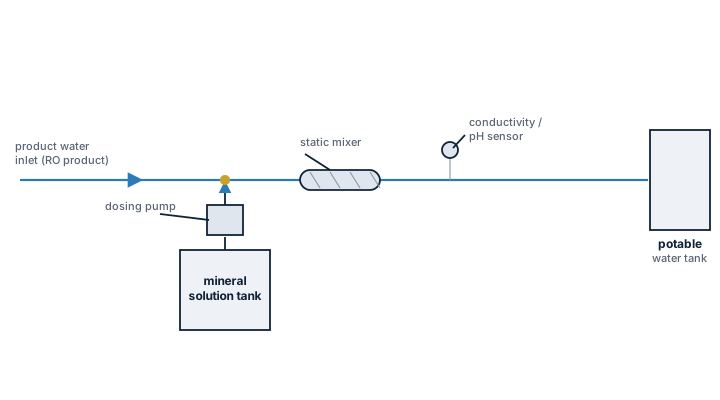
Main components
Dosing media or chemical feed
Either a bed of calcium carbonate or a similar mineral media that the water passes through and slowly dissolves into, or a metered chemical dosing pump injecting a calcium/magnesium solution directly into the flow.
Contact vessel
Where a media bed is used, a pressure vessel giving the water enough contact time and flow distribution to pick up minerals evenly, avoiding channelling that leaves some water under-treated.
Dosing pump and controller
For chemical dosing systems, a metering pump controlled against flow rate or a hardness sensor, so dosing tracks actual water demand rather than running at a fixed rate regardless of consumption.
Monitoring
Hardness or conductivity monitoring downstream of dosing to confirm the treated water is within the target range, sometimes linked to an alarm if dosing drifts out of range.
Media replenishment
Access port or hopper for topping up mineral media as it is consumed, sized against expected water production to set a practical replenishment interval.
Selection and sizing
Dosing capacity is matched to the water maker's production rate, since undersized dosing leaves peak production periods under-treated even if average output is covered. Media-bed systems suit vessels wanting a simpler, chemical-free system with lower control complexity; metered chemical dosing suits vessels needing tighter, adjustable control of final mineral content, for instance to match a target hardness range rather than whatever the media happens to deliver. Target mineral content is generally set to bring water within a range considered non-aggressive to piping and acceptable for taste, rather than to a single fixed point.
- Flow rate capacity against the water maker's peak production, not just average output
- Media-bed versus metered chemical dosing, based on desired control precision
- Target hardness or mineral range for the ship's piping materials and crew preference
- Monitoring and alarm capability to catch under- or over-dosing
- Media or chemical replenishment interval against realistic stores access
Regulations and class
Mineral dosing sits within the broader potable water quality requirements that apply under SOLAS and flag administration rules, which set safe limits for the water crew and passengers drink but generally do not mandate a specific mineral dosing method - the requirement is that the water delivered at the tap meets potable quality, and correcting aggressive, demineralised water is one of the practical ways to protect the piping that carries it there. Class societies typically treat the dosing unit as part of the fresh water generation and distribution system surveyed for general condition rather than as a standalone certified component, unless it is combined with disinfection equipment that does carry its own approval.
Typical faults
| Fault | Consequence |
|---|---|
| Media bed exhausted and not replenished | Water reverts to aggressive, undermineralised condition, pipe corrosion resumes |
| Dosing pump miscalibrated or airlocked | Under-dosing leaves water aggressive; over-dosing wastes chemical and can affect taste |
| Channelling through the contact vessel | Uneven treatment, some water passes with little mineral pickup |
| Hardness monitor not calibrated or checked | Dosing drift goes undetected until pipework damage or complaints appear |
| Media bed not backwashed on schedule | Fouling and channelling, reduced effective contact time |
What to look for in a supplier
- Sizing calculation matched to the vessel's actual water maker output, not a generic model
- Media or chemical grade suited to potable water use with supporting documentation
- Reliable local or remote monitoring so dosing drift is caught before it causes pipe damage
- Realistic media consumption figures against production volume, to plan replenishment logistics
- Compatibility with any UV or chlorine disinfection already fitted downstream or upstream
Test water hardness at the tap periodically, not just at the dosing system outlet - a media bed that channels can pass a spot check right after the unit while still delivering under-treated water to the far end of the distribution line.